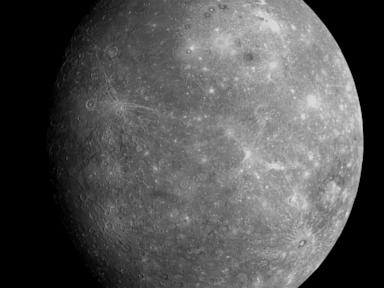
Mercury, the smallest rocky world in our solar system, has lost an estimated 10 to 30 percent more of its diameter than previous models suggested, forcing planetary scientists to completely rethink the deep internal mechanics of the innermost planet. New calculations reveal that as the planet cooled over the last four and a half billion years, its radial contraction was drastically underreported. The hidden shriveling was masked by centuries of asteroid impacts, leaving scars and geological wrinkles buried beneath thick blankets of planetary debris.
For decades, researchers relied on orbital data to map the sprawling cliffs and ridges that ripple across the mercurian crust. These tectonic features, known as fault scarps, form when a cooling interior forces the surface to buckle and fold upon itself like a drying fruit. Yet this straightforward accounting missed a massive blind spot. Heavy bombardment from space continuously shatters the surface, filling ancient basins with pulverized rock and erasing the telltale signs of tectonic compression. Read more on a related subject: this related article.
Decoding the Mercurian Blind Spot
Planetary geologists at the German Aerospace Center approached the problem from a different angle. Instead of hunting for visible ridges across a battered landscape, they mapped the global surface roughness of Mercury to measure the intensity of local impact alterations.
The math proved revealing. Heavily battered zones possessed the fewest visible tectonic wrinkles, confirming that impact debris acted as geological camouflage. By extrapolating the contraction rates from cleaner, less-obscured regions to compensate for the hidden zones, the research team uncovered a much larger planetary squeeze. Mercury has lost roughly 12 miles in total diameter since its formation, pushing past earlier contraction ceilings and redefining the evolutionary timeline of rocky bodies. More reporting by Associated Press explores comparable perspectives on this issue.
This accelerated shriveling changes everything we thought we knew about what lies beneath the crust.
Inside the Iron Giant
Mercury is an anomaly among rocky planets. It possesses a disproportionately massive metallic core that takes up roughly 85 percent of the planet's radius, leaving only a thin outer mantle and crust.
When a world shrinks this aggressively, the physical properties of its interior must accommodate the shift. A greater degree of contraction implies that Mercury began its life at a much higher internal temperature. Furthermore, it suggests that its massive iron core contains fewer light elements like silicon than standard formation models predicted.
Think of it like cooling molten metal in an industrial foundry. As the core sheds heat into the vacuum of space, phase changes ripple outward, driving massive tectonic adjustments. The sheer magnitude of this contraction indicates that the internal thermal engine was far more powerful—and lasted much longer—than planetary textbooks currently admit.
The Limitations of Legacy Data
Despite the breakthrough, these revised figures still represent a conservative estimate. The calculations rely heavily on archival data gathered by NASA's MESSENGER spacecraft, which concluded its orbital mission over a decade ago.
MESSENGER was a pioneering craft, but its instruments could only reliably distinguish tectonic and structural features larger than three miles across. Countless smaller fault scarps remain entirely undocumented, folded tightly into micro-landscapes that low-resolution sensors could never resolve.
Science demands empirical verification, and planetary modeling is only as good as its next observation.
The Upcoming Arrival
The planetary science community is waiting on the horizon for a definitive upgrade. The joint European and Japanese BepiColombo mission is closing in on its final destination, bringing advanced laser altimetry and high-resolution imaging systems designed to peer past the limits of legacy data.
When BepiColombo begins its intensive mapping phase, it will slice through the data fog that has obscured Mercury's true dimensions. Every newly resolved ridge will test the limits of current thermal evolution models. If the trend holds true, the smallest planet in the solar system may reveal an even more turbulent internal history, proving that our cosmic neighborhood still holds violent, foundational secrets just beneath the dust.
.jpeg?width=1200&auto=webp&trim=0%2C4%2C0%2C4)