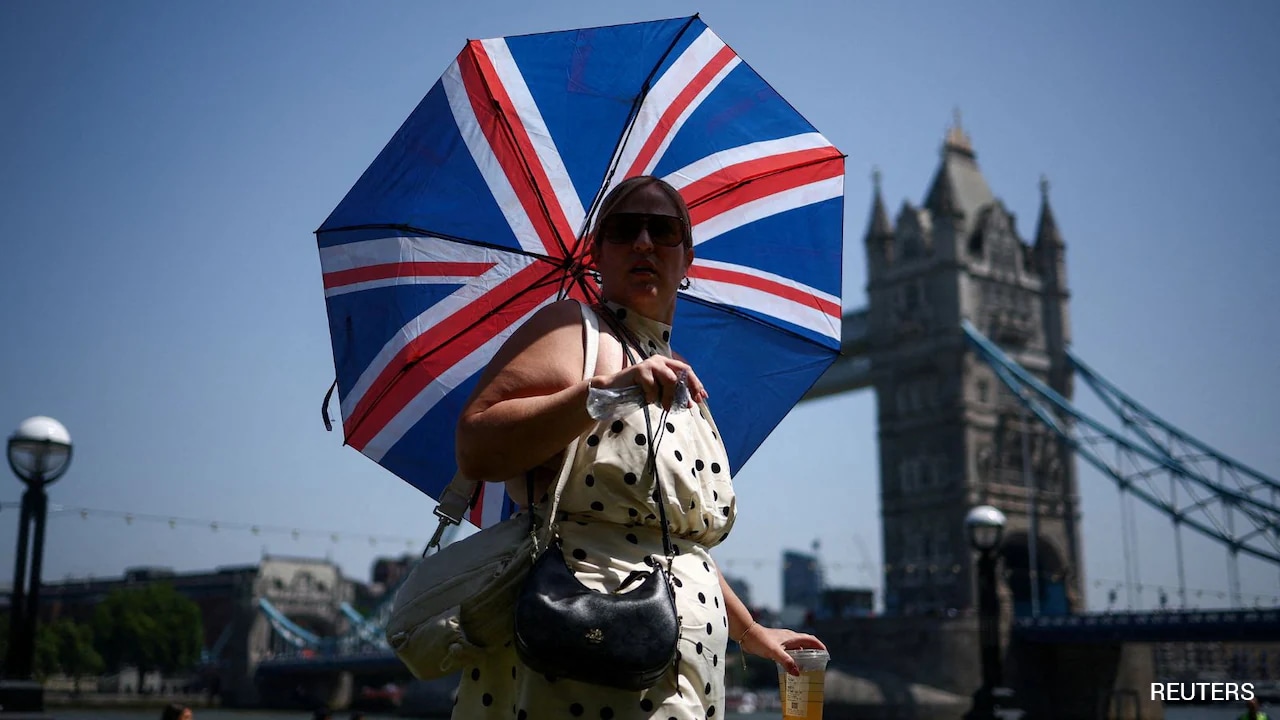
The fan in the corner of the room isn't blowing cool air anymore. It is merely shifting the heat around, a useless, whirring plastic blade slicing through a thick, oppressive soup. Outside, the birds are uncharacteristically silent, tucked deep into the hedges, wings slightly flared away from their bodies to catch any stray, nonexistent breeze. On the pavement below, a discarded ice cream wrapper doesn't just sit; it fuses with the softening asphalt.
This is London in June. Or rather, this is the new June.
For the third time in less than six weeks, the national weather charts have flashed an angry, bruised purple. The headlines call it a historic milestone. Another record shattered. The hottest June day since official measurements began, tumbling down like a line of dominoes after two previous record-breaking spikes earlier in the month. To a data analyst, it is a fascinating spike on a line graph. To the millions of people sweating through their shirts on the London Underground, it feels less like a milestone and more like an eviction notice from the climate we used to know.
We are a nation built for a gentle drizzle. Our houses are thermal traps, designed centuries ago to capture every precious, fleeting watt of solar warmth and hold it hostage behind thick brick walls and double glazing. We do not have air conditioning as a standard feature of civil engineering. We have heavy carpets, thick curtains, and an unwavering cultural belief that summer is a brief, glorious weekend in July where you burn two sausages on a disposable barbecue and then buy a cardigan.
That world is gone. The reality replacing it is heavy, breathless, and increasingly inescapable.
The Micro-Dramas of the Heatwave
To understand what a third consecutive broken record actually means, you have to look away from the meteorological stations and into the quiet, strained rhythms of daily life.
Consider a hypothetical commuter named Sarah. She is standing on a platform at Clapham Junction, watching the digital departure boards flicker with delays. The overhead announcement blames "rail temperature regulation issues." It sounds like bureaucratic jargon. But the physical reality is that steel tracks, when subjected to direct, unyielding sunlight for days on end, can reach temperatures twenty degrees higher than the surrounding air. They expand. They bend. They threaten to derail a multi-ton train if it moves too fast.
Sarah looks down at her phone. The screen is hot to the touch. Her focus isn't on the macroeconomic impact of transit delays or the macro-trends of global emissions. Her focus is narrow, visceral, and immediate: will she make it to the nursery before the late-pickup fine kicks in, and how is her elderly mother coping in a top-floor flat that currently feels like an industrial pizza oven?
This is where the true weight of the weather lands. It is the invisible tax on our collective nervous system. When the temperature spikes so dramatically, so early in the year, the human body doesn't have time to adapt. Acclimatization is a slow, biological negotiation that takes weeks. When the thermometer leaps from a comfortable eighteen degrees to a blistering mid-thirties overnight, the cardiovascular system goes into overdrive just to keep internal organs from cooking.
You can feel the collective exhaustion in the air. Tempers flare faster in traffic. The casual, polite apologies that define British public life dissolve into clipped sentences and impatient sighs. The heat becomes an uninvited roommate, occupying every room, dominating every conversation, and refusing to let anyone sleep.
The Chemistry of the Heavy Air
It helps to think of the atmosphere not as an empty space, but as a giant, reactive sponge. When the air is cool, the sponge is tightly compressed. It holds less moisture, less pollution, less energy. But as the temperature climbs, that sponge expands exponentially. Every degree of warming allows the air to hold roughly seven percent more water vapor.
The air becomes heavy. It holds onto the exhaust fumes from idling cars, the ozone cooked up by the interaction of sunlight and nitrogen oxides, the fine particulate matter that hovers over our cities like a dirty halo. For anyone with asthma, or a lingering respiratory condition, this isn't just uncomfortable weather. It is an obstacle course. Every breath requires conscious effort, a deliberate pull against an atmosphere that suddenly feels too thick to swallow.
The old timers like to bring up the summer of 1976. It has become a cultural touchstone, a mythic era of dried-up reservoirs, ladybird plagues, and standing in lines for communal water standpipes. For decades, that single summer was the benchmark for extreme heat, a freak occurrence that defined a generation.
But there is a crucial difference between then and now.
The heat of 1976 was an anomaly, a wild outlier in a century of predictable moderation. The heatwaves we are experiencing now are structured entirely differently. They are cumulative. They are repeating. Breaking the June record three times in a single year means the system is no longer oscillating around a stable center; the center itself has shifted. We are no longer experiencing a rare, hot summer. We are watching the baseline rise in real-time.
The Silent Shifts Beneath Our Feet
The consequences extend far beyond our personal comfort or our disrupted commutes. They are altering the very fabric of the landscape we take for granted.
Walk into any park or woodland during these sudden spikes, and the signs of systemic stress are glaringly obvious. The leaves on the silver birches and beeches aren't turning the deep, rich green of midsummer. They are curling at the edges, a brittle, premature brown. It is a defense mechanism known as summer dormancy. The trees are effectively shutting down, sacrificing their leaves to conserve water, mimicking autumn in the middle of June because their root systems cannot keep pace with the evaporation rate of the soil.
The soil itself is changing. When clay soil dries out too quickly, it shrinks, cracking open like a jigsaw puzzle. For thousands of homeowners across the southeast, those deep fissures in the garden are a terrifying sight. They signify subsidence. The foundations of houses, built on the assumption of damp, stable earth, are shifting as the ground beneath them withdraws.
It is a slow-motion architectural crisis, driven not by a sudden earthquake or a dramatic flood, but by the quiet, relentless extraction of moisture from the earth by an insatiable sky.
The Illusion of the Beach Day
There is a strange, cognitive dissonance that occurs during these episodes. The media often accompanies the announcements of broken records with images of crowded beaches, children eating melting ice lollies, and people cooling off in fountains. The visual narrative tells us this is a holiday. It frames the heat as a luxury, a free gift from the cosmos that we should be celebrating.
But if you look closely at those crowded beaches, the reality is more complicated. The sea itself is warming at an unprecedented rate. The marine heatwaves off the coast of the UK are upsetting delicate underwater ecosystems, driving cold-water fish further north and causing toxic algal blooms that close those very same beaches to swimmers.
The celebration feels hollow. It is a forced optimism, a collective attempt to reframe an existential threat into a pleasant afternoon at the seaside. We want to believe that this is just a particularly good summer, because acknowledging the alternative requires admitting that the fundamental rhythms of our lives are changing without our permission.
The uncertainty is perhaps the hardest part to carry. We used to look at the weather forecast to decide whether to bring an umbrella. Now, we look at it to determine if our trains will run, if our workplaces will be habitable, or if our vulnerable neighbors will survive the night. The weather has ceased to be a backdrop to our lives; it has become the main protagonist, dictating our schedules and re-writing our expectations.
The Weight of the Afterneath
When the sun finally dips below the horizon on a record-breaking day, there is no immediate relief. The bricks and concrete of our towns and cities have spent twelve hours absorbing the solar radiation like massive storage heaters. They begin to radiate that heat back out into the darkness.
This is the urban heat island effect, a phenomenon that prevents temperatures in built-up areas from dropping significantly during the night. The air remains stagnant, trapped between tall buildings, thick with the residue of the day's heat.
You lie awake in the dark, listening to the occasional siren in the distance, the ambient hum of a city that cannot cool down. The sheet feels too heavy. The pillow is warm on both sides. In that quiet, sleepless space, the statistics lose their abstraction. It doesn't matter if the record was broken by half a degree or a full degree. What matters is the realization that the summers of our childhoods are gone, replaced by something fiercer, more volatile, and entirely unpredictable.
We are learning to live in a country that is stranger than the one we were born into. We are learning to navigate a landscape where the familiar comforts of a British summer have been replaced by a heavy, golden anxiety that lingers long after the sun has set.


