Donald Trump thought he was just delivering another classic, off-the-cuff punchline to an Italian television network. Instead, he kicked off an unprecedented diplomatic crisis with one of America’s most critical European allies.
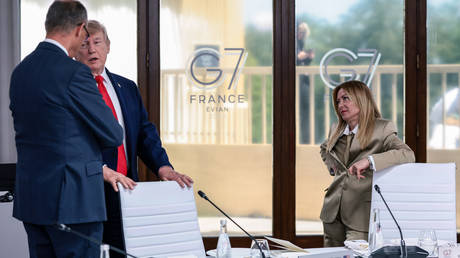
The spark that lit the fuse was deceptively petty. Speaking to Italian broadcaster La7 after the G7 summit in Évian, France, Trump claimed that Italian Prime Minister Giorgia Meloni "begged" him for a photograph, adding that he only agreed because he "felt sorry for her."
Meloni didn't let it slide. She hit back with a self-recorded video on X, calling the story "completely fabricated" and dropping a line that instantly went viral: "Neither I nor Italy ever beg."
What looked like a childish spat over a summit selfie has rapidly deteriorated into a structural breakdown of US-Italian relations. Italian Foreign Minister Antonio Tajani abruptly canceled his high-profile trip to Washington, branding Trump’s words "grave and offensive" to the entire nation.
The Real Ground for the Fight
This isn't actually about a photograph. The public bickering is a thin cover for intense geopolitical friction regarding military autonomy, sovereign airspace, and the limits of alliance.
Trump escalated the conflict on Truth Social, misspelling the Italian leader's name as "Gigiorgia" and tying her alleged "poor numbers" at home to her refusal to back US military maneuvers. Specifically, Trump is furious that Meloni blocked the US military from using Italian landing strips and runways during the recent US conflict with Iran.
Italy historically rejected Washington’s requests to launch bombers from bases in Sicily without parliamentary approval. Meloni stood her ground on the restriction, and Trump hasn’t forgiven her.
Meloni made the terms of the relationship explicit in her public response. She noted that the use of Italian military bases is governed by strict, legally binding bilateral agreements. "As long as I am prime minister, Italy remains a sovereign nation," she stated.
A Brutal Check on Popularity and Public Approval
Trump’s public logic relies on a familiar script: foreign leaders need his star power to survive at home. He claimed Meloni was desperate for a photo to get her "numbers up."
The hard data says otherwise.
A look at the polling numbers for both leaders in June 2026 reveals a deeply ironic reality. Meloni’s domestic standing is actually on an upward trajectory, while Trump is hovering near historic lows.
- Giorgia Meloni: Her public approval rating stands at roughly 35% following a steady recovery from a 2025 slump. Her party, Brothers of Italy, comfortably leads domestic polls with 28% support, well clear of the opposition Democratic Party at 22%.
- Donald Trump: A June Reuters/Ipsos poll places the US president's approval rating at 36%. Despite a minor one-point tick upward due to easing inflation concerns, it remains anchored near the lowest levels of his political career.
Meloni weaponized this data symmetry in her final social media broadside on Instagram, explicitly cutting ties with the idea that she needs Washington's validation. "As for my popularity, being your friend certainly has not helped it," she wrote. "My popularity is none of your concern. I suggest you focus on yours."
The Pivot to Adversaries
The most damaging part of Meloni's rebuttal wasn't the defense of her polling numbers, but her critique of Trump's broader foreign policy framework. She openly questioned why a US president treats democratic allies with public hostility while maintaining a soft stance toward global adversaries.
"It is a shame he doesn't have the same determination with the enemies of the West," Meloni noted, pointing to Trump's historically accommodating rhetoric toward hostile foreign regimes.
This dynamic alters the chessboard for European conservatives. Meloni previously positioned herself as the essential ideological bridge between Washington and Brussels. By drawing a hard line on national sovereignty and public respect, she is signaling to the rest of Europe that alignment with a nationalist US administration cannot come at the expense of national dignity or European legal frameworks.
Navigating the Diplomatic Fallout
For international policy analysts and state departments, the sudden freezing of US-Italy communication channels presents immediate operational hurdles. If you are tracking or managing transatlantic policy, the path forward requires a shift in strategy.
Compartmentalize Military Operations
Do not assume standard access or fast-tracked logistical approvals through Mediterranean bases. Joint NATO operations will require formal parliamentary protocols rather than relying on executive handshakes. Expect Italian oversight on asset deployment to tighten significantly over the coming months.
Reassess Conservative Alliances
The assumption that right-wing populist leaders form a monolith is broken. Meloni’s brand of nationalism is strictly defensive of Italian sovereignty, contrasting directly with Trump’s transactional view of international alliances. Analysts must evaluate European conservative movements through the lens of local national interest, not broad ideological alignment with Washington.
Pivot to Multilateral Frameworks
With bilateral US-Italy executive communication stalled by personal animosity, diplomatic progress will shift toward broader structures. Look for Italy to channel its strategic initiatives through the European Council and G7 frameworks where collective leverage balances unilateral US pressure.
Transatlantic diplomacy is shifting away from personal relationships and returning to the cold reality of national borders and written treaties. Meloni just proved that even the closest allies will choose sovereignty over a photo op every single time.
For a deeper look into the immediate diplomatic response and the Italian government's official reaction, you can watch this Meloni photo row report. This video breaks down the political consensus inside Rome following the public dispute.