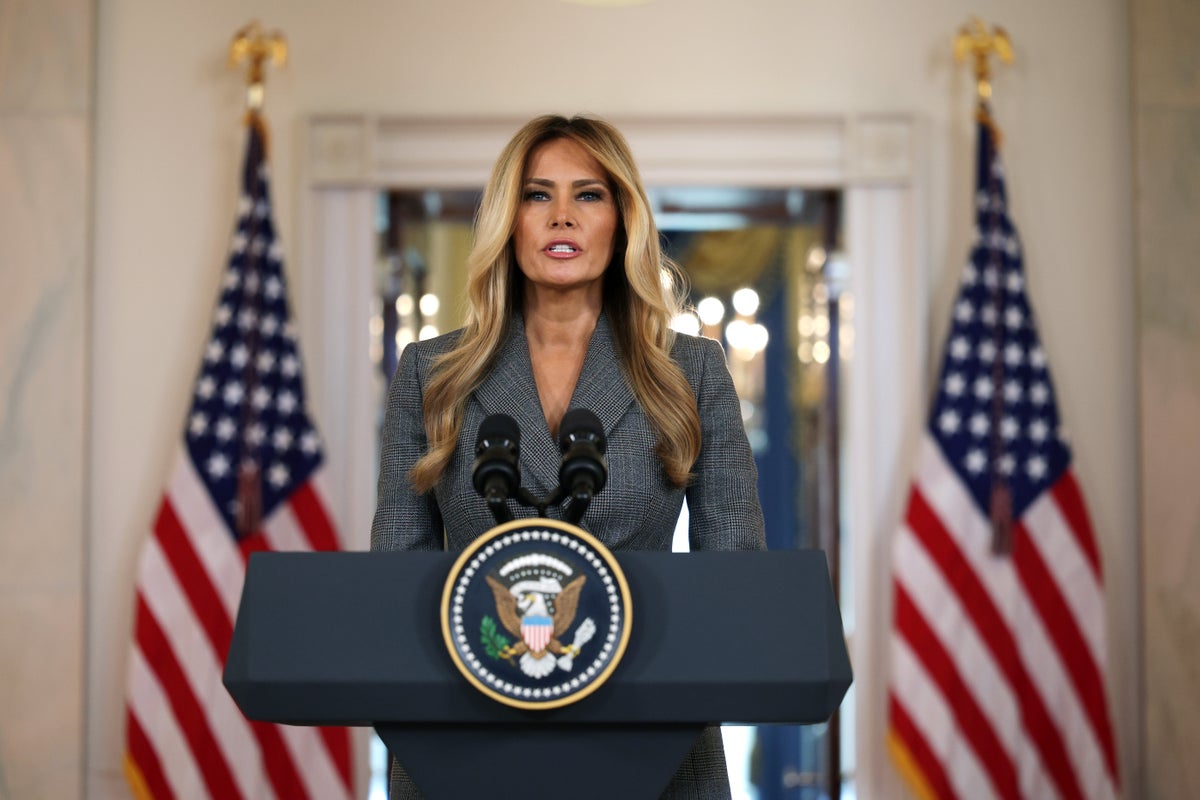
Melania Trump doesn't usually talk. When she does, it’s typically for a curated ribbon-cutting or a stiff holiday video. But her appearance at the White House lectern on Thursday was different. It was jarring. While the rest of the administration was scrambling to manage the fallout from the Iran conflict and soaring inflation, the First Lady decided the most pressing issue in America was her own social history with Jeffrey Epstein.
If the goal was to kill a story, she did the opposite. She didn't just invite the spotlight; she practically begged it to stay. Pundits are calling it bizarre, but that’s an understatement. It was a tactical disaster that has reopened a door her husband has been trying to weld shut for years. Read more on a connected issue: this related article.
The speech that nobody asked for
Standing in the Grand Foyer, flanked by a bust of George Washington and a painting of Donald Trump, the First Lady delivered a scripted denial that felt like it belonged in a different decade. She claimed she was never "friends" with Epstein and that his accomplice, Ghislaine Maxwell, was nothing more than a casual acquaintance.
"The lies linking me with the disgraceful Jeffrey Epstein need to end today," she told the room. More analysis by Wall Street Journal delves into related perspectives on this issue.
But here’s the problem. Most people weren’t even talking about her and Epstein this week. By coming out and saying "I am not a victim" and "Epstein didn't introduce me to my husband," she handed the media a fresh hook. You don't walk into a room and shout that you aren't a bank robber unless someone is already putting you in handcuffs.
A disconnect at the highest level
The most telling part of this entire saga isn't what she said, but who didn't know she was saying it. Shortly after the cameras cut, Donald Trump reportedly told an MS Now host that he "didn't know anything" about the statement before she appeared.
Think about that. The President of the United States—currently navigating a literal war—claims he was blindsided by his own wife holding a televised presser on the most radioactive topic in their orbit. Whether he’s lying to distance himself or he truly was out of the loop, it shows a White House in total disarray.
His spokesperson later tried to walk it back, telling the New York Times that he did know she was making a statement but maybe didn't know the topic. That’s even worse. If the West Wing has no control over the First Lady’s messaging during a national security crisis, who is actually running the show?
The "Love Melania" problem
Melania’s defense centered on characterizing her past interactions as "trivial" and "casual correspondence." She specifically addressed the 2002 email released by the Justice Department earlier this year. That’s the one she signed "Love, Melania" and sent to Maxwell.
She misread the word "trivial" as "trival" during her delivery, which pundits jumped on immediately, but the real issue is the content. In that exchange, she praised a flattering profile of Epstein. She called it a "Nice story."
Her argument is basically that she was just being polite in a high-society way. But when you’re the First Lady and your husband’s second term is being dragged down by questions about his twenty-year friendship with a sex trafficker, "polite" doesn't cut it.
Demanding a public hearing for survivors
The weirdest pivot in the speech came at the end. After spending ten minutes defending her own reputation, she suddenly called on Congress to hold public hearings for Epstein’s survivors.
"Give these victims their opportunity to testify under oath," she said.
It sounds noble on paper. In practice, it’s a massive political gamble. If Congress actually follows through—and top Democrats like Robert Garcia are already jumping at the chance—it means the Epstein story will stay in the news cycle for months. It means more depositions, more document leaks, and more questions about what the Trumps knew and when they knew it.
Survivors like Maria and Annie Farmer aren't buying the gesture. They’ve already called it a "deflection of responsibility," noting that the Trump administration still hasn't fully complied with the Epstein Files Transparency Act.
Why this matters right now
You have to look at the timing. We are in April 2026. The economy is shaky. The war in Iran is the only thing people should be focused on.
By dragging Epstein back into the headlines, Melania has:
- Undermined the White House’s attempt to pivot away from the scandal.
- Created a public contradiction with her husband regarding who knew about the speech.
- Given the House Oversight Committee a "bipartisan" reason to launch fresh investigations.
What happens next
If you're following this, don't expect it to go away. The First Lady’s office is currently refusing to answer follow-up questions, which is a classic move that only fuels more speculation.
Keep an eye on the House Oversight Committee. Now that the First Lady has publicly called for hearings, the GOP chair, James Comer, is in a corner. If he refuses, he’s ignoring the First Lady. If he agrees, he risks damaging the President.
The move was likely intended to be a "clean slate" moment, but in politics, you don't get a clean slate by talking about Jeffrey Epstein. You get a deeper hole. Expect the media to spend the next week digging into those "trivial" emails again, looking for exactly what Melania Trump was trying to get ahead of.