Standard reporting on the final day of a Russian wartime election typically reduces a complex political operation to surface-level theatrics: isolated polling-station disruptions, predictable turnout figures, and foregone outcomes. That framing misses the structural function of the vote. In an authoritarian system fighting a protracted, resource-intensive war in Ukraine, an election is not a mechanism for leadership selection; it is an administrative stress test, a patron-client loyalty audit, and an informational signaling operation designed to manufacture domestic consensus and deter external adversaries.
When voting enters its final day amid active cross-border drone strikes, fuel infrastructure disruptions, and contested balloting in occupied Ukrainian territories, the state is executing a multi-variable optimization problem. Understanding the final phase of these elections—whether examining the March 2024 presidential cycle or the September 2026 State Duma parliamentary cycle—requires dissecting the operational architecture that converts administrative control into a quantifiable mandate.
The Three Pillars of Wartime Electoral Engineering
To maintain political equilibrium during an ongoing military conflict, the Russian electoral apparatus relies on three interlocking mechanisms. Breaking any single pillar degrades the regime's ability to project stability.
1. Temporal Compression and Multi-Day Dilution
Single-day voting creates high-density focal points that favor independent monitoring and coordinated opposition turnout. Extending the voting window across three consecutive days fundamentally alters the operational math for both state administrators and dissenters.
- Administrative Mobilization: A 72-hour window allows state-owned enterprises, municipal bureaucracies, and military units to schedule and verify employee participation in staggered waves on Friday and Saturday, leaving Sunday—historically the day of highest independent turnout—for final margin adjustments.
- Surveillance Saturation: Independent election observers face a threefold increase in resource expenditure to cover polling stations continuously. Overnight ballot storage across two nights introduces unmonitored custody chains where physical ballot boxes remain under the exclusive control of local electoral commissions.
- Digital Obfuscation: Remote Electronic Voting (DEG) systems deployed across key regions, including Moscow, decouple the act of casting a ballot from physical presence. Because cryptographic verification remains opaque to outside auditors, digital tallies function as an elastic buffer capable of absorbing late-stage turnout deficits without requiring physical ballot manipulation.
2. The Systemic Opposition Equilibrium
A total ban on competing political parties would transform a plebiscite into an explicit single-party referendum, lowering its utility as a domestic release valve. The Kremlin instead maintains a curated ecosystem of "systemic opposition" parties—such as the Communist Party (CPRF), the Liberal Democratic Party (LDPR), and New People.
These entities operate under a strict unwritten contract: they are permitted to channel localized socioeconomic grievances—inflation, regional budget cuts, or infrastructure decay—provided they endorse the overarching military agenda in Ukraine and refrain from targeting the executive core. On the final day of voting, their primary function is denominator management. By offering controlled ideological lanes (nostalgic state-socialism, hardline nationalism, or technocratic urbanism), they draw disaffected citizens into the polling stations, thereby inflating overall turnout while fragmenting the non-United Russia or non-incumbent vote share.
3. Territorial Integration via Balloting
Conducting elections inside occupied Ukrainian regions—Donetsk, Luhansk, Zaporizhzhia, and Kherson—serves an administrative objective distinct from domestic vote-gathering. In international law, these votes are nullities, condemned by Western governments and Kyiv as violations of sovereignty. Internally, however, the physical distribution of ballots, establishment of precinct commissions, and reporting of high turnout figures formalize bureaucratic annexation.
The mechanism operates through coercion and dependency. Residents in occupied zones rely on Russian-issued passports for pensions, healthcare, and property rights. Participating in the vote—often under the direct supervision of armed personnel or mobile door-to-door polling teams—creates a paper trail of compliance. The final-day tallies from these territories routinely exhibit near-unanimous support, establishing a statistical baseline that the central government uses to argue that territorial concessions are constitutionally and democratically impossible.
The Kinetic Feedback Loop: External Disruption vs. Internal Consolidation
Surface-level coverage frequently treats Ukrainian long-range drone strikes on Russian cities, oil refineries, and logistics hubs during the voting window as purely destabilizing events. In practice, kinetic pressure during an election triggers a dual-edged psychological and operational response.
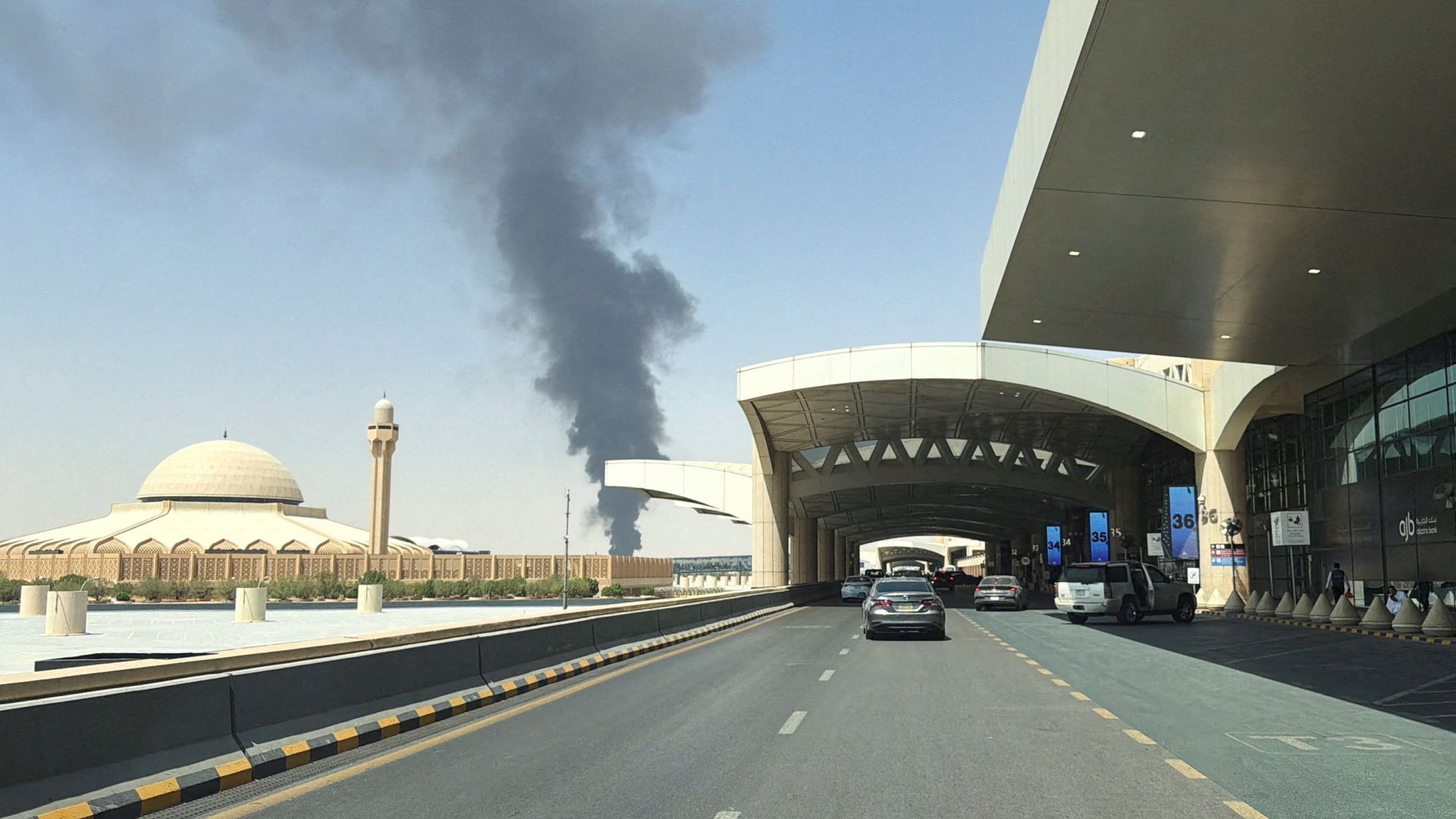
On one side, physical attacks on Moscow and border regions shatter the domestic narrative that the conflict remains a distant, professionalized "special military operation". Air defense interceptions over the capital, smoke rising from energy facilities, and refinery-induced fuel shortages impose tangible economic and psychological friction on urban populations who had previously been insulated from the war's direct costs.
On the other side, the state apparatus weaponizes external kinetic threats to activate a "rally-around-the-flag" reflex. State media frames every intercepted drone and border incursion not as a failure of Russian air defense, but as existential proof that the nation is under siege. Within this framing, abstaining from voting or spoiling a ballot is cast as civic sabotage. The security services use the heightened threat environment to justify expanded police deployments at polling stations, preemptive detentions of activists, and strict bans on unauthorized public gatherings.
The Opposition Bottleneck: Coordination Under Asymmetric Cost
On the final day of Russian elections, anti-war and anti-Kremlin factions repeatedly attempt to overcome atomization through low-cost, high-visibility synchronization—most notably the "Noon Against Putin" or "Noon for a Peaceful Russia" model, where dissenting voters arrive at physical polling stations simultaneously at 12:00 PM local time.
Evaluating this tactic through game theory reveals both its utility and its hard ceiling:
- Information Revelation: In an authoritarian information environment where independent polling is suppressed or distorted by preference falsification, citizens cannot accurately gauge the scale of dissent. Forming physical queues at embassies abroad and domestic precincts solves an acute coordination problem by allowing opponents of the war to visually verify their own numbers without triggering immediate riot-police dispersal, since standing in line to vote remains technically legal.
- The Ballot-Spoiling Dilemma: Once inside the voting booth, dissenting voters face a strategic choice between voting for the least hawkish systemic candidate (such as Vladislav Davankov in 2024 or Yabloko representatives where permitted) or invalidating their ballot by marking multiple boxes or writing anti-war slogans. Invalidated ballots reduce the winning candidate's percentage share slightly, while voting for a systemic alternative inflates the perceived legitimacy of a controlled rival. Neither option alters the seat allocation or executive outcome.
- Asymmetric Risk: While diaspora voters in cities like Berlin or Paris can protest outside embassies at near-zero personal cost, domestic participants face severe asymmetric penalties. Facial recognition networks integrated into urban transit and polling station entrances allow security agencies to retroactively identify, fine, conscript, or prosecute individuals who engage in overt protest actions, such as pouring dye into ballot boxes or staging arson incidents.
The Principal-Agent Problem in Regional Vote Delivery
A critical vulnerability hidden behind headline victory margins—such as the 88.48% recorded in the 2024 presidential cycle or the overwhelming State Duma majorities projected for United Russia—is the distortion of upward information flow.
Regional governors and municipal heads operate within a rigid KPI (Key Performance Indicator) structure dictated by the Presidential Administration. Their career survival, federal budget allocations, and immunity from anti-corruption prosecutions depend on delivering two metrics: high overall turnout and an overwhelming margin for the Kremlin's preferred ticket.
This creates a classic principal-agent distortion. Local officials, fearing punishment if their region underperforms national benchmarks, routinely engage in competitive over-reporting. Administrative coercion of public-sector workers, falsification of precinct protocols, and statistical anomalies in digit distributions inflate the final numbers beyond what the central leadership actually requires for legitimacy.
The operational consequence is informational blindness at the top. When every regional governor reports near-total public alignment with the war effort, the central executive loses reliable telemetry on genuine societal fatigue, localized economic distress, and latent protest potential. Policy decisions regarding further troop mobilization, tax hikes, or prolonged military escalation are then calibrated against manufactured consensus rather than empirical reality.
Strategic Forecast and Analytical Takeaways
Analysts, policymakers, and risk strategists evaluating post-election trajectories in Russia must discard Western electoral frameworks that treat vote shares as direct proxies for public opinion. The final-day numbers are outputs of administrative capacity, not voter preference.
To accurately extract signal from the noise of Russian wartime elections, apply the following analytical protocol:
- Track Turnout Divergence, Not Vote Share: Compare physical in-person turnout against Remote Electronic Voting (DEG) figures and regional historical baselines. Sharp spikes in Sunday afternoon electronic tallies indicate aggressive administrative patching rather than organic voter enthusiasm.
- Monitor Regional Variance for Elite Friction: Discrepancies between neighboring regions with similar socioeconomic profiles reveal where local governors lack the administrative grip—or the political will—to enforce Kremlin KPIs. Underperforming industrial or border regions represent the primary fault lines for future elite fragmentation.
- Discount Mandate Rhetoric, Watch Fiscal Policy: Regardless of the celebratory rhetoric surrounding record turnout or legislative supermajorities, the true measure of the regime's confidence appears in the 90 days following the vote. If the Kremlin immediately introduces unpopular fiscal adjustments—such as corporate and personal income tax hikes, social spending cuts, or expanded military recruitment drives—it confirms that the election functioned purely as a procedural clearance gate to absorb domestic blowback before imposing heavier wartime costs on the population.