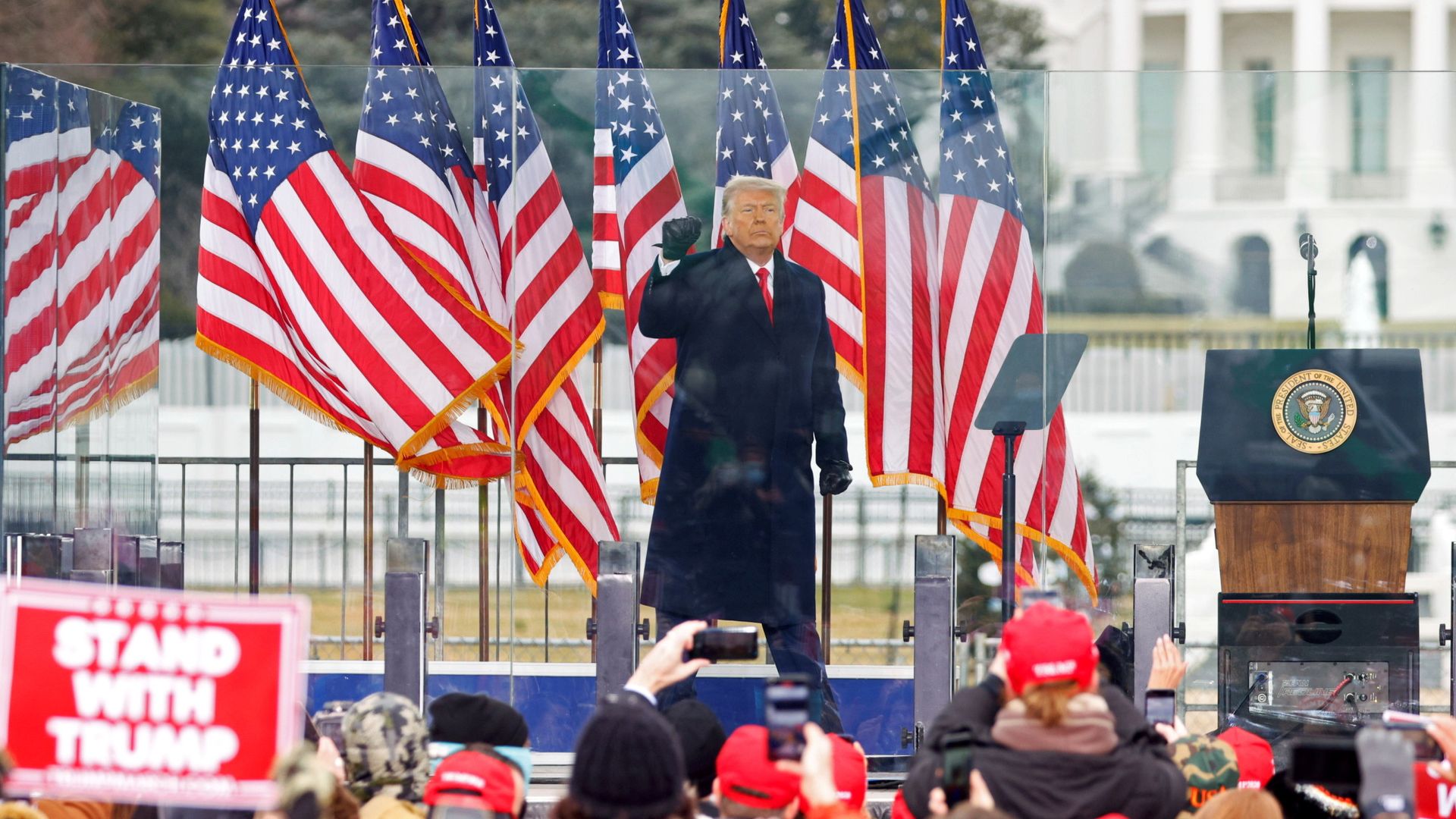
Donald Trump’s recent public appearances function less as traditional political speeches and more as a high-frequency feedback loop designed to optimize base mobilization while minimizing the cost of media acquisition. To analyze these events through the lens of standard political science—searching for policy white papers or linear arguments—is to fundamentally misunderstand the operational logic at play. These appearances are built on a framework of three distinct strategic pillars: In-Group Identity Reinforcement, Information Asymmetry Exploitation, and The Elasticity of Narrative. By quantifying the rhetorical patterns and structural timing of these events, we can map the transition of a political campaign into a decentralized brand ecosystem.
The Architecture of the Grievance Loop
The primary engine of a Trump appearance is the systematic identification and amplification of perceived institutional failures. This is not a haphazard collection of complaints but a calculated Attribution Error Strategy. By attributing complex economic or social shifts to specific "out-group" actors, the rhetoric simplifies the cognitive load for the audience, providing a clear target for political energy.
- The Victimhood-Power Paradox: The speaker simultaneously portrays himself as the most powerful individual capable of fixing the system and the most persecuted victim of that same system. This creates a psychological bond with the audience; if the leader is under attack, the follower’s identity is also under attack.
- Resource Scarcity Framing: Every policy point—from border security to trade tariffs—is framed as a zero-sum game. The logic dictates that for the constituent to gain, a specific "other" must lose. This removes the need for nuanced economic modeling and replaces it with a binary moral imperative.
- Linguistic Mirroring: Trump utilizes a restricted code—short, repetitive sentences with high emotional density. This mirrors the informal communication style of his core demographic, effectively bypassing the "expert" barrier that characterizes traditional bureaucratic speech.
Information Asymmetry and the Disruption of Fact-Checking
Traditional media operates on a "linear verification" model: a claim is made, and a rebuttal is issued based on evidence. Trump’s strategy renders this model obsolete through Volume-Based Saturation. By delivering a high volume of non-falsifiable claims (predictions of "disaster" or subjective superlatives) alongside specific but context-free data points, he creates a cognitive environment where the cost of verification exceeds the audience's attention span.
The mechanism here is the Gish Gallop, applied at a macro-political scale. When forty distinct claims are made in a sixty-minute window, a fact-checker can realistically address perhaps five in a standard news segment. This leaves thirty-five claims to stand as "truth" by default in the mind of the viewer. Furthermore, the use of "Many people are saying" serves as a strategic hedge. It shifts the burden of proof from the speaker to an anonymous collective, making the statement technically a report on a sentiment rather than a claim of fact.
The Cost Function of Media Attention
From a strategic consulting perspective, the Trump rally is an exercise in Zero-Cost Earned Media. While a traditional candidate must spend millions on targeted ad buys to achieve specific impressions, Trump generates those impressions by providing "high-conflict content" that media algorithms are programmed to prioritize.
- The Conflict Premium: News organizations, driven by engagement metrics, cannot ignore inflammatory or "norm-breaking" statements. These statements act as "loss leaders"—small, controversial remarks that "buy" the candidate hours of prime-time coverage and social media trending status.
- The Fragmentation of Meaning: Because the speeches lack a rigid structure, media outlets can slice the content into disparate "clips" that serve different narrative purposes. One outlet uses a clip to show strength; another uses the same clip to show volatility. Both drive engagement, and both keep the candidate at the center of the national conversation.
Operationalizing the "Deep State" Construct
The "Deep State" is not merely a conspiracy theory in the context of these appearances; it is a Strategic Boundary Object. In management theory, a boundary object is something that is plastic enough to adapt to local needs but robust enough to maintain a common identity across sites.
By defining the enemy as an amorphous, unelected bureaucracy, the speaker provides a catch-all explanation for any friction his administration or campaign encounters. This creates a permanent state of Operational Immunity. If a policy fails, it was sabotaged; if a legal challenge arises, it is a "witch hunt." This framework is logically impenetrable because any evidence presented against the speaker is, by definition, evidence of the "Deep State's" coordinated effort to silence him.
The Economic Logic of Protectionism as Branding
The shift toward hardline protectionism and tariffs is frequently analyzed as a trade policy. However, it is more accurately described as a Market Differentiation Strategy. By rejecting the consensus of global neoliberalism, the speaker carves out a unique market position that no other major political figure occupies.
This is the "Blue Ocean" strategy of politics. Instead of competing on the "Red Ocean" of minor tax adjustments or incremental healthcare tweaks, Trump moves the competition to a space where he is the sole provider of "Total Protection." The tariffs are the physical manifestation of this brand promise. The economic feasibility—the potential for increased consumer costs or retaliatory trade wars—is secondary to the Symbolic Utility of the policy. It signals a "Buy American" ethos that resonates at a visceral level, regardless of the underlying GDP impact.
Predictive Modeling of Audience Retention
Attendance at these rallies remains high not because of the novelty of the information, but because of the Performative Consistency. The audience is not looking for a "new" speech; they are looking for a "perfect execution" of the existing repertoire. This is akin to a legacy rock band playing its greatest hits.
- The Ritual of Inclusion: The rally provides a physical space for a dispersed digital community to manifest in the real world. This solidifies the "tribe" and creates a barrier to entry for opposing viewpoints.
- The Comedy/Conflict Balance: Trump frequently utilizes humor to de-escalate tension or to mock opponents. This makes the heavy themes of national decline more palatable and encourages long-form viewing.
- The Call-to-Action (CTA) Integration: Every appearance concludes with a direct mobilization instruction. This isn't just "go vote"; it is "defend your country." The escalation of stakes from "civic duty" to "existential struggle" is the primary driver of high-turnout modeling.
Structural Limitations and the Law of Diminishing Returns
Despite the efficiency of the rally model, it faces two critical structural bottlenecks. The first is Audience Saturation. There is a finite number of voters who respond to this specific rhetorical frequency. Once that ceiling is hit, the same tactics that mobilize the base begin to alienate the "Median Voter," who prioritizes stability and predictability over disruption.
The second is the Institutional Counter-Pressure. As the speaker identifies more institutions as enemies (the judiciary, the intelligence community, the electoral system), those institutions develop their own defensive protocols. This leads to a state of permanent gridlock where the "Energy of the Rally" cannot be translated into the "Legitimacy of Governance."
The strategic move for any entity attempting to counter or navigate this environment is not to engage with the content of the grievances, but to disrupt the Feedback Loop itself. This requires a transition from "Debunking" (which only feeds the loop) to "Pre-bunking" or, more effectively, the creation of a competing narrative that offers a higher "Meaning-to-Cost" ratio for the audience.
The current political landscape is no longer a battle of ideas; it is an optimization race for attention and identity. Understanding the mechanics of the Trump appearance is the first step in decoding the future of all mass-market political communication.
Ensure all future strategic assessments of this movement prioritize the Engagement Delta—the difference between the energy expended to create a controversy and the resulting volume of media coverage—rather than the literal text of the claims made.