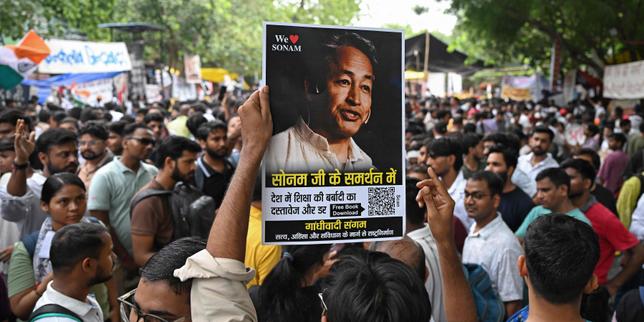
The removal of activist Sonam Wangchuk from New Delhi’s Jantar Mantar protest site to Safdarjung Hospital marks a tactical inflection point in the management of public dissent. When an state apparatus uses a judicial health-monitoring mandate as a mechanism for involuntary isolation, it is executing a highly calculated political risk management playbook. This shift—categorized by Wangchuk’s legal counsel as "pretextual detention"—moves the conflict from a public ideological arena into an opaque administrative ecosystem.
Understanding this event requires analyzing the asymmetric leverage of hunger strikes and the specific institutional friction points that dictate state responses.
The Leverage Dynamics of Voluntary Starvation
A prolonged hunger strike functions as a high-stakes leverage game. The protester imposes a deterministic cost function on the state: the accelerating decay of the activist's physical health creates an escalating political liability.
Wangchuk’s 21-day fast, initiated alongside the Cockroach Janta Party (CJP) to demand structural accountability for national examination irregularities, operated on a strict timeline governed by physiological depletion. By Day 21, with reported losses of 20 percent of body mass and critical alterations in blood chemistry, the activist’s physical degradation threatened to trigger a massive public backlash.
The state’s counter-strategy relies on breaking this timeline. By executing a forced hospitalization under the banner of "essential medical care" and complying with broad judicial oversight directives, the state alters the operational environment in three distinct areas:
- Information Asymmetry: Moving a public figure from an open venue like Jantar Mantar to a secure medical unit immediately chokes off the flow of real-time communication. The restriction of digital devices and external medical consultation creates a centralized information funnel controlled by state-run hospital bulletins.
- Disruption of Mass Mobilization: The timing of the intervention—occurring precisely 48 hours before a scheduled mass march to Parliament during the Monsoon Session—serves a logistical purpose. It breaks the organizational momentum by removing the symbolic head of the movement right at its peak.
- Diffusing Legal Accountability: Framing an involuntary removal as a medical necessity based on clinical risk profiles creates a powerful legal shield. This defense successfully shifts the courtroom debate away from constitutional protest rights and onto the state's duty to protect human life.
The Legal and Clinical Conflict Line
The legal challenge mounted by Wangchuk’s family highlights a profound structural contradiction in democratic administrative law. The core argument rests on a clear distinction between clinical monitoring and physical custody. While the Delhi High Court had directed the government to monitor the activist's health, the transformation of that health directive into a round-the-clock security detail—featuring dozens of police personnel guarding the ward—suggests an entirely different objective: physical containment.
[Judicial Order: Monitor Health Condition]
               │
               ▼ (State Interpretation)
[Forcible Removal from Protest Venue] ──► [Solitary Confinement & Restricted Legal Access]
               │
               ▼ (Protester Reaction)
[Refusal of Intravenous/Medical Fluids] ──► [Stalemate & Escalated Legal Contestation]
This dynamic creates an immediate operational stalemate. Wangchuk’s refusal of intravenous fluids, oral rehydration solutions, and external medication within the hospital walls effectively neutralizes the clinical justification for his confinement. When a patient explicitly denies consent for treatment, maintaining physical custody under the guise of medical care exposes a clear logical flaw. The hospital space stops functioning as a place of healing and becomes a secure, sterile detention facility.
Network Resilience of De-Centralized Movements
The state's reliance on a centralized neutralization strategy—assuming that removing the primary figure will collapse the protest—overlooks the structural resilience of modern, decentralized movements.
The immediate continuation of the indefinite fast by alternate leadership figures, such as CJP founder Abhijeet Dipke, demonstrates that the movement's operational capability remains intact. The organizational model is built to survive the removal of key individuals.
The primary vulnerability of the state's intervention strategy lies in its potential to accelerate public outrage. Attempting to manage political risk by forcing an activist into a hospital room often backfires, transforming a localized policy protest into a much broader, highly volatile civil liberties movement.
The immediate policy trajectory will be determined by the Delhi High Court's impending interpretation of its own monitoring order. If the judiciary validates the state's broad use of health interventions for physical containment, it will establish a highly consequential legal precedent. This would effectively hand administrative authorities a standardized blueprint for neutralizing disruptive, non-violent protests by simply reframing political containment as medical necessity.
Sonam Wangchuk's past hunger strikes explained This video provides direct context on the evolution of Wangchuk's protest tactics and his historical reliance on hunger strikes as primary tools for political negotiation with the central government.