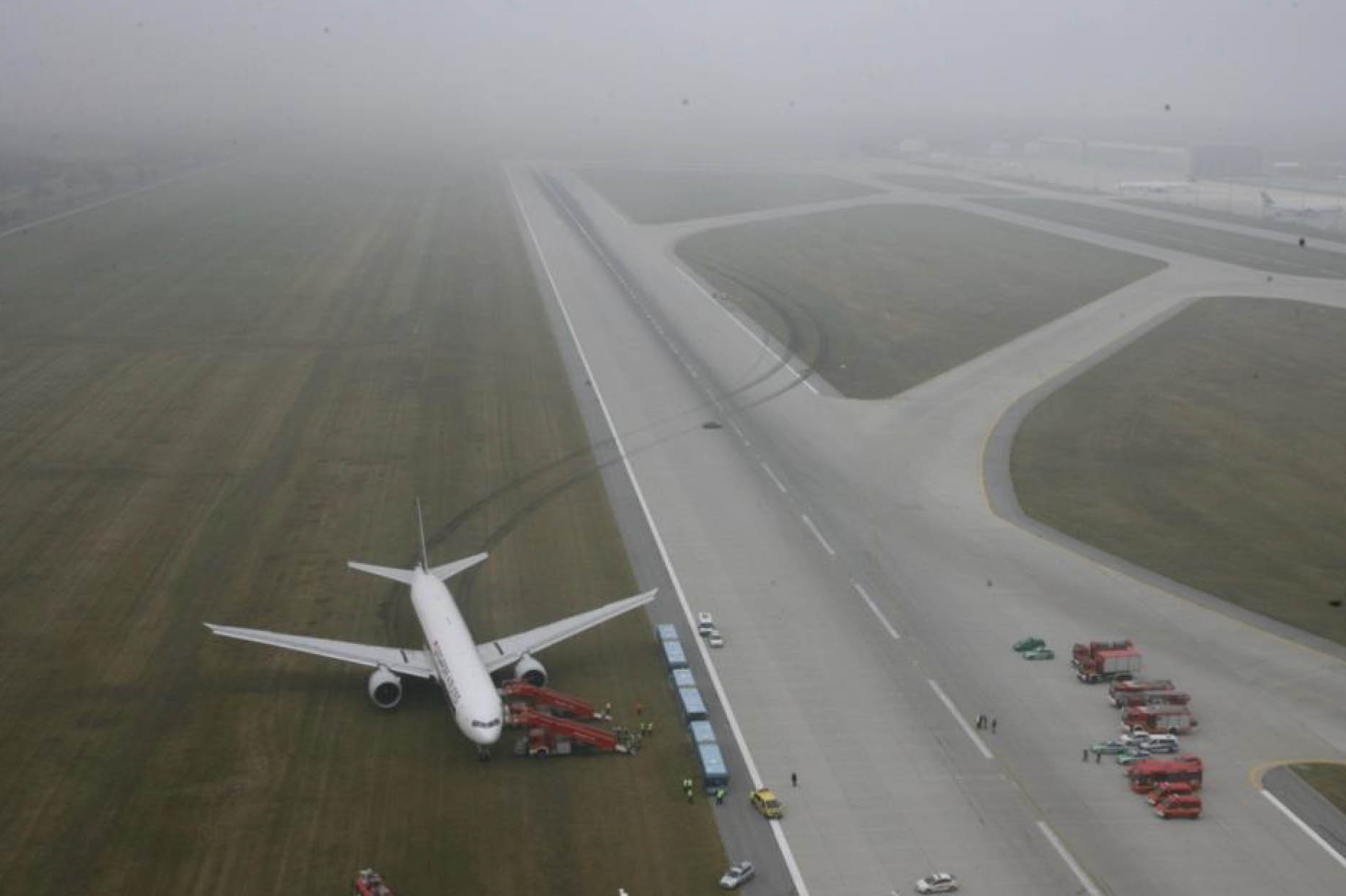
The recent runway excursion at Wilson Airport (WIL) involving a "hard landing" is not an isolated incident of pilot error, but rather the visible output of a specific intersection between aircraft performance envelopes and regional infrastructure constraints. When an aircraft departs the paved surface of a runway, the event represents a breakdown in the energy management equation required to transition a kinetic mass from flight to a static ground state. At Wilson Airport, this equation is frequently compromised by high density altitude, short runway lengths, and the specific approach gradients required to navigate the surrounding urban sprawl of Nairobi.
To understand the systemic risk at Wilson Airport, one must move beyond the surface-level reporting of "no injuries" and "hard landings." Instead, we must categorize the failure into three distinct operational variables: Energy Dissipation Failure, Environmental Infrastructure Constraints, and the Mechanical Feedback Loop of the landing gear assembly.
The Energy Dissipation Failure Chain
A landing is fundamentally a controlled dissipation of kinetic energy. The aircraft must touch down within a specific "aim point" (usually the first 1000 feet of the runway) at a speed known as $V_{ref}$, which is typically $1.3$ times the stalling speed in the landing configuration.
A "hard landing" occurs when the vertical descent rate at the moment of impact exceeds the design limits of the aircraft’s landing gear—often more than 10 feet per second. However, the hard landing is frequently the precursor to a runway excursion (the aircraft leaving the runway) because of how that vertical energy is redirected.
- The Bounce Dynamics: When an aircraft hits the tarmac with excessive force, the oleo struts (the shock absorbers in the landing gear) compress and then rapidly expand. This often lofts the aircraft back into the air in a "ballooned" state.
- The Loss of Effective Braking: During this micro-bounce, the tires lose contact with the pavement. Anti-skid systems and manual braking are useless without friction. By the time the aircraft settles back onto the runway, it has consumed several hundred meters of "roll-out" distance while still traveling at high velocity.
- The Deceleration Deficit: If the pilot attempts to force the aircraft down to compensate for the bounce, they risk a nose-gear first impact, which can lead to "porpoising" or a total loss of directional control, steering the aircraft off the side or the end of the runway.
Environmental Infrastructure Constraints at Wilson Airport
Wilson Airport presents a unique set of challenges that narrow the margin for error compared to its neighbor, Jomo Kenyatta International Airport (NBO). The airport sits at an elevation of approximately 5,500 feet. This altitude significantly affects the "Density Altitude"—a measure of air density that dictates aerodynamic performance.
In the thin air of Nairobi, wings produce less lift, and engines produce less thrust. Crucially, while the aircraft’s Indicated Airspeed (IAS) remains the same for the pilot’s instruments, the Ground Speed (GS) is significantly higher. An aircraft landing at Wilson is moving over the ground much faster than an aircraft landing at sea level, even if the cockpit gauges show the same numbers. This "hidden speed" increases the required stopping distance exponentially, as the energy that brakes must dissipate is calculated by $KE = \frac{1}{2}mv^2$. Because velocity ($v$) is squared, even a 10% increase in ground speed results in a 21% increase in kinetic energy.
Wilson’s primary runway, 07/25, is roughly 1,460 meters (4,790 feet) long. For many regional turboprops and light jets, this is a "tight" envelope. When you combine a high-speed touchdown due to density altitude with a "hard landing" that wastes runway real estate, an excursion becomes a mathematical certainty rather than a possibility.
The Mechanical Feedback Loop and Directional Control
When an aircraft is reported to have "forced off the runway," the investigation must look at the transition from aerodynamic control to mechanical control.
Early in the landing roll, the rudder (controlled by air flowing over the tail) provides steering. As the aircraft slows, the rudder loses effectiveness, and the pilot must transition to nose-wheel steering and differential braking. A hard landing often damages the steering linkage or the tire integrity. If one tire blows due to the high-impact force, the resulting drag on that side of the aircraft creates a "yaw moment" that can pull the plane off the runway edge faster than a pilot can compensate with the opposite rudder.
Furthermore, the "hard landing" reported in this instance suggests a high-energy impact that may have triggered a "squat switch" malfunction. These switches tell the aircraft's computers whether it is in the air or on the ground. A malfunction here can prevent the deployment of spoilers or the engagement of reverse thrust, both of which are critical for stopping on Wilson's limited runway length.
Evaluating the Operational Risk Profile
The frequency of incidents at Wilson Airport suggests a shift from "human error" to "systemic risk." We can define the risk profile of this specific environment using the following variables:
- Thermal Expansion of Air: High midday temperatures in Nairobi further increase density altitude, lengthening the required landing roll.
- Urban Encroachment: Obstacles near the runway thresholds often force pilots into a "steep" approach angle to maintain clearance. A steep approach increases the likelihood of a high vertical sink rate, leading directly to the "hard landing" observed.
- Surface Friction Coefficients: Wilson’s runways, while maintained, are subject to the heavy "rubbering" of frequent short-haul cycles. During the transition from the dry to wet seasons, this rubber buildup becomes extremely slick, reducing the effectiveness of braking systems during the critical first seconds of a hard landing recovery.
Strategic Mitigation for Regional Operators
To reduce the recurrence of these excursions, operators at Wilson Airport cannot rely solely on standard pilot training. A structural shift in flight operations quality assurance (FOQA) is required.
Specifically, operators must implement a mandatory "Stabilized Approach" height of 500 feet for visual conditions. If the aircraft is not perfectly aligned, at the correct speed, and on the correct glidepath by this altitude, a "Go-Around" must be performed. The culture of "forcing" a landing onto a short runway like Wilson's is a leading indicator of future hull losses.
Furthermore, aircraft performance calculations should be adjusted to include a 15% "safety buffer" beyond the manufacturer’s recommended landing distance to account for the unique density altitude variables of the Nairobi basin. The focus must shift from "landing successfully" to "landing within the first third of the runway or not landing at all."
A final technical audit of the runway 07/25 drainage and friction levels is necessary to ensure that the physical infrastructure is not contributing to the loss of directional control during these high-impact events. Until these variables are addressed, the "hard landing" will remain a frequent precursor to runway excursions at one of Africa's busiest regional hubs.
The strategic play for the Kenya Civil Aviation Authority (KCAA) is the installation of an EMAS (Engineered Materials Arrestor System) at the overruns of Wilson’s primary runways. Given the physical constraints preventing runway extension, an EMAS bed—which uses crushable concrete to safely decelerate an aircraft—would transform a potential "hull loss" excursion into a minor operational delay, effectively decoupling the "hard landing" from the "catastrophic overrun."