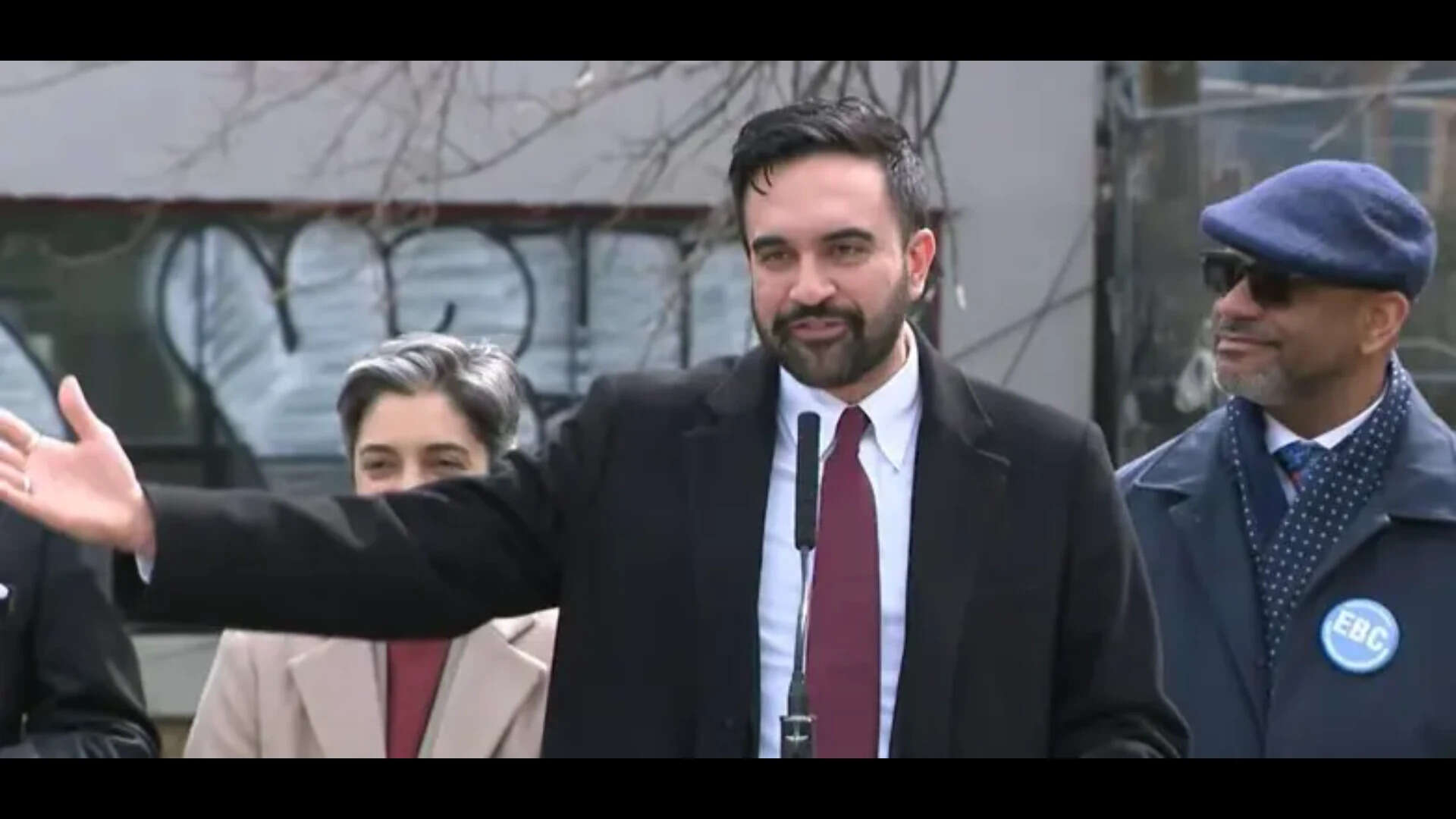
Political communication in high-density urban environments operates as a zero-sum game for auditory dominance. When New York State Assemblymember Zohran Mamdani was interrupted by a heckler during a recent press conference, the exchange was not merely a momentary lapse in decorum; it was a live demonstration of the Feedback Loop of Political Legitimacy. In this framework, the official’s response to unscripted opposition determines their ability to maintain the "asymmetry of authority" required to lead a public narrative. Mamdani’s specific rhetorical pivot—claiming that if he didn't hear yelling, he wouldn't know he was doing his job—transforms a tactical disruption into a metric of performance.
The Dynamics of Spatial Contestation
Press conferences are structured environments designed to project controlled messaging. When an external actor (the heckler) enters this space, they introduce Acoustic Interference, a variable that forces the speaker to choose between three primary defensive postures:
- Suppression: Attempting to outshout or physically remove the dissenter.
- Absorption: Pausing and waiting for the disruption to cease, effectively yielding the floor.
- Reframing: Integrating the disruption into the speaker’s own value proposition.
Mamdani utilized Reframing. By categorizing the heckling as a lagging indicator of his own political efficacy, he redirected the energy of the confrontation. This is a classic application of the Inoculation Theory in social psychology, where exposure to a weakened form of an opposing argument (the heckler's noise) allows the speaker to build "antibodies" or credibility with their primary audience.
The Cost Function of Public Dissent
To understand why Mamdani’s response was strategically sound, one must quantify the "Cost of Silence." For a progressive politician representing a volatile district, silence in the face of opposition signals a lack of conviction. The heckler, by providing a vocalized contrast, lowers the barrier for the politician to display "Vigilant Leadership."
The interaction can be modeled through a Bilateral Conflict Utility function:
- Heckler Goal: Maximize disruption and delegitimize the speaker's platform.
- Politician Goal: Minimize the "Decibel-to-Information" ratio while maximizing the "Resilience Quotient."
When Mamdani stated, "If I don't hear him yelling at me, I'm not doing my job," he effectively inverted the heckler's utility. The more the heckler yelled, the more Mamdani’s "job performance" was validated in the eyes of his base. This is a strategic capture of the opponent's labor. The heckler is no longer a disruptor; they have been conscripted into the role of a "Performance Validator."
Structural Limitations of the Reframing Tactic
While effective in the immediate term, the "Validation through Opposition" strategy has a measurable Diminishing Marginal Return. If every public appearance is characterized by shouting matches, the signal (the actual policy content) is lost to the noise (the conflict).
The efficacy of this strategy depends on three variables:
- Proximity: The physical distance between the speaker and the dissenter dictates the perceived threat level.
- Audience Composition: If the surrounding crowd is neutral or hostile, reframing fails because the "Performance Validator" logic relies on a sympathetic core audience to accept the premise.
- Duration of Interference: Long-form disruption eventually breaks the speaker's cadence, leading to cognitive load issues where the speaker can no longer maintain a logical thread.
The Taxonomy of Political Interruption
Not all heckling serves the same function. To analyze this incident with rigor, we must distinguish between the types of friction encountered in the New York political ecosystem:
- Ideological Friction: Disagreement on the fundamental "Why" of a policy.
- Tactical Friction: Disagreement on the "How," often coming from within a politician's own coalition.
- Performative Friction: Disruption for the sake of digital virality, where the heckler’s goal is a 15-second clip rather than a policy shift.
Mamdani’s interaction appeared to be a blend of Ideological and Performative friction. The heckler represents a specific segment of the electorate that views the Assemblymember's platform as an existential threat. In this context, Mamdani’s response is a signal to his donors and volunteers that he is a "Battle-Tested" asset.
Power Asymmetry and the Microphone
The most overlooked technical aspect of this incident is the Amplification Gap. A politician at a press conference holds a microphone; the heckler holds only their lungs. This creates a structural advantage that the speaker must exploit without appearing "Bully-ish."
Mamdani’s choice to acknowledge the yelling without demanding its cessation is a sophisticated use of Passive Dominance. By acknowledging the noise but refusing to let it halt the proceedings, the speaker asserts that their message is "Robust to Noise." This is a critical distinction in high-stakes communication: a message that requires perfect silence is fragile; a message that thrives in chaos is resilient.
Strategic Recommendations for Navigating High-Friction Environments
For organizations or public figures operating in polarized environments, the Mamdani incident provides a blueprint for "Friction Management." The goal is not to eliminate dissent—which is often impossible and visually suspicious—but to categorize it as a necessary byproduct of impact.
The optimal strategy involves:
- Pre-emptive Framing: Setting the stage by acknowledging that the presence of opposition is the primary indicator of a policy's significance.
- The Pivot Point: Identifying the exact second where a disruption ceases to be a distraction and starts becoming a "case study" for the speaker’s point.
- Acoustic Decoupling: Training speakers to maintain a steady heart rate and vocal pitch despite rising external decibels, thereby maintaining the "Calm-to-Chaos" ratio.
The long-term risk for Mamdani, and those who use this "Inversion Strategy," is the creation of a Conflict Habituation effect. When an audience expects a confrontation, they stop listening to the legislative substance and start waiting for the "yelling." This shifts the politician's brand from "Policymaker" to "Gladiator." While the latter is useful for fundraising and social media engagement, it creates a bottleneck for actual governance, which requires the quiet, unglamorous work of consensus-building.
The immediate move for any strategist in this position is to analyze the source of the heckling to determine if it represents a growing trend in the district or a localized anomaly. If the former, the "Validator" rhetoric must be supplemented with localized town halls to prevent the "Gladiator" brand from alienating moderate swing voters who prioritize stability over spectacle.