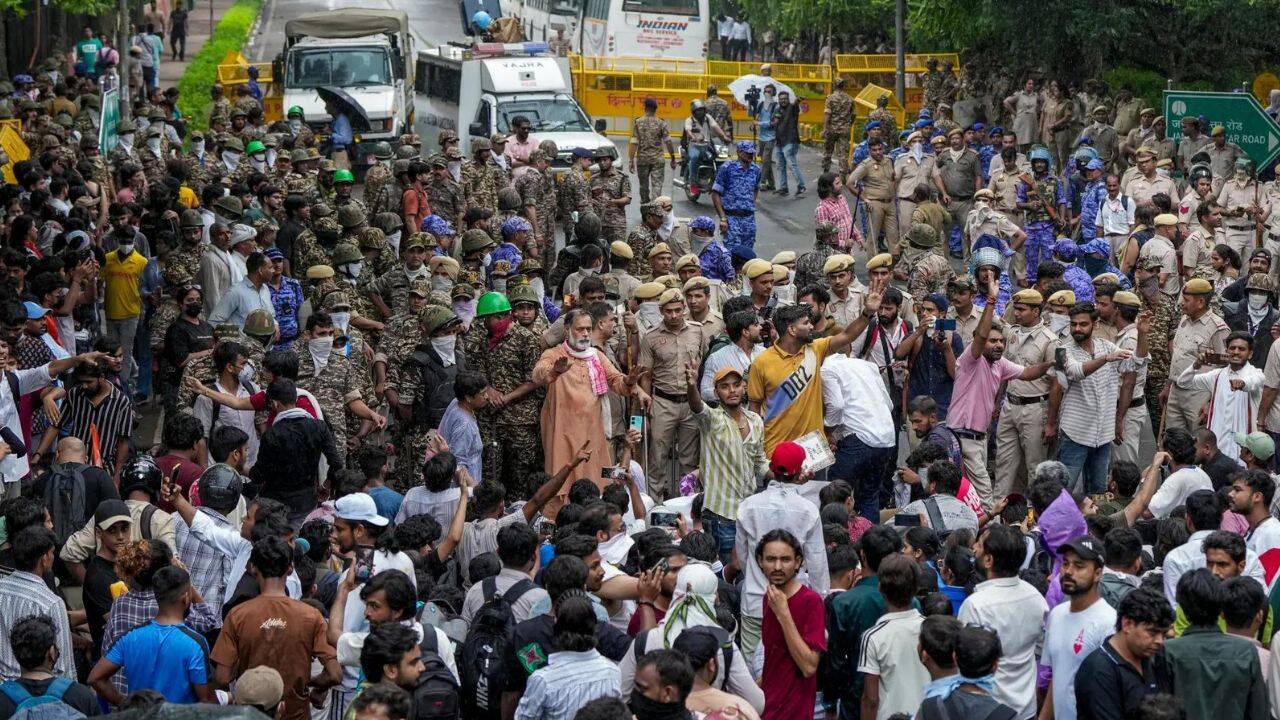
Public demonstrations function as high-stakes arenas for narrative control where visual symbols frequently substitute for policy debate. The intersection of street-level political activism, digital manipulation, and state regulatory frameworks exposes a fragile equilibrium between protected speech and criminal defamation. When a demonstration organized by civil rights bodies, such as Citizens for Justice and Peace, becomes the vector for digitally altered imagery displaying a political figure alongside the Prime Minister, the incident transcends a localized law enforcement matter. It illustrates a predictable trajectory of modern political friction: ideological provocation, rapid digital amplification, statutory intervention through First Information Reports, and institutional polarization.
Deconstructing this event requires an examination of the vectors that drive modern protest iconography. Political iconography relies on immediate visual recognition. By superimposing or digitally morphing photographs to place opposing figures in compromising or provocative visual contexts, bad actors attempt to bypass rational political discourse and trigger visceral emotional responses. This tactic exploits the cognitive bias known as the illusory truth effect, where repetition and striking imagery make fabricated claims appear credible to uncritical audiences.
The immediate operational response to such incidents typically manifests through the invocation of criminal law, specifically statutory provisions governing defamation, public mischief, and the misuse of electronic records. In jurisdictions governed by robust legal codes, the filing of a formal First Information Report initiates a structural investigation designed to determine several critical legal thresholds:
The source of the digital alteration: Investigators must trace whether the image manipulation occurred within the organizing body or was introduced by an external provocateur infiltrating the crowd.
The degree of malicious intent: Legal statutes require proof of mens rea—the intent to incite public disorder, defame an individual, or promote enmity between different groups.
The amplification network: Determining how the image spread across digital platforms helps authorities assess the scale of potential public harm and assign proportional liability.
Protest organizers face a distinct governance challenge regarding perimeter security and crowd curation. Large-scale public assemblies attract diverse factions, ranging from dedicated ideological advocates to opportunistic agitators seeking to hijack a platform for distinct agendas. When organizers fail to police their own ranks or vet the visual materials displayed on placards, banners, and digital screens, they inherit institutional liability. This creates a severe operational vulnerability: a single unauthorized poster can delegitimize an entire movement, shifting public and media focus away from core grievances toward the misconduct of individuals within the assembly.
From a strategic perspective, the deployment of morphed imagery alters the cost-benefit function of public demonstrations. For protest groups, provocative visuals offer a high-yield method for capturing attention in a saturated media ecosystem, but they carry an asymmetric risk profile. The introduction of falsified media invites immediate state crackdowns, legal prosecution, and the forfeiture of moral high ground. For state authorities and targeted political figures, such incidents provide a legal justification to tighten surveillance on civil society organizations, increase regulatory friction for public gatherings, and discredit broader dissenting movements by highlighting isolated instances of bad faith participation.
The long-term consequence of this dynamic is the gradual erosion of public trust in visual media. As deepfakes and digitally altered photographs become common tools in political warfare, the evidentiary value of photographic proof degrades. Observers default to partisan skepticism, viewing all documentation through a lens of cynicism. Moving forward, the governance of public protest will depend heavily on the development of verified digital credentials for media displayed at public rallies and stricter self-regulatory protocols by civil society networks to isolate actors who rely on deception rather than argumentation.