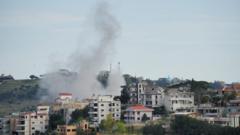
The execution of localized air strikes within high-density environments operates on a precise calculus of kinetic efficiency, intelligence decay, and collateral friction. When standard news reporting states that an strike has claimed nineteen lives in Lebanon, it treats the event as an isolated statistic. A rigorous strategic analysis, however, isolates this data point as an output of a broader operational system: the targeted attrition framework. To understand the true impact of these kinetic engagements, analysts must look past the immediate casualty counts and evaluate the structural inputs, the geographic constraints, and the strategic feedback loops that drive state-sponsored aerial campaigns.
The primary objective of these strikes is rarely indiscriminate destruction; rather, it is the systematic degradation of an adversary’s command, control, communications, computers, intelligence, surveillance, and reconnaissance (C4ISR) capabilities. When an air campaign scales up to hit specific residential or urban nodes, it reveals a shift from long-range interdiction to immediate tactical elimination. This shift creates a distinct set of operational realities that govern both the attacking force's targeting matrix and the defending population's survival vectors.
The Tri-Axe Operational Framework of Modern Air Campaigns
Every kinetic strike in a contemporary asymmetric conflict relies on three interdependent pillars. If any single pillar fails, the operational efficacy of the strike collapses, resulting in either a missed target or unacceptable collateral friction.
1. The Intelligence-to-Kinetic Pipeline
The bottleneck of any targeted strike is the latency between target identification and weapon delivery. This is known as the Find, Fix, Track, Target, Engage, and Assess (F2T2EA) cycle.
- Find and Fix: Signals intelligence (SIGINT) and human intelligence (HUMINT) identify a high-value asset or a munitions depot within a specific structure.
- Track: Imagery intelligence (IMINT) via unmanned aerial vehicles (UAVs) monitors the target to establish a pattern of life, aiming to minimize non-combatant presence while ensuring the target remains localized.
- Target and Engage: The launch authority matches the target profile with the appropriate ordnance—frequently joint direct attack munitions (JDAMs) or small diameter bombs (SDBs) to control the blast radius.
The nineteen casualties reported in recent strikes indicate a high density of individuals within the strike zone at the moment of impact. This suggests either a compressed F2T2EA cycle where strikes were ordered on time-sensitive targets (such as moving personnel or active launch platforms), or a deliberate targeting of structural nodes where leadership elements were clustered.
2. Collateral Friction and Structural Density
Urban and peri-urban environments alter the physics of kinetic ordnance. Standard military doctrine calculates the Circular Error Probable (CEP) to determine weapon accuracy, but CEP fails to account for structural collapse dynamics.
When a missile strikes a building in a high-density area, the primary blast wave is only the initial cause of mortality. The secondary and tertiary effects—structural pancake collapse, fragmentation of building materials, and thermal energy release—multiply the casualty radius far beyond the weapon's theoretical design.
In the context of the Lebanese theater, towns and villages frequently feature reinforced concrete structures built in close proximity. A strike targeting a ground-floor weapons cache or a basement command bunker inevitably destabilizes the entire vertical stack of the building, trapping occupants who may have had no direct affiliation with the tactical asset below.
3. The Asymmetric Information War
Kinetic actions do not occur in a vacuum; they generate immediate narrative data. For the striking force, the metric of success is the quantifiable degradation of enemy infrastructure. For the target organization, the metric of utility shifts to leveraging the civilian toll to generate international diplomatic pressure and domestic mobilization.
This creates an inherent data deficit for outside analysts. Casualty figures released by local health authorities or state-run media typically aggregate combatants and non-combatants into a single metric. To parse the reality of the strike, analysts must apply a probability matrix based on the location of the strike, the time of day, and the known operational footprint of local militias in that specific sector.
The Cost Function of Urban Air Interdiction
To evaluate the strategic utility of an air campaign, one must calculate its cost function. The striking military balances the tactical value of the eliminated asset against the strategic liabilities incurred.
$$Cost = C_{ordnance} + C_{intelligence} + L_{diplomatic} - V_{asset}$$
Where:
- $C_{ordnance}$ is the direct fiscal cost of the hardware deployed.
- $C_{intelligence}$ represents the exposure and potential burn rate of intelligence assets (HUMINT assets exposed or SIGINT capabilities revealed).
- $L_{diplomatic}$ is the measurable loss in international political capital and the acceleration of adversary recruitment.
- $V_{asset}$ is the tactical and strategic value of the neutralized target.
When strikes result in double-digit casualties, the $L_{diplomatic}$ variable rises exponentially. If the $V_{asset}$ eliminated is merely a low-level commander or a replaceable rocket launcher, the cost function yields a net negative strategic return. Conversely, if the strike neutralizes a tier-one operational planner or a critical strategic missile storage facility, the striking force views the high collateral cost as a calculated, acceptable liability within their doctrine of total attrition.
Geographic Vector Analysis: The Lebanon Sector
The geography of Lebanon presents distinct operational challenges that dictate the outcomes of these air strikes. The country’s terrain can be divided into three distinct kinetic zones, each altering how air power manifests on the ground.
The Southern Border Zone
Characterized by rugged topography, terraced hills, and highly fortified subterranean networks. Here, air strikes primarily target hard nodes, tunnel networks, and hidden launch positions. Casualties in this zone are more heavily weighted toward active combatants due to the widespread evacuation of civilians from the immediate border tier.
The Bekaa Valley Corridor
A vast geographic expanse utilized for logistics, supply lines, and deep-theater storage. Air strikes in this region target moving convoys and large-scale depots. Because these targets are often located on the periphery of agricultural towns, strikes here alternate between low-casualty precision interdictions on highways and high-casualty misses when weapons storage facilities cook off adjacent to residential blocks.
The Urban Nucleus (Beirut and Suburbs)
The highest-stakes environment. The extreme population density renders any kinetic action highly volatile. The proximity of buildings means that a single payload can damage three to four surrounding structures via sympathetic shockwaves. It is in this zone where the intelligence threshold must be highest, as the margin for error approaches zero.
Strategic Forecast and Operational Implications
The continuation of air strikes yielding high casualty figures points to an intensification of the conflict's velocity. As targeting matrices expand to include lower-priority nodes to maintain operational pressure, the probability of civilian exposure increases.
Forces relying on aerial supremacy will likely face diminishing tactical returns. As high-value targets are depleted, the adversary adapts by decentralizing command structures, shifting communication to hardwired or low-tech alternatives, and embedding deeper within the civilian fabric. This adaptation forces the attacking military into a strategic paradox: they must either increase the volume and weight of aerial ordnance—thereby compounding international backlash—or transition to high-risk ground operations to achieve definitive clearing objectives.
The critical variable to watch over the coming operational cycle is the ratio of strikes to infrastructure degradation. If the casualty rate climbs while the adversary’s rate of fire or logistical movement remains steady, it signals that the air campaign has hit an optimization ceiling, rendering further kinetic degradation strategically inefficient.


