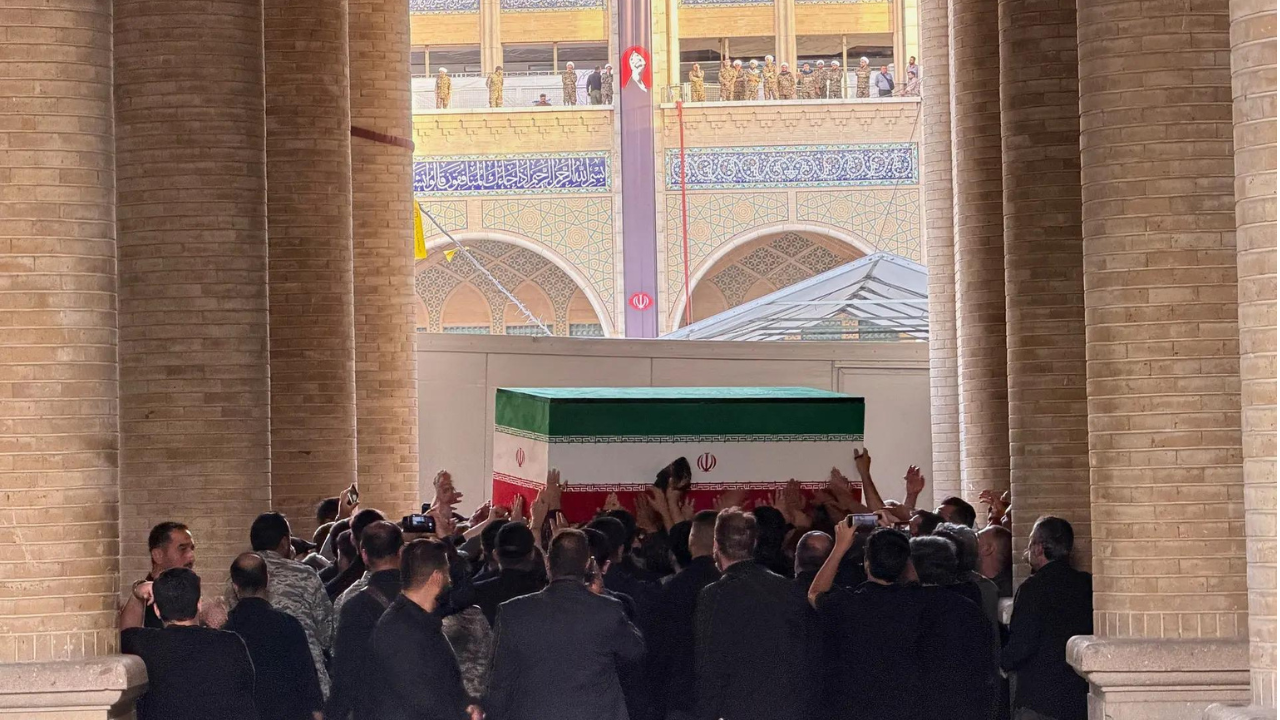
The transition of supreme authority within the Islamic Republic of Iran represents a critical stress test for the regime's institutional architecture. State-managed mass rituals, such as the public mourning ceremonies for senior leadership, function not merely as expressions of grief but as deliberate instruments of political stabilization and ideological reinforcement. By examining the structural components of these events, analysts can decode the regime's internal consolidation strategies and its projected foreign policy posture during a period of high systemic vulnerability.
The operational architecture of Iranian state transitions relies on three primary vectors to maintain continuity: institutional compliance, ideological signaling, and security mobilization.
The Institutional Framework of Power Transition
The legal mechanisms governing the succession of the Supreme Leader are clearly defined by the Constitution of the Islamic Republic of Iran. Under Article 111, if the Supreme Leader is unable to perform their duties, a leadership council temporarily assumes responsibility until the Assembly of Experts selects a successor.
The immediate challenge during this interim period is the mitigation of factional friction. The political elite in Iran is not monolithic; it comprises pragmatic conservatives, hardline ideologues, and economic stakeholders tied to the Islamic Revolutionary Guard Corps (IRGC).
[System Shock: Loss of Supreme Leader]
       │
       ▼
[Article 111 Activation: Temporary Council]
       │
       ▼
[IRGC Security Containment] ──► [Suppression of Internal Dissent]
       │
       ▼
[Assembly of Experts Vote] ──► [Legitimacy Ratification]
The first priority of the security apparatus during a transition is the enforcement of domestic stability. The IRGC and its paramilitary wing, the Basij, deploy to pre-determined urban nodes to prevent spontaneous civil unrest. This domestic security posture operates in tandem with the management of public gatherings, ensuring that large crowds remain directed toward state-sanctioned narratives.
Ideological Signaling and the Function of Ritualized Slogans
The deployment of specific ideological slogans during state funerals serves a dual external and internal purpose. Standardized chants, directed at foreign adversaries, are utilized to signal ideological continuity to external observers. The state media apparatus amplifies these chants to project an image of unyielding systemic resolve, countering any perception of vulnerability that external actors might exploit during a leadership vacuum.
Internally, these slogans function as a mechanism for elite and popular alignment. The regime uses the funeral space to re-establish the ideological boundaries of the state. Participation in these rituals acts as a public declaration of loyalty to the foundational tenets of the 1979 revolution. The state relies on these public displays to manufacture a sense of collective purpose, effectively utilizing mass psychology to suppress dissenting political factions that might seek to challenge the transition process.
The primary limitation of this strategy lies in the growing disconnect between formal state mobilization and the broader demographic realities of Iran. Economic stagnation, driven by structural inefficiencies and international sanctions, has systematically eroded the regime's social contract with younger, urban populations. While the state can mobilize hundreds of thousands of loyalists and public sector employees for televised funeral ceremonies, this mobilization does not necessarily correlate with deep-seated domestic legitimacy.
Economic and Geopolitical Strategic Adjustments
A leadership transition forces an immediate recalibration of Iran's regional strategy. The network of non-state actors and allied militias, often referred to as the Axis of Resistance, requires continuous financial and logistical assurance from Tehran to maintain operational cohesion.
The second limitation facing the incoming leadership is the management of the state's constrained capital allocation. The regime must balance two competing economic demands:
- Domestic Subsidy Maintenance: Funding essential goods and services to prevent widespread domestic unrest driven by inflation.
- External Security Funding: Maintaining financial pipelines to regional proxies to preserve Iran's strategic depth and deterrence capabilities.
This resource scarcity creates a structural bottleneck. The incoming Supreme Leader must secure the explicit backing of the IRGC, which controls significant sectors of the Iranian economy, including construction, energy, and telecommunications. This economic interdependence ensures that any new leadership will remain highly deferential to the security apparatus's institutional preferences, limiting the potential for significant shifts in either domestic economic policy or regional confrontational postures.
The structural continuity of the Iranian state depends entirely on the speed and cohesion of the Assembly of Experts' decision-making process. Delays in ratifying a successor invite factional maneuvering and increase the probability of elite fragmentation. The most probable outcome of any transition sequence is the rapid installation of a candidate pre-approved by the security elite, thereby ensuring that the core tenets of Iranian foreign policy and domestic governance remain unaltered.