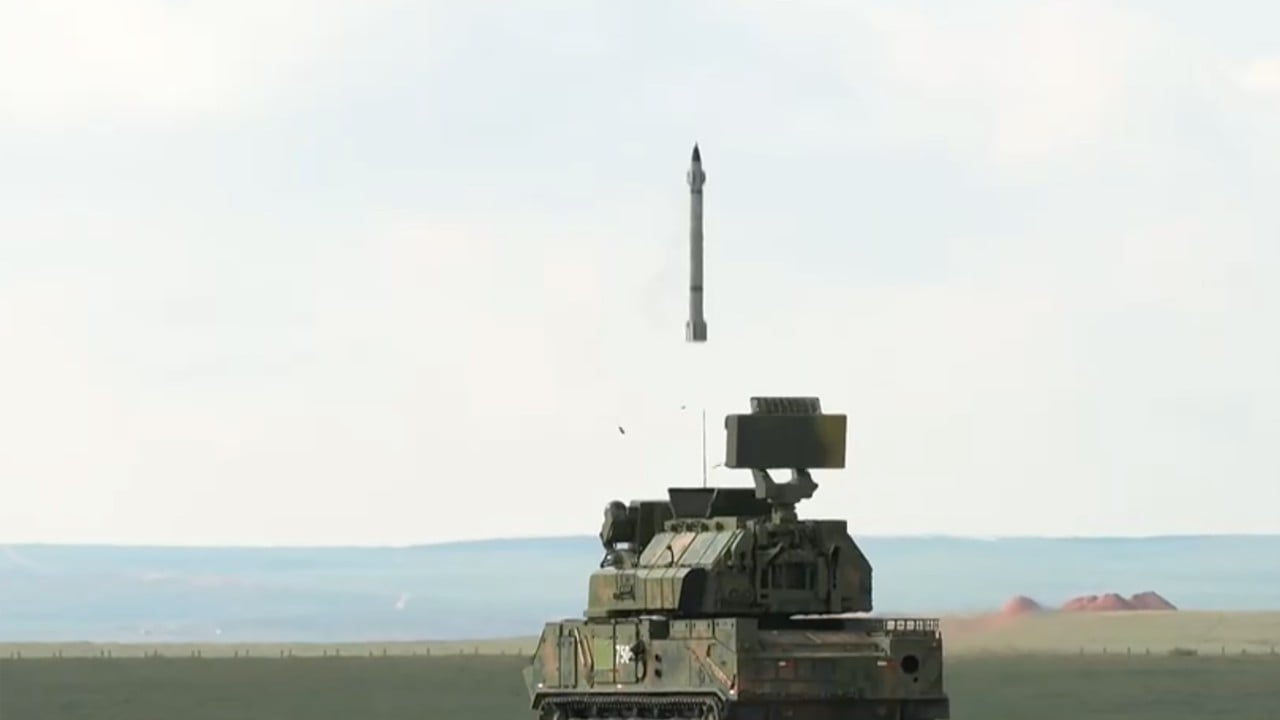
Evaluating whether the People’s Liberation Army (PLA) HQ-17 short-range air defense (SHORAD) system can protect an amphibious landing force from Taiwanese counterstrikes requires stripping away platform-versus-platform comparisons and modeling the engagement as a dynamic queuing and saturation problem. An amphibious lodgment is not a static garrison; it is a high-density logistical bottleneck compressed onto narrow littoral terrain, exposed to multi-axis, high-volume fires from across an island with pre-surveyed terrain and hardened coastal defenses. The HQ-17—a tracked, self-propelled derivative of the Russian Tor-M1—was engineered to accompany mechanized maneuver brigades against precision-guided munitions (PGMs), cruise missiles, and low-altitude strike aircraft. Yet transporting that tactical doctrine onto a contested beachhead introduces severe thermodynamic, electromagnetic, and logistical constraints that degrade its theoretical intercept envelope.
To determine the survivability of a PLA amphibious task force under an HQ-17 umbrella, analysts must evaluate four interacting variables: the kinematic intercept window against diverse Taiwanese munition profiles, magazine depth relative to salvo density, electromagnetic survivability in a saturated electronic warfare (EW) environment, and the physical vulnerability of tracked transporter-erector-launcher-and-radar (TELAR) units during ship-to-shore transit.
The Kinematic Envelope and Threat Spectrum
The baseline HQ-17 and its wheeled successor, the HQ-17A, operate as self-contained tactical units. Each vehicle integrates a search radar, a phased-array engagement radar, an electro-optical tracking backup, and eight vertically launched surface-to-air missiles (SAMs). Vertical cold-launch eliminates the dead zone associated with rail-launched systems, allowing the interceptor to pitch over immediately via gas-dynamic thrusters and engage targets at altitudes from roughly 10 meters up to 10 kilometers, at slant ranges between 1.5 and 15 kilometers (extending toward 20 kilometers in upgraded variants).
Taiwanese defensive doctrine relies on asymmetric, distributed firepower designed to overwhelm point defenses at the water's edge. The threat spectrum confronting an HQ-17 battery on a beachhead spans four distinct kinematic regimes:
- Subsonic Anti-Ship and Land-Attack Cruise Missiles: Systems such as the Hsiung Feng II and Hsiung Feng III (supersonic) skim the sea surface to delay radar horizon detection. Against a sea-skimming target flying at 15 meters altitude, an HQ-17 radar mounted roughly 3.5 to 4 meters above the ground faces a strict radar horizon limit of approximately 22 to 24 kilometers. Once accounting for sea clutter, target acquisition, track confirmation, and command-to-line-of-sight (CLOS) guidance loop closure, the effective engagement window against a supersonic Hsiung Feng III traveling at Mach 2.5+ compresses to less than 15 seconds.
- Tactical Ballistic Missiles and Guided Multiple Launch Rocket Systems (GMLRS): Taiwan’s Thunderbolt-2000 artillery rockets and MGM-140 ATACMS present high-angle, terminal-phase trajectories. While the HQ-17 possesses a stated counter-rocket, artillery, and mortar (C-RAM) capability against small, sub-caliber projectiles, defending against a coordinated salvo of 227mm guided rockets requires rapid fire-control cycling. The engagement radar can guide multiple missiles simultaneously against targets within a constrained azimuth sector, but high-elevation terminal dives exploit the upper zenith blind spot of the phased-array antenna.
- Loitering Munitions and Small Unmanned Aerial Systems (sUAS): Taiwan has prioritized domestic production of loitering munitions (such as the Chien Hsiang anti-radiation drone) and commercial-off-the-shelf first-person-view (FPV) quadcopters. These platforms exhibit low radar cross-sections (RCS) and slow airspeeds, placing them near the Doppler notch used by pulse-Doppler radars to filter out stationary ground and wave clutter. Even when detected, firing a multi-hundred-thousand-dollar interceptor at a low-cost drone creates an unsustainable cost-exchange asymmetry.
- Stand-Off Glide Bombs and Air-Launched PGMs: Delivered by F-16V aircraft operating from hardened mountain bases on Taiwan’s east coast, munitions like the AGM-154 Joint Standoff Weapon (JSOW) approach at low observability and high subsonic speeds, forcing the SHORAD layer to intercept the incoming ordnance rather than the launch platform.
The Saturation Math of Amphibious Lodgments
The primary operational constraint of the HQ-17 in an amphibious assault is not single-shot probability of kill ($P_k$), which is high against non-maneuvering subsonic targets, but magazine exhaustion. A single HQ-17 TELAR carries eight ready-to-fire missiles. A standard PLA air defense battalion supporting a combined-arms brigade typically fields 12 to 16 TELARs, yielding a total ready-to-fire inventory of 96 to 128 interceptors across the entire maneuver unit.
During the initial phase of an amphibious landing—when landing craft, hovercraft (such as the Type 726), and amphibious fighting vehicles (ZBD-05) are transitioning through the surf zone—the PLA cannot immediately deploy full battalion-level air defense formations ashore. Early waves may bring only a single battery of four TELARs onto the beachhead, providing 32 ready missiles to cover a landing zone several kilometers wide.
Consider the engagement arithmetic under standard salvo doctrine. To achieve a high composite probability of kill against incoming threats, air defense operators routinely fire two interceptors per target (a shoot-shoot doctrine) or two interceptors followed by assessment (shoot-look-shoot). Under a shoot-shoot protocol, a four-vehicle battery with 32 missiles can engage a maximum of 16 discrete targets before every launcher is completely dry.
Reloading an HQ-17 is not an instantaneous automated process performed under fire. It requires a dedicated transloader vehicle carrying replacement four-round canisters, a hydraulic crane operation, and roughly 10 to 15 minutes of stationary exposure. On an open beachhead lacking concrete revetments, stationary transloading turns both the TELAR and its resupply truck into high-priority targets for counter-battery artillery and loitering munitions.
If Taiwanese forces synchronize a combined-arms strike—pairing a battery of Thunderbolt-2000 rockets (firing 12 to 36 rockets per launcher) with a swarm of Chien Hsiang anti-radiation drones—they can saturate the 32-missile buffer in under two minutes. Once the ready racks are depleted, the amphibious infantry and armor ashore are left entirely exposed to follow-on precision strikes until either naval air defense destroyers offshore assume the engagement or secondary waves land fresh TELARs.
Electromagnetic Vulnerability and Sensor Degradation
Radar-guided SHORAD systems rely on continuous electromagnetic emissions to search for threats and guide interceptors. In the Taiwan Strait, the electromagnetic spectrum will be heavily contested from the opening minute of conflict. Deploying the HQ-17 in this environment exposes three distinct sensor vulnerabilities:
- Anti-Radiation Munition (ARM) Targeting: Taiwan’s Chien Hsiang loitering munitions are specifically designed to home in on enemy radar emissions. Because the HQ-17 uses a command-guidance architecture—meaning the ground vehicle must continuously track both the target and the interceptor via radar until detonation—the TELAR cannot shut off its engagement radar immediately after launch without losing control of the missile in flight. This mandatory illumination window gives passive radiation seekers a fixed, high-power beacon to track down to impact.
- Clutter and Multipath Interference in the Littoral Zone: Radar propagation at the boundary between sea and land suffers from severe multipath reflections and ducting anomalies. Low-altitude targets skimming the waves generate false ghost tracks, forcing radar signal processors to raise detection thresholds. Raising the threshold to suppress false alarms inevitably reduces sensitivity against low-RCS targets like stealthy cruise missiles or composite-body drones.
- Active Jamming and Decoys: Stand-off jamming pods carried by Taiwanese F-16Vs and ground-based coastal EW stations can inject noise and deceptive range-gate pull-off signals into the HQ-17’s C-band/Ku-band radar frequencies. While the HQ-17 incorporates frequency agility and an electro-optical (EO) tracking channel as a backup, the EO system is severely degraded by weather, smoke, and the thermal bloom of combat on a burning beachhead. The Taiwan Strait experiences frequent low cloud ceilings, sea fog, and heavy precipitation, which can reduce EO tracking ranges to a fraction of radar range.
The Amphibious Transit and Deployment Bottleneck
The physical mechanics of moving an HQ-17 from a Type 071 amphibious transport dock or Type 075 landing helicopter dock onto a Taiwanese beach introduce mechanical and tactical friction that does not exist in continental land warfare.
First, the HQ-17 is a heavy tracked armored vehicle weighing approximately 35 to 37 metric tons. Unlike the ZBD-05 amphibious infantry fighting vehicle, which is engineered with a hydrojet propulsion system and planing hull to swim ashore from several kilometers out at sea, the HQ-17 is not an amphibious swimming vehicle. It must be carried all the way to the dry shore via air-cushioned landing craft (LCAC) or traditional displacement landing craft.
During the transit phase aboard an LCAC, the HQ-17 is effectively dead weight. While the vehicle’s radar could theoretically radiate from the deck of a hovercraft, the violent pitch, roll, and salt-spray plume generated by an LCAC moving at 40 knots degrade radar stabilization and foul optical apertures. Consequently, the PLA faces an acute coverage gap: the amphibious force is most vulnerable while moving slowly through the final 10 kilometers of water, yet its dedicated organic SHORAD assets cannot operate effectively until they roll off the ramp onto solid ground.
Second, coastal terrain in Taiwan severely restricts where heavy tracked vehicles can exit the beach. Taiwan’s west coast consists largely of wide tidal mudflats, concrete seawalls, and dense urban sprawl intersecting aquaculture fishponds. Heavy tracked vehicles like the HQ-17 risk immobilization in soft mudflats if they deviate from cleared beach exits. Narrow, predictable exit chokepoints allow Taiwanese defenders to pre-sight artillery and anti-tank guided missiles (ATGMs) onto the exact corridors the HQ-17 must traverse to disperse inland.
Third, salt-water corrosion and sand ingestion pose immediate maintenance hazards. The HQ-17’s gas-turbine auxiliary power unit (APU)—which powers the radar and fire-control electronics while the main diesel engine is idling—and its sensitive phased-array cooling systems require clean airflow and precise thermal management. Operating in a maritime surf environment without forward maintenance depots accelerates mechanical failure rates across the battalion.
Integration Within the PLA Layered Defense Architecture
Assessing the HQ-17 in isolation misrepresents PLA operational doctrine. Beijing does not intend for SHORAD units to fight an independent battle on the beach; the HQ-17 is designed as the terminal inner tier of a multi-layered integrated air defense system (IADS).
In a doctrinal PLA amphibious operation, air defense is structured into three concentric rings:
- The Outer Area-Defense Layer: Provided by Type 055 and Type 052D destroyers operating in the Strait, firing long-range HHQ-9B interceptors to destroy Taiwanese strike aircraft and high-altitude ballistic trajectories before they reach the amphibious task force.
- The Medium-Range Transitional Layer: Provided by shipborne HQ-16 variants on Type 054A frigates and early-landed medium-range systems, engaging cruise missiles and stand-off munitions at ranges out to 40–70 kilometers.
- The Point-Defense Terminal Layer: Executed by the HQ-17, Type 625E hybrid gun-missile systems, and man-portable air defense systems (MANPADS) like the QW-2, tasked with intercepting "leakers" that penetrate the outer naval umbrella.
The flaw in this layered architecture during an amphibious invasion is the vulnerability of the outer naval tiers. Destroyers and frigates operating within 50 to 100 kilometers of Taiwan’s coast sit squarely inside the engagement zones of mobile, land-based Hsiung Feng anti-ship missile batteries hidden in Taiwan’s coastal mountains. If Taiwanese anti-ship salvos force PLA surface combatants to withdraw further west or expend their vertical launch system (VLS) cells on self-defense, the outer and middle layers of the air defense umbrella collapse.
When the naval IADS is suppressed or pushed back, the HQ-17 ceases to be a terminal "leaker" defense and is forced to absorb the full weight of Taiwan’s strike complex alone—a mission its 15-kilometer range and 8-missile magazine were never built to sustain.
Strategic Forecast for PLA Littoral Air Defense
The HQ-17 will successfully intercept individual subsonic cruise missiles, helicopters, and fixed-wing aircraft that stray within its engagement envelope, making it dangerous for Taiwanese pilots to conduct traditional low-altitude close air support directly over a consolidated beachhead. However, the system cannot independently shield a PLA amphibious lodgment from high-volume, multi-axis precision fires.
To prevent rapid magazine exhaustion and sensor suppression on a contested beachhead, PLA force planners must shift away from relying on standalone, radar-emitting SAM vehicles like the HQ-17 during the initial assault waves. The operational solution requires pairing surviving HQ-17 batteries with high-capacity, low-cost kinetic and directed-energy point defenses—specifically automated 30mm rotary cannon platforms (such as the Type 625E) and high-energy laser systems—to absorb low-cost drone swarms without depleting surface-to-air missile stocks. Simultaneously, the PLA must decouple sensor emissions from the launcher by networking the HQ-17 into passive off-board detection grids, allowing TELARs to remain electromagnetically silent until seconds before terminal intercept. Without these structural adaptations to magazine depth and emission control, the HQ-17 remains a high-value asset vulnerable to rapid saturation in the opening hours of an amphibious landing.