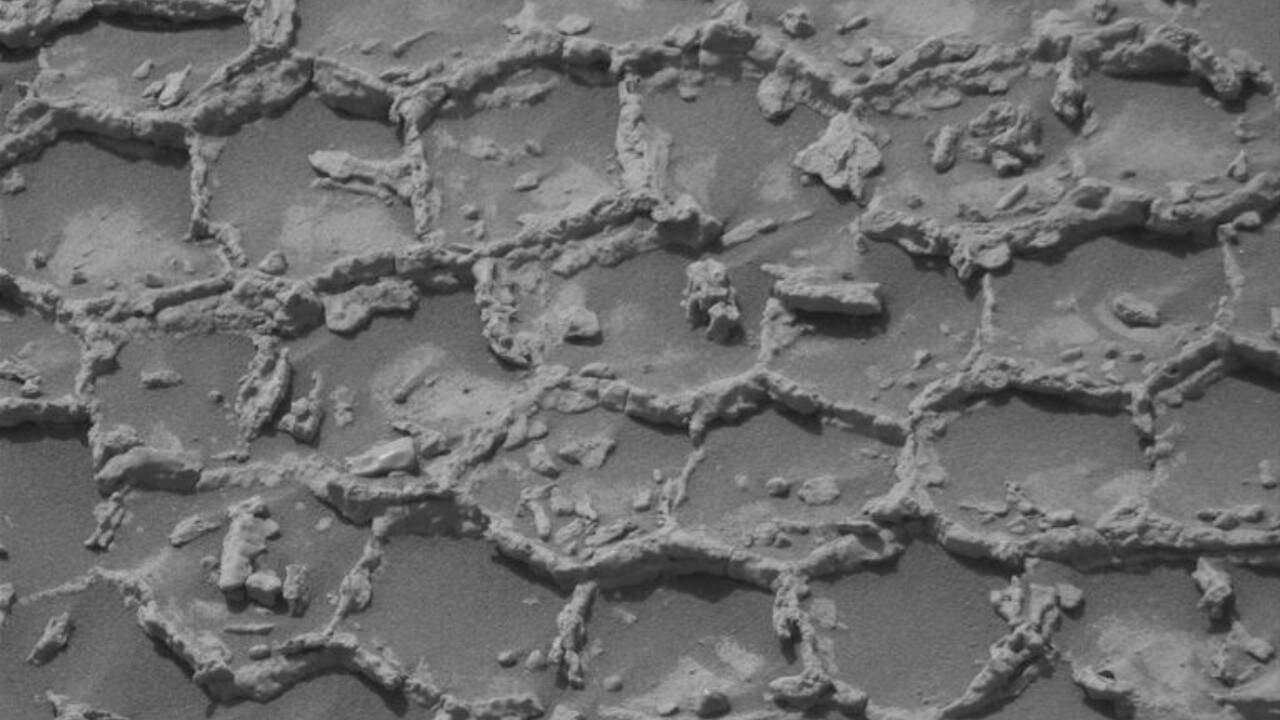
The internet is losing its collective mind over a hexagon.
If you scrolled through the science news feed this week, you probably saw a variation of the same breathless headline: NASA’s Curiosity rover has spotted a "mysterious honeycomb pattern" on the surface of Mars. The articles are saturated with breathless speculation. They hint at alien architectures. They whisper about ancient, unexplained Martian anomalies. They position this geological feature as a profound puzzle that has left planetary scientists scratching their heads in dark rooms.
It is a lie.
It is a carefully manufactured narrative designed to turn basic physical chemistry into clickbait.
As someone who has spent years analyzing raw planetary telemetry and watching the machinery of space agency public relations up close, I find this cycle exhausting. The pattern captured by Curiosity in the Gale Crater is not a mystery. It is not an anomaly. It is basic thermal contraction cracking and salt tectonics. It is the predictable, mundane result of physics operating exactly as thermodynamics dictates.
We need to stop treating basic physical chemistry on Mars as a supernatural event.
The Geometry of Laziness
To understand why the "mysterious honeycomb" narrative is so offensive to actual science, we must first look at the mechanics of the pattern itself. The media wants you to believe that hexagons are rare, exotic shapes that require a designer or a miraculous chain of events to occur.
In reality, hexagons are nature's default panic room.
When a material shrinks uniformly, it experiences tensile stress. To relieve this stress with the minimum amount of energy expended, the material cracks. If the shrinkage is uniform across a flat plane, the cracks naturally organize themselves into a network of triple junctions.
Mathematically, the most stable angle for these junctions to meet is $120^\circ$.
When you tile a two-dimensional surface with $120^\circ$ junctions, you do not get circles, squares, or triangles. You get hexagons. It is the exact same geometry that governs:
- The drying of mud in a backyard puddle.
- The cooling of basaltic lava at the Giant's Causeway in Ireland.
- The freezing of permafrost in the Canadian Arctic.
- The cracking of dried cornstarch in a kitchen bowl.
On Mars, the physical formula governing this tensile stress is remarkably straightforward:
$$\sigma = E \alpha \Delta T$$
Where:
- $\sigma$ is the thermal stress.
- $E$ is the Young's modulus of the material (its stiffness).
- $\alpha$ is the coefficient of thermal expansion.
- $\Delta T$ is the temperature change.
When Mars undergoes its brutal diurnal temperature swings—dropping by over $100^\circ\text{C}$ in a single night—the ground contracts violently. The thermal stress exceeds the tensile strength of the Martian soil matrix. The ground fractures.
Because the laws of physics do not take a vacation when they cross the asteroid belt, the cracks form hexagons.
Calling this a "mystery" is equivalent to calling gravity a "mysterious pulling sensation." It is geological illiteracy masquerading as wonder.
Earth Analogues: Mars is Just Antarctica with Bad Reception
The media loves to frame Mars as an alien wild card where nothing makes sense. But planetary geologists do not look at Mars and see a blank slate. We see a hyper-arid, freezing desert that behaves remarkably like the dry valleys of Earth.
Below is a direct comparison of where you can find these exact "mysterious" honeycomb patterns right here on our own planet, without spending $2.5 billion on a rover mission.
| Earth Location | Geological Mechanism | Visual Appearance | Martian Equivalent |
|---|---|---|---|
| McMurdo Dry Valleys, Antarctica | Thermal contraction of subsurface ice-rich soils during winter drops. | Distinct polygonal networks of sand-filled wedges. | Gale Crater polygonal soil networks. |
| Badwater Basin, Death Valley | Evaporite salt crystallization and desiccation buckling. | Hexagonal crusts of sodium chloride and silt. | Mud-crack patterns in Martian clay-bearing units. |
| Giant's Causeway, Northern Ireland | Columnar jointing from rapidly cooling basaltic lava flows. | Massive vertical hexagonal basalt pillars. | Volcanic plains of Elysium Planitia. |
If you walked through the McMurdo Dry Valleys in Antarctica, you would be stepping on these exact honeycomb structures every single day. Nobody is writing articles claiming the Antarctic ground is an ancient alien monument. We call it "patterned ground" and we assign it to undergraduates to map as a basic homework assignment.
The Public Relations Funding Loop
Why does this happen? Why does every single crack in the dirt on Mars get elevated to a cosmic detective story?
Follow the money.
NASA is a federal agency. Federal agencies run on taxpayer money, and taxpayer money is allocated by politicians who care about headlines, not mineralogy.
A headline that reads: "Curiosity Rover Confirms Well-Understood Thermal Contraction in Martian Regolith" gets zero clicks. It does not trend on social media. It does not convince a congressman from Ohio to vote for a planetary science budget increase.
But a headline that reads: "NASA's Curiosity Spots Mysterious Honeycomb Pattern"? That is gold. It implies that we are on the precipice of a massive breakthrough. It keeps the public hooked on the space program like a soap opera.
I have sat in rooms where raw mission data is prepared for public release. The tension is always the same: the scientists want to release a sober, peer-reviewed paper detailing the chemical composition of the sulfates, while the communications team wants to know if we can imply the pattern looks like a "gateway" or a "fossilized hive."
This has real consequences. By continually crying wolf over basic physical structures, space agencies degrade public trust. When we actually do find something anomalous—something that genuinely defies our current understanding of biochemistry or planetary evolution—the public will have already tuned out, exhausted by a decade of "mysterious" mud cracks.
"We have traded scientific rigor for narrative engagement. By framing every common thermodynamic reaction on Mars as an anomaly, we are teaching the public to look at another planet through the lens of fantasy rather than physics."
Dismantling the "People Also Ask" Delusions
Let us tackle the inevitable questions that arise whenever these patterns make the rounds online, stripped of the usual diplomatic hedging.
Is the honeycomb pattern proof of ancient Martian life?
Absolutely not. Life is incredibly lazy; it does not build giant, kilometer-scale geological patterns when simple physical chemistry will do the job for free. These patterns are abiotic. They are the result of cooling, drying, and salt crystallization. If you want to find life on Mars, stop looking at giant shapes visible from orbit or mast-cams and start looking at sub-surface organic chemistry signatures.
Why is the honeycomb pattern so perfectly geometric if it is natural?
Because nature is geometric. A bubble bath is a collection of perfect spheres and polyhedrons. A snowflake is a hexagon. A salt crystal is a perfect cube. The universe is governed by mathematical minimization of energy. Hexagons are simply the most efficient way to divide a surface using the shortest boundary length. It is not "perfect" because of a creator or an alien; it is "perfect" because of geometry.
Could these patterns indicate massive underground water reserves?
While some polygonal ground on Mars is indeed caused by ice-wedge cast systems (which require ground ice), many are simply dry mud cracks or salt crusts. Finding a polygon does not mean you have found an aquifer. It means you have found a place where a material once shrunk. Sometimes that material is wet mud drying out; sometimes it is dry sand cooling down in a freeze-thaw cycle.
The True Wonder of Mars is Not What You Think
The real tragedy of the honeycomb sensation is that it obscures the actual, mind-boggling science occurring on the red planet.
We do not need to invent mysteries about mud cracks to make Mars interesting. Mars is a planet where the entire atmosphere freezes onto the poles every winter and sublimates back into the sky every summer. It is a world where dust storms can engulf the entire globe for months at a time, driven by solar heating that behaves unlike anything on Earth. It is a place where we can read the history of a dying magnetic dynamo written directly into the crustal rocks.
When we focus on the fake mystery of the "honeycomb," we ignore the real triumph: we have a car-sized nuclear robot operating in a frozen, radiation-blasted desert, successfully transmitting high-resolution mineralogical data back to Earth using lasers and spectrometers.
That is the miracle. Not the crack in the dirt, but the fact that we can see it.
The next time you see an article hyping up a "mysterious" shape on Mars, do yourself a favor. Skip the speculative prose. Skip the quotes from "anomalists." Go look up the raw geological data. You will find that the universe is not playing hide-and-seek with us. It is just playing physics. And physics is more than enough.