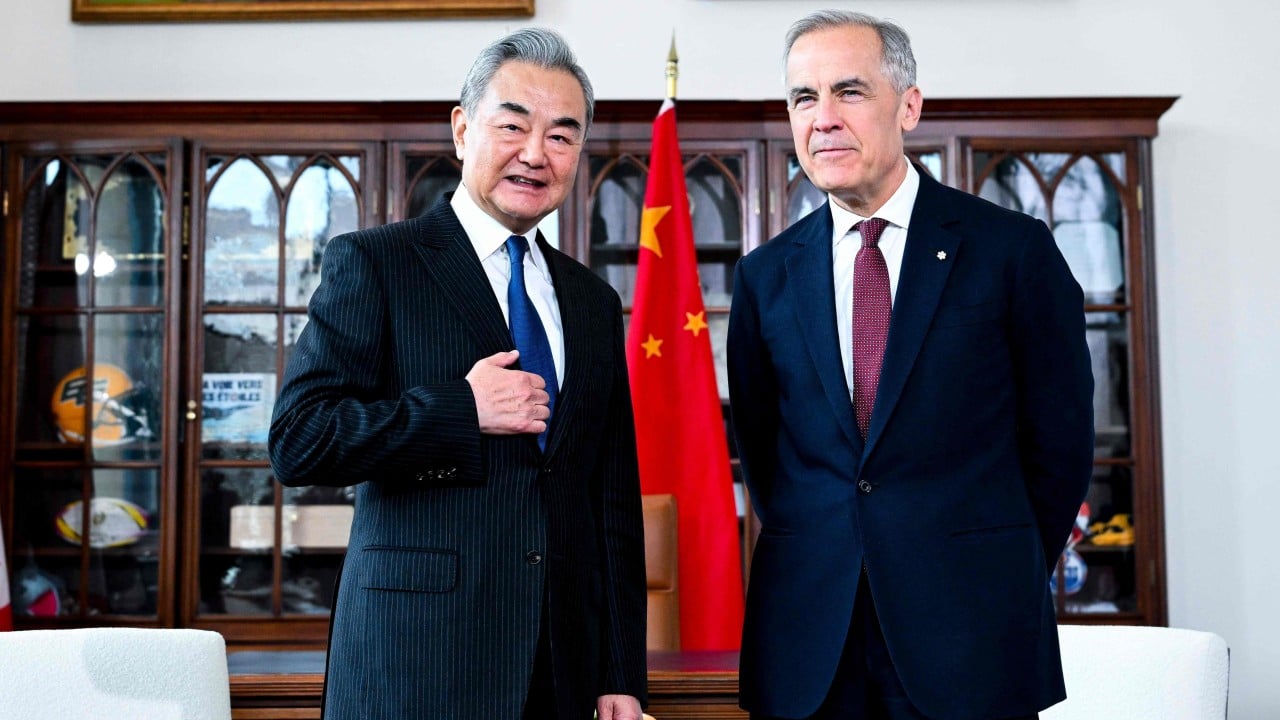
Canada is trying to walk an economic tightrope that might not exist anymore. Prime Minister Mark Carney is attempting a massive geopolitical balancing act, and the stakes couldn't be higher. In January, Carney jet-setted to Beijing, locking in a shiny new strategic partnership with Xi Jinping. He walked away promising a 50% surge in Canadian exports to China by 2030, along with a massive tariff drop on Canadian canola.
Then, just weeks later, Carney stood before the Economic Club of New York, pitching the exact opposite vibe. He pitched a "Canada Strong" message tailored to appeal directly to Donald Trump, reminding Americans that Canada supplies 60% of their crude oil imports and buys more American goods than China, Japan, and Germany combined.
You can't have it both ways. Washington is actively locked in an intense trade war and views Beijing as its top economic adversary. Carney's attempt to cozy up to China while trying to save the United States-Mexico-Canada Agreement (USMCA) ahead of its mandatory July review is a high-risk gamble. It's a strategy that could completely backfire.
The Myth of Canadian Strategic Autonomy
Carney loves to talk about "strategic autonomy." He tells audiences that integration has been weaponized and that a country that cannot feed, fuel, or defend itself isn't truly sovereign. It sounds great in a speech. In reality, it ignores the sheer gravity of the Canada-US trading relationship.
Canada isn't a global island. It shares a continent with the world's largest economy. Carney has explicitly stated that Canada is actively diversifying away from the US by signing trade deals across the globe. He wants to double non-US exports within a decade.
But look at the math. You don't just replace your largest trading partner overnight. The United States is embedded in every single layer of the Canadian economy. Trying to forcefully pivot toward China to gain leverage against Washington is an incredibly dangerous game.
The Trump administration has already proven it doesn't tolerate side deals. Washington has already floated fresh 10% tariffs on trading partners over forced labor concerns. If Ottawa thinks it can build a parallel trade alliance with Beijing without facing immediate, punishing retaliation from the US, it's dreaming.
China Submerged Trade Footprint is Already Posing a Threat
The situation gets even trickier when you look at what Canada actually sells to China. Official export data tells one story, but Chinese import data reveals a completely different, much larger reality.
University of Alberta researchers recently highlighted a massive discrepancy in how the two countries track trade. In 2025, China reported buying $41.5 billion USD in goods from Canada. Meanwhile, official Canadian data only registered $24.4 billion USD in exports to China.
Where is that massive $17.1 billion USD gap coming from? It's gold.
Canada-China 2025 Trade Discrepancy (USD)
- China-reported imports from Canada: $41.5 billion
- Canada-reported exports to China: $24.4 billion
- Unreported Gap: $17.1 billion (65% explained by gold)
Gold alone explained the vast majority of the difference. Canada reported almost zero gold exports to China, yet Beijing reported over $11 billion USD in Canadian gold entering its borders.
This means Canadian commodities are already deeply flowing into China through global third-party hubs and intermediary trading desks. Canada's exposure to Chinese demand is far larger and more structurally embedded than Ottawa admits.
This hidden dependency makes Carney's public push for a 50% export increase look even more radioactive to American trade officials. Washington is actively trying to decouple from Chinese supply chains. Meanwhile, Canada's prime minister is busy signing deals to deepen ties in energy, clean tech, and agriculture with Beijing.
The Core Conflict Flashing in the USMCA Review
The immediate danger isn't a decade away. It's happening right now. The USMCA free trade agreement faces a mandatory review this summer. Trump has openly mused about the absolute worst-case scenarios for Canada, ranging from brutal across-the-board tariffs to wild rhetoric about annexation.
Carney's pitch to New York executives was simple: American industries need Canadian resources to survive. He pointed out that Canadian aluminum exports are the energy equivalent of 10 Hoover dams. He noted that Canada provides 99% of US natural gas imports and 85% of its electricity imports.
He wants Americans to believe that "Canada Strong" helps make America great again.
But the Trump administration doesn't view trade as a win-win partnership. They view it as a scorecard. When Canada's trade minister, Dominic LeBlanc, heads to Washington for frozen trade talks, he's walking into a room where American officials are tracking every move Canada makes with China.
The US has roughly 30 outstanding industrial and trade disputes with Canada under the current agreement. While that's half of what Mexico is currently facing, it's plenty of ammunition for an aggressive US Trade Representative like Jamieson Greer to demand massive concessions.
If the US suspects that Canada is acting as a backdoor for Chinese goods, or if Carney's clean energy partnership with Beijing allows Chinese companies to bypass US tariffs via Canadian subsidiaries, the USMCA could face annual rolling reviews. That type of constant economic uncertainty would completely crush foreign investment in Canada.
What Canada Needs to Do Next
Carney's current strategy is trying to please everyone, and it's putting Canada's primary economic relationship in extreme jeopardy. Splitting the difference between Washington and Beijing is a luxury a mid-sized economy simply cannot afford right now. To protect its economic future, Ottawa needs to pivot immediately.
- Put the China Strategic Partnership on Ice: Pause the implementation of the January Beijing agreements. Pushing for a 50% export increase to China right before the USMCA review is absolute political suicide in Washington.
- Enforce Strict Rules of Origin: Prove to the US Trade Representative that Canada will not be used as a transshipment hub for Chinese steel, aluminum, or critical minerals.
- Leverage the AI Power Demand: Instead of selling critical minerals to global commodity markets where China buys them up, lock them into long-term supply guarantees with the US. Frame Canadian copper, nickel, and uranium as the exclusive fuel for America's exploding AI data center energy needs.
- Resolve the Section 232 Disputes: Focus LeBlanc's upcoming Washington negotiations entirely on securing permanent exemptions for Canadian steel and autos, rather than bragging about global diversification.
The idea that Canada can seamlessly juggle the world's two biggest superpowers is an illusion. The geopolitical floor has shattered. Carney needs to stop playing global statesman and start fiercely protecting the single trading relationship that actually keeps the Canadian economy alive.