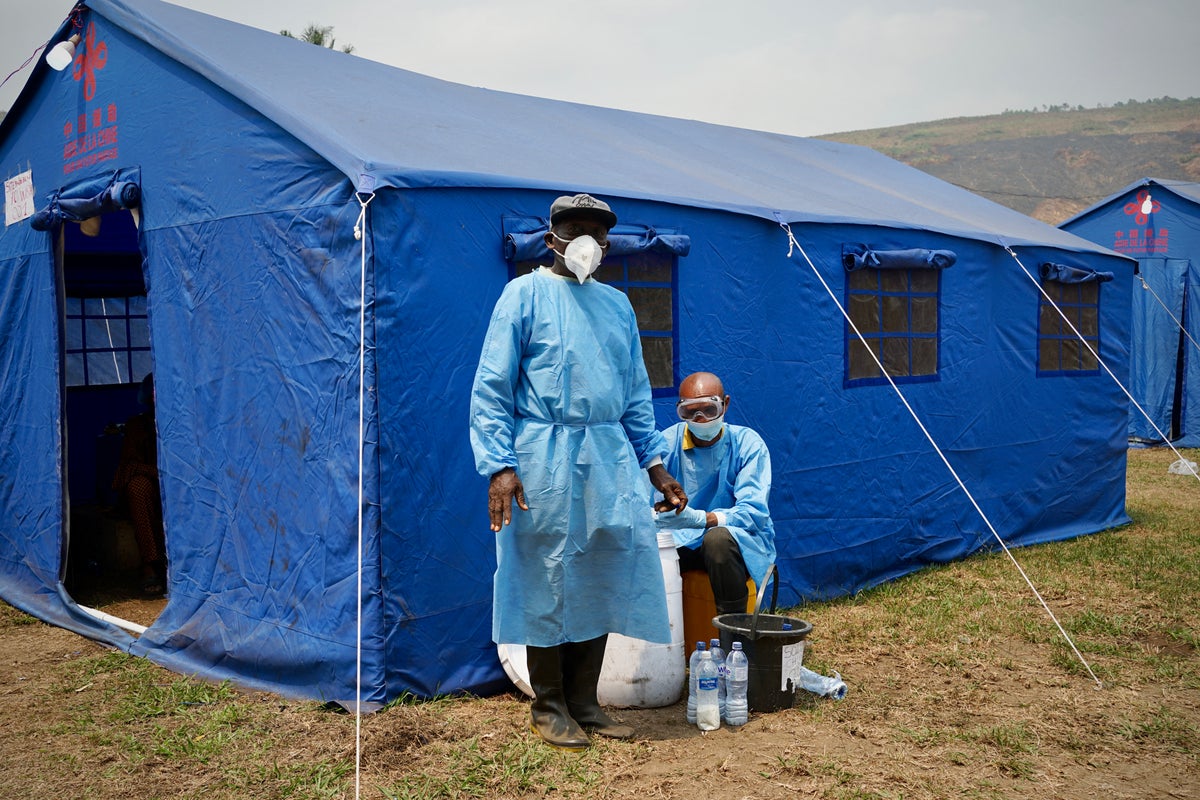
The dirt road outside Beni does not look like a frontline. To the casual eye, it is simply a ribbon of red clay winding between banana palms and corrugated iron roofs, choked with the dust of passing motorbikes and the chatter of children chasing hoops of bent wire. Life here persists with a fierce, stubborn rhythm. Women balance plastic basins of cassava on their heads. Men push bicycles laden with charcoal toward the morning market.
Yet, beneath the ordinary noise of daily survival, a quiet arithmetic is unfolding.
Listen closely. Sixty.
That is the number of distinct health zones now caught in the grip of an ancient adversary in eastern Congo. Two more zones have just fallen under the shadow. The numbers sound clinical, administrative, almost weightless when printed in a quarterly bulletin three thousand miles away. But numbers do not bleed. Numbers do not sit on the edge of a narrow cot in a hastily erected transit center, staring at a damp concrete floor, wondering if the fever shaking their bones is the beginning of the end.
Disease has its own geography. It does not march in uniform. It follows the invisible fault lines of human connection—a handshake at a roadside café, a shared bus ride down a rutted highway, a traditional mourning ritual where grief demands physical touch. Every time a new zone lights up on the epidemiologist's map, it represents a moment where human warmth became a vector of transmission.
Consider a hypothetical mother named Kanzu, living on the periphery of one of those newly breached zones. Kanzu is thirty-two, the mother of four, and she knows the forest better than any textbook. She knows which roots soothe a stomach ache and which mushrooms to avoid. But she has never seen a filovirus. She only knows that her youngest child, a two-year-old named Kambale with bright, curious eyes, woke up shivering, burning with a heat that water could not wash away.
When Kambale falls ill, Kanzu does what mothers everywhere do. She gathers him into her arms. She holds him against her chest, pressing her cheek to his forehead, whispering the old lullabies that have calmed generations of children through the worst of tropical fevers.
That embrace is an act of supreme love. It is also, in the cruel calculus of this outbreak, a moment of profound vulnerability.
This is the central tragedy of the eastern Congo epidemic. The very instincts that bind communities together—care, kinship, communal mourning, the desperate need to comfort the suffering—are weaponized by the virus. To fight it requires a complete inversion of human nature. It demands that we keep our distance when every fiber of our being tells us to pull closer. It demands that we surrender our dead to strangers in protective suits rather than washing them with our own hands.
Trust is fragile here. Why shouldn't it be? Decades of conflict have left deep scars across the hills of Kivu. Armed groups move through the mists of the Virungas. Promises made by distant capitals in Kinshasa often arrive broken, if they arrive at all. When teams of health workers step out of white Land Cruisers wearing rubber boots and chlorine sprayers, they do not always look like saviors to a weary population. They can look like an occupation. They can look like the bearers of bad news, or worse, the bringers of the plague itself.
Fear breeds rumor. Rumor breeds silence. And silence is the ecosystem in which the virus thrives.
If you want to understand why sixty zones are now affected, you cannot look solely at the virology. You have to look at the checkpoints. You have to look at the porous borders where traders cross rivers on wooden pirogues, carrying goods and invisible pathogens alike. You have to look at the overcrowded clinics lacking running water, where nurses work double shifts without gloves, trading their own safety because there is simply no one else to take the shift.
We talk about containment as if it were a switch to be flipped. It is not. It is hand-to-hand combat waged with contact tracing forms, infrared thermometers, and endless hours of conversation under corrugated tin roofs where community leaders drink lukewarm Fanta and listen to doctors explain why the old ways of burying the dead must change.
Every single link in the chain of transmission must be tracked down. Not by satellites, but by foot soldiers in flip-flops who walk into hostile villages, enduring suspicion and hostility, simply to ask: Who was coughing? Who helped wash the body? Who sat on the bench?
It is exhausting work. It is invisible work. And it is the only thing standing between a localized tragedy and a continental catastrophe.
The map in the coordination tent in Goma changes daily. Red pins multiply. The ink spreads. But behind every red pin is a kitchen where a pot of beans sits cold, a schoolyard missing a favorite runner, a family whispering in the dark about who might be next.
The fire is still moving. But so are the people trying to outrun it.
As the sun dips below the jagged silhouette of the Mitumba mountains, painting the sky in violent shades of violet and amber, the day shift changes. A nurse named Bahati washes her hands in a bucket of chlorinated water for the twentieth time. Her skin is raw, cracked at the knuckles, stinging from the bleach. She looks out across the courtyard toward the isolation ward, where the yellow glow of a single generator-powered bulb cuts through the gathering tropical night.
She picks up her clipboard, takes a deep breath, and steps back inside.