The air inside the clinic smelled of wet concrete, rusted iron, and the distinct, sharp tang of chlorinated water used to scrub floors that could never quite be trusted.
Dr. Mukendi did not look up when the radio crackled. He already knew what the voice from provincial headquarters would say. The static hissed, a harsh wave breaking against the silence of the room, and then the confirmation dropped like a stone into a well. The virus had crossed another border. It had breached a sixth province.
Six.
A number on a dashboard in Geneva. A terrifying reality in a dirt-floor treatment ward where the supply of clean gloves was measured in hours, not days.
Epidemiology texts will tell you that outbreaks follow mathematical curves. They talk about reproduction numbers, exponential growth, and vector mapping. But mathematics does not sweat through a heavy plastic apron in ninety-degree heat. Mathematics does not watch a mother hesitate at the threshold of a triage tent, her sick child cradled in her arms, weighing the terror of the unknown against the terrifying stories she has heard about what happens inside these walls.
To understand how an invisible enemy conquers territory, you have to look past the charts. You have to look at the roads.
Consider a hypothetical merchant named Jean-Paul, whose daily route represents the silent highways of transmission. Jean-Paul does not know he is carrying anything other than cassava flour and dried fish on the back of his battered truck. He stops at a bustling market in a border town, shares a gourd of palm wine with a cousin, trades jokes with a trader from the neighboring district, and sleeps under the stars. By the time Jean-Paul feels the first dull ache behind his eyes—the microscopic herald of a fever—he has already crossed three geographical zones. He has left a trail of breadcrumbs that viral hunters will spend weeks trying to connect.
This is how geography changes shape during an outbreak. Distances shrink. Borders dissolve. A local health crisis becomes a regional migration, tracked not by passports, but by symptoms.
Public health officials often speak of containment as a logistical puzzle. They list isolation units, contact tracing protocols, and cold-chain vaccine storage as if logistics alone can cage a beast that feeds on human touch. But disease is deeply social. It strikes at the heart of our most fundamental human instincts. When someone you love falls shivering onto a mat, your first impulse is not to quarantine them. Your impulse is to reach out, to pull them close, to wipe their brow, to hold a cup of water to their cracked lips.
The tragedy of the pathogen is that it weaponizes our compassion. Every instinct that makes us human—gathering to comfort the sick, honoring the dead with communal vigils, traveling to find safety or work—becomes the very mechanism of our undoing.
When the news broke that the outbreak had touched its sixth province, the immediate panic in the capital was palpable. Cable news anchors traded in superlatives, throwing around words like unprecedented and unstoppable. They sat in air-conditioned studios miles away, analyzing the failure of containment strategies.
They did not smell the bleach. They did not see the exhaustion etched into the faces of community health workers who had not slept for thirty-six hours.
True expertise in a crisis does not come from distant oversight; it comes from the dirt under your fingernails. It comes from recognizing that rumors travel faster than viruses, and are often twice as lethal. Weeks before the sixth province reported its first laboratory-confirmed case, the whispers had already arrived. Whispers of a curse. Whispers of foreign medicine that brings death instead of healing.
If you dismiss those rumors as ignorance, you have already lost the war.
Fear is a rational response to historical abandonment. When communities have spent generations ignored by central infrastructure, when the only time government or international aid workers show up is when a plague arrives, suspicion is the natural armor. Building trust is harder than manufacturing vaccines. It requires sitting on wooden benches for hours, listening to elders express grievances that have nothing to do with medicine and everything to do with dignity. It requires drinking tea you aren't sure is safe, simply because refusing it means building a wall between yourself and the people you came to save.
Dr. Mukendi knew this better than anyone. He had spent twenty years in the field, watching outbreaks flare, recede, and return like seasonal storms. He knew that containment is less about the syringe and more about the conversation.
Think about what happens in a contact-tracing interview.
A young epidemiologist sits across from a grieving widower. The investigator needs names, dates, locations, relationships. The widower needs to mourn. Every question feels like an accusation, an intrusion into sacred grief. The air thickens with tension. The investigator’s pen hovers over the notepad, trembling slightly—not from fear of the disease, but from the crushing weight of human sorrow.
How do you bridge that gap? You don't do it with policy manuals. You do it by lowering your pen, looking the man in the eyes, and acknowledging that the math on your paper can never capture the magnitude of his loss.
As the geographic footprint of the outbreak widens, the challenge shifts from medical intervention to systemic resilience. Each new province represents a different ecosystem of vulnerability. In one region, dense urban slums make physical distancing an impossible luxury. In another, dense rainforests and fractured roads mean that a single refrigerated vaccine vial must be carried on foot across rivers and mountain ridges by teams of dedicated porters who walk until the soles of their boots give out.
We like to think of human civilization as a fortress, insulated from the wild by technology and science. We draw lines on maps and call them borders, imagining they possess some mystical power to halt a microscopic strand of RNA.
The virus does not read maps.
It does not care about provincial boundaries, administrative districts, or geopolitical designations. It recognizes only the human pulse, the shared breath, the fragile interconnectedness of a species that spans a continent.
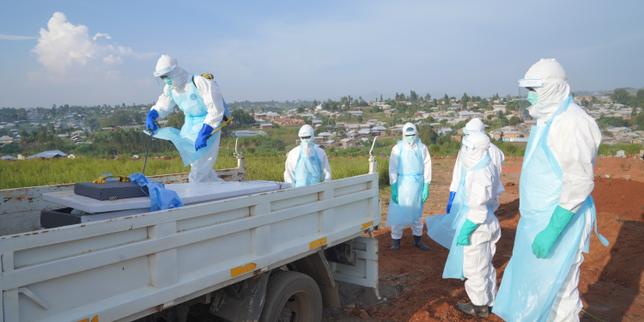
By late afternoon, the clinic courtyard began to quiet down, though the work inside never truly stopped. Dr. Mukendi stepped outside to let the cooling air hit his face, wiping a smear of dust and dried sweat from his forehead. Across the compound, a group of local volunteers were unloading crates of protective gear from a battered Land Cruiser, laughing quietly among themselves to ward off the creeping dread.
They were standing at the edge of the sixth province. They were staring down an enemy that had already proven its mobility, its resilience, and its utter indifference to human suffering.
Yet, as the sun dipped below the horizon, painting the sky in shades of bruised purple and gold, the courtyard did not empty. The volunteers stayed. The doctors stayed. The families outside the gates waited, watching the warm glow of the clinic windows pierce the gathering dark.
The map was changing, bleeding red into new territories. But against that vast, quiet terror, someone inside struck a match, lit a kerosene lamp, and went back to work.