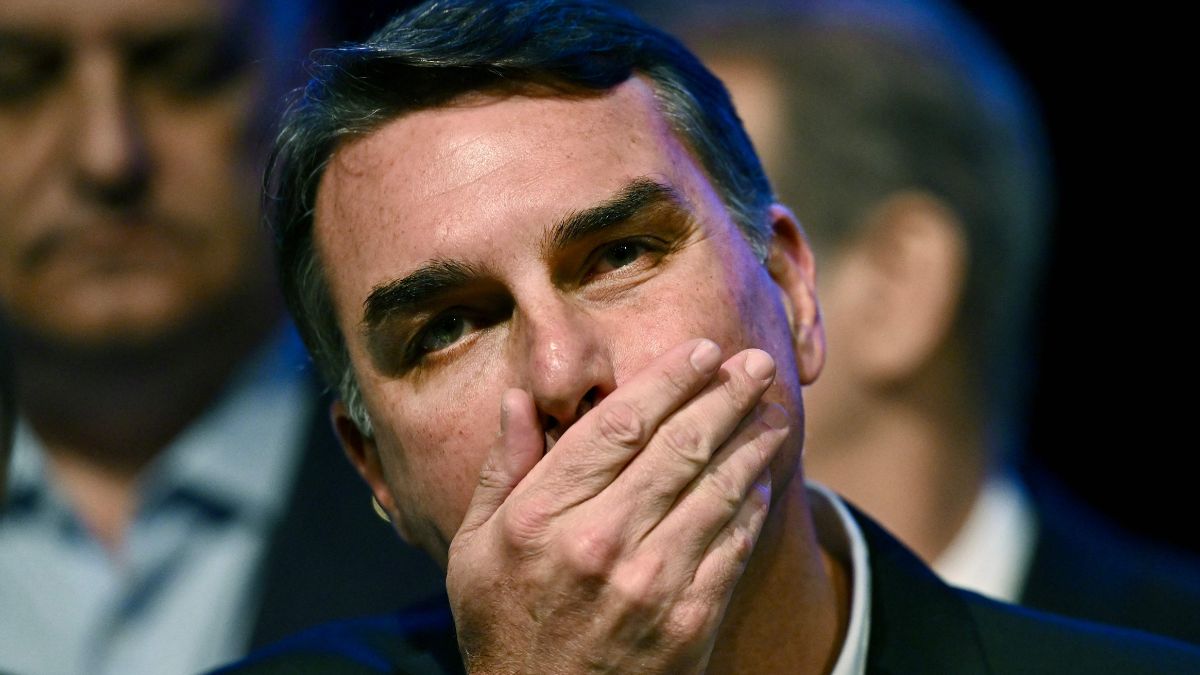
The cabin of a commercial airliner at thirty-five thousand feet is a peculiar purgatory. Outside the thick acrylic window, there are no borders, no ballot boxes, and no supreme court dockets. There is only the hum of pressurized air and the slow, steady burn of jet fuel carrying you away from the noise.
For Flávio Bolsonaro, the eldest son of Brazil’s former president Jair Bolsonaro, that hum became the soundtrack to a profound political reckoning. When reports surfaced that the Brazilian senator had landed in the United States, carrying the tacit political blessing of Donald Trump’s orbit in the wake of electoral defeat, the headlines read like standard diplomatic wire copy. Flight paths. Political alliances. Post-election maneuvers.
Dry. Clinical. Incomplete.
To understand why a powerful sitting senator steps off a plane onto American soil after his family’s political dynasty suffers a stinging loss at the ballot box, you have to look past the departure lounge. You have to understand the specific, suffocating gravity of losing power in a country where politics is never just a career. In Brazil, losing an election does not mean retiring to write a memoir or joining a corporate board. It means watching the walls of your fortress turn to glass overnight.
The Architecture of a Sudden Fall
Consider a hypothetical scenario to grasp the sheer psychological whiplash of this transition. Imagine spending four years inside the highest rooms of a national palace, where every phone call is answered on the first ring and every legal inquiry stops politely at the front gate. Then, on a single Sunday evening in October, a digital tally ticks past fifty percent in the wrong direction. By Monday morning, the security detail shrinks. By Tuesday, the judges you once publicly mocked are scheduling hearings. By Wednesday, your allies are suddenly too busy to take lunch.
That is not fiction. That is the exact atmospheric pressure that descended upon the Bolsonaro family after the 2022 presidential election in Brazil, when Luiz Inácio Lula da Silva reclaimed the presidency by a razor-thin margin of less than two percentage points—roughly two million votes out of more than 124 million cast.
I have watched political dynasties crumble from the press galleries of Brasília, and the sound is never an explosion. It is a slow, rhythmic clicking of doors locking from the outside. When Jair Bolsonaro boarded a military plane to Orlando, Florida, just days before his presidential term officially expired at the end of December 2022, he was breaking a decades-old democratic tradition of handing the presidential sash to his successor. He was also establishing a blueprint.
Florida, and the broader United States, had become something far more vital than a vacation destination for Brazil’s embattled right wing. It had become an ideological sanctuary.
Flávio Bolsonaro’s arrival in the United States, framed around the warmth and approval of Donald Trump’s political ecosystem, follows that exact flight path. Yet his journey carries its own distinct weight. Unlike his father, who left office as a private citizen stripped of executive immunity, Flávio remained a sitting senator from Rio de Janeiro—a man still holding the foro privilegiado, the special legal standing that requires Brazil’s Supreme Federal Court to oversee any criminal proceedings against members of Congress.
Why, then, does a man who still holds formal power in Brasília seek refuge and validation thousands of miles away in North America?
Two Dynasties, One Mirror
To answer that, you have to understand the strange, symbiotic mirror that has formed between the American populist right and its Brazilian counterpart over the last decade.
When Donald Trump won the White House in 2016, he inadvertently drafted an operating manual for political outsiders across the Western Hemisphere. Two years later, in 2018, Jair Bolsonaro—a former army captain who had spent twenty-seven years as a relatively marginal congressman—picked up that manual and rode a wave of anti-establishment fury all the way to the Palácio do Planalto. His sons—Flávio, Carlos, and Eduardo—became the architects, enforcers, and digital megaphones of that movement.
Trump famously dubbed Jair Bolsonaro the "Trump of the Tropics." It was a nickname the family wore like a coat of arms.
When both men lost their bids for re-election—Trump in 2020, Bolsonaro in 2022—their responses echoed across continents with eerie precision. Both questioned the integrity of their nations' voting systems. Both rallied furious crowds who refused to accept the legitimacy of the incoming administrations. And when the dust settled, both movements found themselves facing the sharp edge of institutional accountability.
In Brazil, that accountability arrived swiftly. In June 2023, Brazil’s Superior Electoral Court voted 5–2 to bar Jair Bolsonaro from running for public office until 2030, ruling that he had abused his political power and misused state media to cast baseless doubts on the country’s electronic voting machines. Meanwhile, investigations into the January 8, 2023 riots—when thousands of Bolsonaro supporters stormed and ransacked the Congress, the Supreme Court, and the presidential palace in Brasília—tightened the legal net around the former president’s inner circle.
For Flávio Bolsonaro, the political ground beneath Rio de Janeiro and Brasília had shifted violently.
The Weight of the Name
People often confuse the Bolsonaro brothers, treating them as interchangeable extensions of their father’s loud, confrontational persona. That is a mistake.
While Eduardo positioned himself as the globe-trotting ideological warrior—frequenting conservative conferences from Budapest to Washington—and Carlos operated as the volatile master of the family’s social media warfare, Flávio was always meant to be the pragmatist. He was the eldest. The dealmaker. The one who wore well-tailored suits, cultivated relationships with traditional center-right politicians in the Centrão, and sought to translate street-level populism into durable institutional power.
Yet being the pragmatist in a family defined by permanent combat is an exhausting, precarious balancing act.
For years, Flávio lived under the shadow of the rachadinha scandal—allegations dating back to his time as a state lawmaker in Rio de Janeiro, accusing him of skimming salaries from ghost employees on his legislative staff. Though Brazil’s Superior Court of Justice eventually annulled key evidence in the case on procedural grounds in 2021, effectively stalling the prosecution, the episode left a permanent scar. It taught Flávio a visceral lesson about the fragility of legal survival in Brazil.
When you lose the presidency, you lose the ability to set the national agenda. You lose the power to appoint judges, steer federal police leadership, or shield allies from parliamentary inquiries. Suddenly, every past controversy is fair game. Every political rival smells blood in the water.
Landing in the United States with the approval of Donald Trump does not erase a single legal docket in Brasília. American political backing carries zero jurisdiction over a Brazilian Supreme Court justice. So why does it matter so deeply?
Because in modern populist politics, legitimacy is an international currency.
The Invisible Stakes of the Exile Strategy
Think of political survival like keeping a fire alive during a monsoon. If you stay in the open rain—surrounded by hostile courts, critical media, and demoralized local allies—the flames eventually drown. To keep the embers glowing, you have to move them under a roof until the weather changes.
For the Bolsonaro movement, the United States—and specifically the political orbit surrounding Donald Trump—serves as that roof.
By stepping onto American soil and aligning visibly with Trump’s political machine, Flávio accomplishes three distinct objectives that would be nearly impossible to achieve from a quiet senate office in Brasília.
First, he signals to his base back home that the movement is not dead; it is merely regrouping on a global stage. When millions of conservative voters in São Paulo, Rio de Janeiro, and the agricultural heartland of Mato Grosso see a Bolsonaro welcomed in the United States with the blessing of the most powerful figure in American conservatism, the narrative shifts. Defeat in Brazil is reframed not as a rejection by voters, but as a temporary setback in a larger, international struggle.
Second, proximity to Trump offers a form of diplomatic leverage. During Trump’s first presidency, and throughout his subsequent political resurgence, the American leader repeatedly demonstrated a willingness to use his platform—and the weight of American political pressure—to champion ideological allies abroad. For Brazilian politicians watching from afar, an endorsement or even a warm handshake from Trump’s circle serves as a subtle warning to Brasília: We are watching, and we have friends in high places.
Third, and perhaps most humanly, distance buys time and oxygen.
I remember speaking once with a former Latin American cabinet minister who spent eighteen months in self-imposed exile in Miami after a fierce political transition in his home country. What struck me most wasn't his anger at his political enemies; it was his exhaustion. He described the constant, low-grade paranoia of living in a capital city where every waiter might be recording your dinner conversation and every morning newspaper brings a fresh leak from a prosecutor’s office. Stepping off a plane in Florida, he told me, felt like taking off a fifty-pound vest he hadn't realized he was wearing.
It is easy to analyze political figures purely as chess pieces moving across a map. We forget that they are also human beings reacting to fear, humiliation, and the sudden loss of control. Flávio Bolsonaro watched his father go from the undisputed commander-in-chief of South America’s largest democracy to a legally disqualified figure fighting to stay out of prison. Watching that unfold from the front row changes how you calculate risk.
The Trap of Distance
Yet history is ruthless to politicians who stay away from home too long.
There is a classic, recurring flaw in the exile strategy, one that has undone leaders from Buenos Aires to Caracas over the past century. When you leave the battlefield to seek validation abroad, you surrender the daily, unglamorous work of local politics to the people who stayed behind.
While Flávio courts allies in North America and basks in the reflected glow of Donald Trump’s approval, the Brazilian right is not sitting still. New figures are rising to fill the vacuum left by Jair Bolsonaro’s ineligibility. Governors like Tarcísio de Freitas in São Paulo—a former infrastructure minister under Bolsonaro who has carefully cultivated a more moderate, technocratic image—are quietly positioning themselves as the viable future of Brazilian conservatism.
In politics, absence rarely makes the heart grow fonder. More often, it makes the voters look for someone who is actually in the room.
There is also the risk of misreading American politics itself. Donald Trump’s support is famously transactional and fiercely focused on his own immediate battles. Relying on Washington or Mar-a-Lago as a political lifeline means tying your fate to the volatile tides of another country’s domestic turmoil. What looks like an unbreakable alliance in an airport arrival hall can quickly become a footnote when American priorities shift elsewhere.
The View From the Terminal
Still, standing at the edge of this moment, it is impossible to ignore the sheer audacity of the maneuver.
Modern politics has broken free from its old geographic cages. A senator from Rio de Janeiro can lose an electoral battle in South America, board an overnight flight north, and instantly plug himself into an American political network that amplifies his relevance back home. Borders still exist on paper, stamped neatly into diplomatic passports, yet the battle for narrative control happens in an open, borderless stream of images, endorsements, and perceived alliances.
Flávio Bolsonaro’s arrival in the United States is neither a permanent retreat nor a triumphant return. It is a pause between storms.
Somewhere between the humid, relentless political heat of Brasília and the manicured, air-conditioned certainty of American conservative circles, a political dynasty is trying to figure out how to survive its own twilight. The suitcases are unpacked. The handshakes have been photographed. The signals have been sent across two continents.
Now comes the hardest part for any politician who has flown away from a lost crown: figuring out what happens when the applause fades, the flight back south is called, and you have to walk through customs alone.


