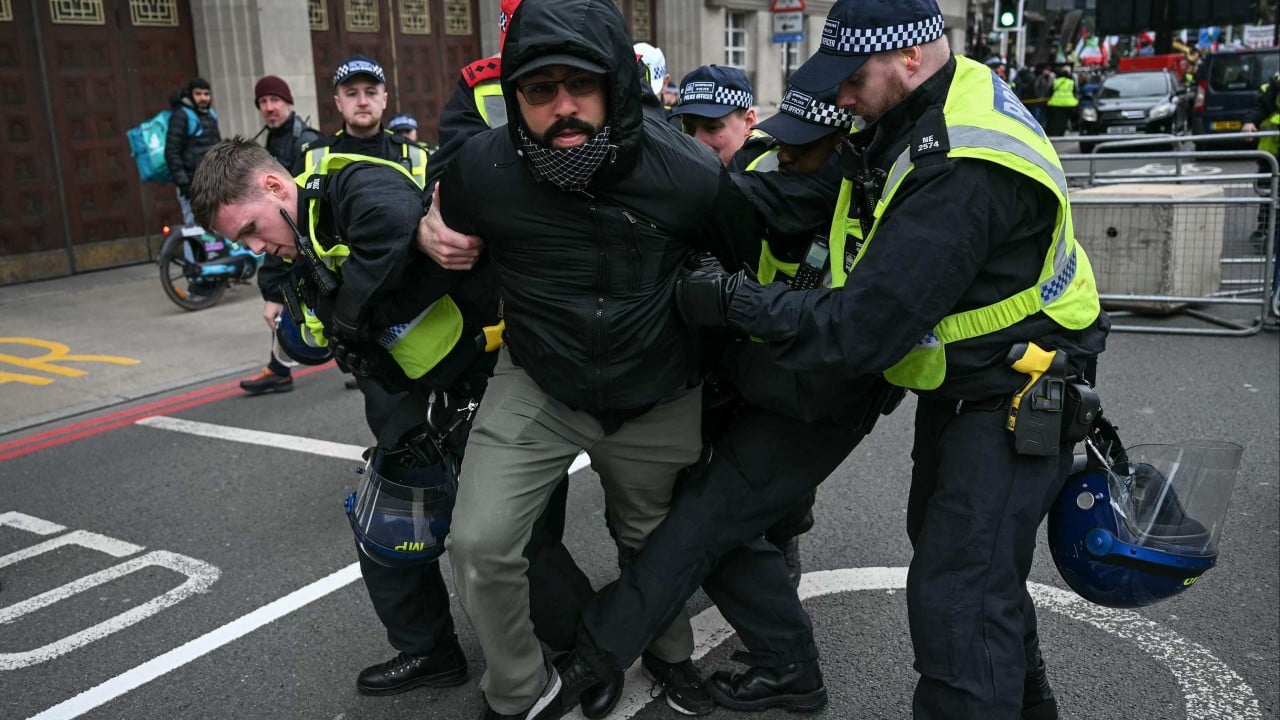
The headlines are predictable. Twelve arrests. Hundreds of defiant marchers. A city held hostage by "banned" ideologies. The mainstream narrative treats these events like a morality play where the Metropolitan Police are the thin blue line between order and total anarchy.
They’re wrong.
The media focuses on the scuffles. They obsess over the number of boots on the ground. They miss the structural reality: banning a march is the most effective way to ensure it becomes a permanent, unmanageable fixture of urban life. We are watching a live demonstration of the "Streisand Effect" applied to civil engineering, and the bill—both financial and social—is coming due.
The Myth of the "Effective Ban"
A ban is not a disappearance. In the context of modern protest, a ban is a promotional campaign. When the Home Office or the Met decides a specific route or gathering is "illegal," they aren't stopping the sentiment; they are merely decentralizing the chaos.
I have watched public order strategies evolve for two decades. The logic used to be "contain and bleed"—allow the energy to dissipate in a controlled space. Now, the strategy is "confront and scatter." By banning the organized march, the police trade a predictable, stewarded line of movement for a fragmented, unpredictable swarm.
Twelve arrests in a crowd of hundreds is not a victory. It is a rounding error. It signals that the risk-to-reward ratio for breaking the law has shifted entirely in favor of the protester. If you can defy a direct order from the Commissioner and walk away without a charge, the law isn't a barrier. It's a suggestion.
The Operational Bankruptcy of "Section 12"
The police love to cite Section 12 or Section 14 of the Public Order Act. They treat these like magic spells that grant them absolute control. In reality, these powers are the ultimate admission of operational bankruptcy.
When you invoke a ban, you admit that your intelligence, your community policing, and your crowd control tactics have failed. You are reaching for the "nuclear option" because you can no longer manage the baseline.
- Predictability: An authorized march has a start, a middle, and an end.
- Logistics: You know exactly how many portable toilets, barriers, and officers you need.
- Liability: The organizers carry the burden of safety.
The moment you ban it, you own the entire mess. Every side street becomes a potential flashpoint. Every officer is now a reactive agent instead of a proactive guide. The Met is burning through millions of pounds in overtime not to "keep the peace," but to play an expensive game of Whac-A-Mole that they are statistically guaranteed to lose.
The False Equivalence of Arrest Counts
The public is conditioned to look at arrest numbers as a metric of success. This is a fundamental misunderstanding of public order policing.
Arrests are often a sign of tactical failure. In a perfectly managed protest, the arrest count is zero because the friction never reaches the point of physical intervention. An arrest is a resource drain. It takes two officers off the line for hours to process one individual. If you arrest twelve people, you’ve effectively neutralized twenty-four officers for a significant portion of the shift.
In the London protests, the arrests are frequently for "breach of peace" or "obstructing a highway." These are low-level offenses that clog the courts and rarely result in meaningful deterrence. We aren't seeing the removal of dangerous agitators; we are seeing the performative theater of "doing something."
Why the "Banned" Label is a Gift to Activists
If you want to radicalize a moderate, tell them they aren't allowed to walk down a public street.
The "lazy consensus" suggests that banning a pro-Palestinian march (or any march) keeps the public safe. The counter-intuitive truth? It validates the most extreme elements of the movement. It allows them to frame their cause not just as a geopolitical grievance, but as a fight for domestic civil liberties.
I’ve sat in briefings where the "optics" were debated more fiercely than the logistics. The moment the police declare a march illegal, they hand the organizers a megaphone. They transform a repetitive Saturday afternoon walk into a high-stakes act of "resistance."
Consider the math of attention. A legal march gets a 30-second clip on the evening news. A "banned" march that results in a standoff gets a 24-hour cycle of live-tweeting, viral TikToks, and international headlines. The police are effectively acting as the marketing department for the very groups they are trying to suppress.
The Economic Delusion of Public Order
Let’s talk about the money. The Met is currently operating on a deficit that would bankrupt a small nation. Every time a "banned" march happens, the cost-per-protester skyrockets.
Imagine a scenario where the city simply stopped trying to micromanage the optics. If the march happened, blocked traffic for three hours, and dispersed, the cost would be negligible. Instead, we have "Special Operations" pricing. We have intelligence units, drone surveillance, and thousands of officers in riot gear.
We are spending £20 million to prevent £200,000 worth of inconvenience.
This isn't about safety. It’s about the preservation of an image of control that hasn't existed since the invention of the smartphone. The status quo is a sunk-cost fallacy. We keep banning protests because we've already spent so much money saying we would, even though every metric shows that the bans make the city less stable.
The Hidden Cost: Erosion of Consent
British policing is built on the principle of "policing by consent." This isn't just a fluffy catchphrase; it’s the structural foundation of the force. When the police are viewed as the enforcement arm of a political ban, that consent evaporates across the board.
It’s not just the protesters who lose faith. The "silent majority" that the government claims to be protecting sees the chaos on the news and concludes the police are incompetent. The protesters see the police as the enemy. The officers on the ground see themselves as political pawns.
Nobody wins.
The "fresh perspective" that no one wants to admit is this: The most effective way to handle a controversial march is to ignore it. Give them the permit. Let them walk. When you remove the friction of the "illegal" tag, you remove the oxygen that feeds the fire.
Stop Asking "How Do We Stop It?"
The question itself is flawed. You don't "stop" a mass movement in a democratic society through administrative bans. You might as well try to ban the tide from coming in.
Instead of asking how to stop the march, we should be asking why we are so terrified of 500 people with placards that we are willing to suspend the rule of law and bankrupt the police force to hide them from view.
The disruption to London isn't caused by the protesters. It is caused by the state's allergic reaction to them. We are stabbing ourselves in the leg to prove we can feel pain.
The current strategy is a cycle of escalation that serves only the extremists and the pundits. It does nothing for the residents of London, and it certainly does nothing for the "public order" it claims to uphold.
The next time you see a headline about "police arresting 12 at a banned march," don't see it as a victory for the law. See it as a receipt for a massive, taxpayer-funded failure of imagination.
The law was broken, but the strategy was already shattered.
Stop trying to fix the protest. Fix the policing. Better yet, stop pretending that a ban is anything more than an expensive invitation to a riot.