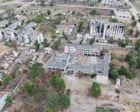
A local ceasefire in Oleshky sounds like mercy. It isn't. It is a transaction.
Read the standard coverage of any truce in southern Ukraine and you get the same comforting script. Exhausted civilians. Desperate shortages. Diplomats or local commanders carving out a quiet window so flour, insulin, and generators can cross a shattered front line. The headline frames it as a moral breakthrough amid a deepening humanitarian crisis. In similar developments, we also covered: Anatomy of a Prosecutorial Collision Over False Statements to Congress.
That framing is lazy. Worse, it is dangerous.
In modern positional warfare along the Dnipro River basin, a localized pause is rarely born out of sudden compassion. It happens when two opposing sides calculate that a temporary freeze serves their immediate operational, political, or logistical math better than firing at that exact stretch of riverbank. Calling a tactical pause a humanitarian victory confuses the symptom with the cause—and ignores who actually writes the rules when the shooting stops. TIME has analyzed this important issue in great detail.
The Lazy Consensus Around "Humanitarian Truces"
The lazy consensus assumes a simple sequence: crisis worsens, pressure mounts, ceasefire holds, civilians get relief. Everything flows neatly from human need.
Anyone who has spent years analyzing conflict logistics, civil-military coordination, or frontline supply chains knows reality does not move in straight lines. I have watched aid agencies and political planners pour millions of dollars and months of diplomatic capital into localized pauses only to see convoys stalled at checkpoints, water pumps left without spare parts, or front lines hardened into concrete before a single pallet reaches the people who need it most.
To evaluate a truce in a place like Oleshky—a town sitting on the left (east/south) bank of the Dnipro across from Kherson, exposed to artillery, drone surveillance, and riverine friction—you have to separate three distinct concepts that commentators routinely mash together:
- A ceasefire: A temporary suspension of armed hostilities over a defined area and timeframe, usually negotiated through tacit signaling, local intermediaries, or third-party guarantees rather than a comprehensive peace treaty.
- Humanitarian access: The legal and physical ability of relief actors to reach affected populations safely, impartially, and without obstruction—not merely the existence of a quiet afternoon.
- Humanitarian relief: The actual delivery of life-sustaining goods and services (food, clean water, medical care, shelter, evacuation) that measurably reduces mortality and suffering.
A ceasefire can exist without humanitarian access. Access can exist without meaningful relief. When reporters treat a local pause as proof that aid will automatically flow, they hand over free credibility to actors whose primary incentives are military or administrative control.
Why Geography and Military Math Dictate Every Pause
War does not pause in a vacuum. It pauses where terrain, ammunition stocks, weather, and reconnaissance intersect.
Along the lower Dnipro, geography is unforgiving. Wide channels, marshland, floodplains, and ruined crossings turn every movement into a targeting problem. Short-range FPV drones, loitering munitions, and counter-battery fire punish anyone who exposes vehicles, boats, or repair crews on open roads or water. A localized ceasefire along a sector like Oleshky immediately alters the risk calculus for both sides.
Consider what a quiet window actually buys in an active riverine theater:
- Force preservation and rotation: Exhausted infantry, drone teams, and artillery crews can resupply, swap out, or reposition without drawing immediate fire during the window.
- Reconnaissance and fortification: Even when kinetic strikes stop, observation doesn't. Engineers and spotters can assess damage, clear debris, or adjust positions.
- Information leverage: Announcing or accepting a local pause lets a side project restraint, blame the opponent for any violation, or claim credit for civilian survival while shifting pressure elsewhere.
Imagine a scenario where two commanders agree to a 48-hour quiet period around Oleshky to allow emergency water and medical deliveries. On paper, civilians win. In practice, if neither side agrees on verification rules, drone loitering zones, or safe corridors outside the immediate pocket, a single stray mortar or disputed drone strike collapses the pause by hour six—leaving civilians in the open and giving both sides a propaganda talking point about who "broke" the agreement.
That is not a cynical theory. It is a recurring pattern across modern urban and riverine conflicts.
The Questions Nobody Asks About Oleshky and Similar Fronts
When a local ceasefire makes news, readers usually search for comforting answers to predictable questions. Most of those questions start from the wrong premise.
"Does a local ceasefire mean the humanitarian crisis in Oleshky is easing?"
No. A pause in active shelling does not repair a shattered municipal grid overnight. A humanitarian crisis in an occupied or contested frontline town is structural: damaged electrical substations, contaminated or unreliable water supply, scarce specialized medicine, restricted movement, economic collapse, and psychological exhaustion.
A few truckloads of food or a brief lull in incoming fire treats acute deprivation for days, not structural collapse for months. Calling a truce a turning point when hospitals still lack power, fuel, and staff misleads the public about what survival actually requires.
"Why do warring sides agree to local ceasefires if they still want to win?"
Because tactical restraint is a tool of war, not its opposite. As military theorists from Carl von Clausewitz onward have argued, war is an instrument of policy governed by political and strategic calculation, while modern conflict analysts—such as Mary Kaldor on the political economy of war and Hugo Slim on humanitarian ethics in armed conflict—have repeatedly shown how armed groups manipulate aid, access, and ceasefires to consolidate control and legitimacy.
If a local freeze conserves scarce munitions, reduces friendly losses in an exposed sector, or lets a force stabilize a difficult frontline without conceding strategic ground, agreeing to it is rational self-interest.
"Who really benefits most from a localized truce?"
Whoever controls the ground, the checkpoints, and the distribution narrative once the cameras turn away.
If aid enters under tight military supervision, local authorities or armed actors can decide who gets supplies, who gets left out, and how distribution is framed. Even well-intentioned relief can inadvertently subsidize a garrison's logistics or relieve an occupying administration of the cost of feeding and caring for civilians under its control.
What Actually Works Instead of Wishful Ceasefire Hype
If you care about civilians caught in a place like Oleshky—or if you are trying to read frontline news without getting played—stop cheering announcements and start demanding operational specifics.
Here is what separates real humanitarian progress from diplomatic theater:
- Insist on verified terms, not vague promises. A real local pause specifies exact geographic boundaries, start and end times, permitted vehicle types, drone-free buffers, and neutral monitoring. Without those details, "ceasefire" is just a headline.
- Prioritize dual-use infrastructure over photo-op shipments. Ten trucks of canned goods make great footage; generators, water-treatment chemicals, pumps, insulin, and medical consumables keep people alive after the convoy leaves.
- Track civilian exit and evacuation corridors separately from aid entry. Sometimes the safest humanitarian outcome for vulnerable residents—elderly people, patients, families with children—is voluntary, safe passage out of the fire zone, not staying put under a fragile truce.
- Audit the chain of custody. Ask who inspects shipments, who runs distribution points, and whether aid reaches the most isolated neighborhoods rather than just the easiest ones to film.
The Blind Spots of This Contrarian View
Being contrarian does not make you infallible. Pushing hard against "ceasefire optimism" carries real risks of its own.
First, cynicism can slide into fatalism. Even a flawed, short-lived pause can save lives if a surgeon gets supplies, a trapped family gets out, or a water main gets patched before winter sets in. Dismissing every truce as "just a military trick" ignores the concrete difference a quiet day makes to someone hiding in a basement.
Second, demanding airtight diplomatic verification before welcoming relief can set an impossible bar in chaotic war zones. Local arrangements between commanders on the ground are often messy, informal, and fragile precisely because formal agreements are politically toxic at higher levels. Perfect is the enemy of surviving the week.
The goal is not to sneer at every attempt to lower the violence. The goal is to stop mistaking a temporary tactical pause for a solution to a war.
Watch what moves on the ground, not what gets promised on a statement.