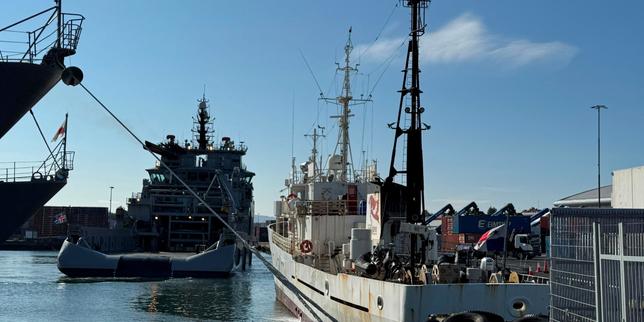
The coffee in the paper cup grew cold long before the horizon turned the color of bruised steel. Standing on the pier in Reykjavík, the wind had a way of cutting straight through heavy wool, finding the spaces between ribs, reminding everyone present that this northern latitude does not forgive the unprepared.
We were waiting for a ship that had become an idea.
Months earlier, the name Paul Watson carried a specific kind of gravity across the docks. To some, it was a rallying cry written in spray paint and salt spray, a promise that the giants of the deep would not go quietly into the industrial night. To others, particularly those whose livelihoods depended on the rhythmic machinery of the hunt, it was a disruption, an external imposition of morality from people who never had to clean a harpoon or balance a seasonal ledger in Icelandic krónur.
Then came the order.
Twenty-one activists, bound to the philosophy of the Captain Paul Watson Foundation, found their paperwork scrutinized, their temporary stays revoked, and their presence declared incompatible with the public order of a nation that sits uneasily between ancient tradition and modern global scrutiny.
Paperwork. It sounds so bureaucratic. So dry. A few lines of ink on an official decree issued by the Ministry of Justice, stating that twenty-one human beings must pack their bags, leave their berths, and catch the next flight south. But behind every administrative stamp is a collision of worlds. On one side stands the state, armed with sovereignty, maritime laws, and the heavy inertia of legal precedent. On the other stand individuals who believe that the legal boundaries of nations matter very little when the biological boundaries of the planet are dissolving.
Consider the human cost of a deportation order that never makes the evening news. It is not just about boarding a plane. It is the sudden halt of conversations over steaming bowls of fish soup in local cafés. It is the dismantling of makeshift planning stations where maps of the North Atlantic were pinned to corkboards with red string connecting Reykjavík to the invisible coordinates of whaling vessels. It is the quiet humiliation of being escorted through terminals by officials whose job is simply to enforce the distance between a conviction and a coast.
To understand why twenty-one people could cause such friction in a country with a population smaller than a modest European suburb, you have to look backward.
Whaling in the North Atlantic is not a casual enterprise. It is stitched into the historical memory of Icelanders who survived centuries of isolation by looking to the ocean for calories and survival. When modern industrial vessels leave port to hunt fin whales, they carry the ghost of that survival with them. That is the argument from the dockside tavern, where old salts speak quietly of independence, of foreign interference, and of a people's right to manage their own waters without actors from abroad dictating the terms of ecological ethics.
We decide our own relationship with the sea, the argument goes.
And they are right, formally speaking. International law grants sovereign states immense latitude over their territorial waters and domestic commerce. When the Icelandic government acts to expel foreign nationals who organize direct action against domestic industries, it is exercising a classic definition of statecraft.
Yet law and legitimacy are rarely identical twins.
Walk down any street in downtown Reykjavík today, and you will hear whispered debates that never reach the floor of the Althing. Younger Icelanders, fluent in global climate anxiety and digital connectivity, look at the hunting quotas with a growing sense of generational alienation. For them, the image of a harpooned whale is not a symbol of ancestral resilience; it is an embarrassing postcard from the past, a relic of an economy that should have evolved alongside the booming whale-watching tourism industry that now brings millions of travelers to Faxaflói bay.
The twenty-one activists were merely the physical manifestation of this internal cultural fracture. They did not create the division; they accelerated it. By putting their bodies on the line—or attempting to, before the state stepped in—they forced a society to look in the mirror and ask a brutal question: What do we actually value more, the preservation of a polarizing tradition or the preservation of a global reputation?
Governments hate that question. It cannot be answered with a simple budget line or a diplomatic communiqué. It requires soul-searching, and states are notoriously bad at introspection.
When the deportation orders were finalized, the official rationale was framed around public safety and the prevention of unlawful interference with legal commercial operations. From the perspective of the Ministry of Justice, the calculus was straightforward. Foreign nationals entering the country to disrupt a permitted, albeit controversial, commercial sector represent a liability. They draw protests, they tax police resources, and they create diplomatic headaches with trading partners.
Logical? Yes. Efficient? Absolutely.
But efficiency often misses the emotional undercurrent that makes these conflicts so intractable.
The activists arriving under the banner associated with Paul Watson operate on a different temporal scale. They do not think in election cycles or quarterly financial reports. They think in evolutionary time. To them, a fin whale is a sentient elder of the marine ecosystem, an organism whose removal ripples through the trophic web in ways science is only beginning to map. When you reduce that worldview to a visa violation, you miss the entire point of why those twenty-one individuals bought one-way tickets to the edge of the Arctic Circle in the first place.
They were not there to fill out immigration forms correctly. They were there to make a noise so loud that the sea could no longer be exploited in silence.
The irony, of course, is that expulsion often amplifies the message it is meant to silence. A deportation order is a megaphone disguised as a punishment. By forcing the activists out, the Icelandic state drew international headlines back to a whaling season that might otherwise have passed with quiet indifference in foreign media markets. Every news outlet from Paris to Tokyo suddenly had to explain why twenty-one people were being shown the door, which meant explaining what those people were trying to stop.
That is the paradox of state power in the digital age. You can control your borders, but you cannot contain a narrative once it hits the water.
In the final accounting, the twenty-one left on scheduled flights. Their gear was packed into nylon duffels, their passports stamped with administrative finality, their boots carrying the scent of volcanic ash and harbor mud out through the security gates of Keflavík International Airport. The docks grew quiet again. The gulls resumed their wheeling circuits above the grey water.
Yet the tension remains suspended in the salt air, waiting for the next tide, waiting for the next ship, waiting for the moment when a country must finally decide whether its future lies with the ghosts of the old hunt or the uncharted currents of a changing world.