The mainstream media is addicted to the narrative of fragility. They see a prime minister resign and a barrage of missiles over Kiev, and they immediately reach for the "chaos" template. They want you to believe that the Latvian government collapsed under the sheer weight of a security breach and that Russian kinetic strikes are the only metric of success in the East.
They are looking at the wrong map.
The resignation of the Latvian Prime Minister following drone incursions isn't a sign of weakness. It is a symptom of a much deeper, more tectonic shift in how border sovereignty functions in the age of cheap, autonomous attrition. If you think this is about "unrest" or "political instability," you’ve already lost the plot.
The Sovereignty Trap
Let’s dismantle the first lazy assumption: that drones entering Latvian airspace is a failure of Latvian defense.
Border defense is a legacy concept built for tanks and planes—heavy, hot, and loud objects that trigger specific legal and kinetic responses. When a drone crosses a border, it isn't just a military event; it’s a legal paradox. If you shoot it down, you risk debris hitting civilians or escalating a border skirmish into an Article 5 conversation. If you don't shoot it down, your political career dies in the court of public opinion.
The Latvian Prime Minister didn't quit because she couldn't stop the drones. She quit because the current international legal framework makes it impossible to manage them without looking either incompetent or bloodthirsty.
We are seeing the end of the "impenetrable border." In its place, we have a gray zone where hardware from Ukraine, Russia, and NATO-aligned states drifts across lines of latitude and longitude that no longer carry the weight they did in 1994. The "intrusion" isn't the story. The story is the total obsolescence of the West’s tactical response to low-cost loitering munitions.
The Kiev Kinetic Fallacy
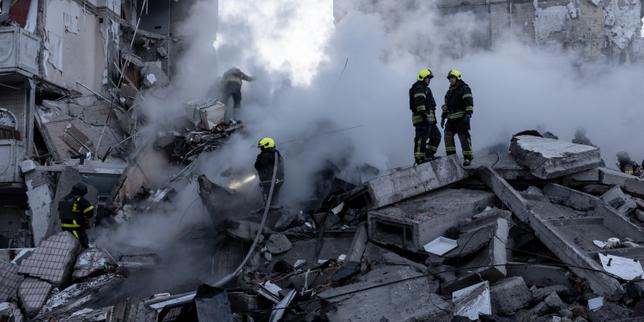
Meanwhile, every headline focuses on "five dead in Kiev" after a "massive" Russian attack.
Every loss of life is a tragedy. But from a cold-blooded strategic perspective, the focus on death tolls is exactly what the Kremlin wants. It obscures the failure of the Russian tactical objective.
If you launch a "massive" strike and the result is five casualties and a handful of damaged substations, you haven't conducted a military operation. You’ve conducted a very expensive, very loud PR campaign. Russia is burning through its dwindling stock of high-end cruise missiles to achieve effects that a well-placed group of saboteurs could manage with a few jugs of gasoline.
The media calls this "escalation." I call it "resource exhaustion disguised as aggression."
We need to stop measuring the war in Kiev by the number of explosions and start measuring it by the cost-per-kill ratio. Ukraine is successfully forcing Russia to use $2 million missiles to destroy $50,000 targets. That is a losing mathematical formula for Moscow, regardless of how many scary headlines it generates in the West.
The Ukraine Drone Autonomy Problem
Here is the truth no one wants to say out loud: Ukraine’s drone program is becoming too successful for its own good.
As Kiev scales its long-range strike capabilities, it is inevitably going to hit things it shouldn't. The "intrusion" into Latvian or Romanian or Polish airspace isn't always a Russian provocation. Sometimes, it’s a Ukrainian guidance system failing, or a drone being jammed into a random flight path.
The West is terrified of this.
We have spent decades building a world where only "responsible" states have long-range strike capabilities. Now, we have a nation in a fight for its life, mass-producing autonomous flying bombs in garages. These drones don't care about the diplomatic nuances of the Suwalki Gap.
The "consensus" view is that we need to give Ukraine more air defense. The contrarian reality? We need to accept that "friendly" drones are going to violate NATO airspace regularly, and we have no plan for it. The Latvian resignation is just the first domino. It won't be the last.
Why the "Buffer Zone" is Dead
For years, geopolitical "experts" talked about the Baltics as a buffer.
That concept is dead. Technology killed it. When a $500 FPV drone can be piloted from a basement and flown across a border to drop a grenade on a patrol car, there is no such thing as a buffer.
The Latvian government’s collapse is a realization that the old tools—diplomatic protests, troop movements, and traditional border guards—are useless against the democratization of aerial violence. You can’t "deter" a drone that doesn't have a pilot to scare or a budget to cut.
Stop Asking if the War is Spreading
People keep asking: "Is the war spreading to NATO?"
Wrong question.
The war isn't "spreading" in the sense of tanks rolling across the border into Riga. The war has already redefined the border. It has turned the Baltic states into a laboratory for a new kind of friction where "peace" is just a period between undetected drone flights.
The real question is: How long can a democratic government survive when it can no longer guarantee the sanctity of its own air?
The Latvian Prime Minister saw the writing on the wall. She realized that being the leader of a country during a "gray zone" conflict is a job with 100% liability and 0% authority. You get blamed for the breach, but you aren't allowed to trigger the war that would actually stop the breach.
The Brutal Path Forward
If we want to actually "secure" the region, we have to stop the pearl-clutching every time a drone crosses a line on a map.
- Accept Collateral Sovereignty: Small nations near conflict zones will lose total control over their lower-atmosphere airspace. It is a physical reality. Trying to maintain the political fiction of "unbroken borders" will only lead to more government collapses.
- Shift the Metric: Stop counting Russian missiles. Start counting Russian manufacturing capacity. If they can’t replace what they fire, the "massive attacks" are actually a slow-motion surrender.
- Automated Response: If a drone enters your airspace, it must be neutralized by autonomous systems—not a political committee. The moment a human has to decide whether to shoot down a drone near a border, the drone has already won.
The media will keep giving you the "chaos" narrative because it sells. They will tell you the Latvian government fell because of "pressure."
Nonsense. The government fell because it tried to apply 20th-century political stability to a 21st-century technological nightmare.
The Baltics aren't "falling." They are just the first ones forced to admit that the old rules of the state are officially broken.
Stop looking for the "escalation" in the headlines. It’s already happened in the hardware.


:max_bytes(150000):strip_icc():focal(819x186:821x188)/Murdaugh-Family-e90854a716884d608fb6fd925e18d840.jpg)
