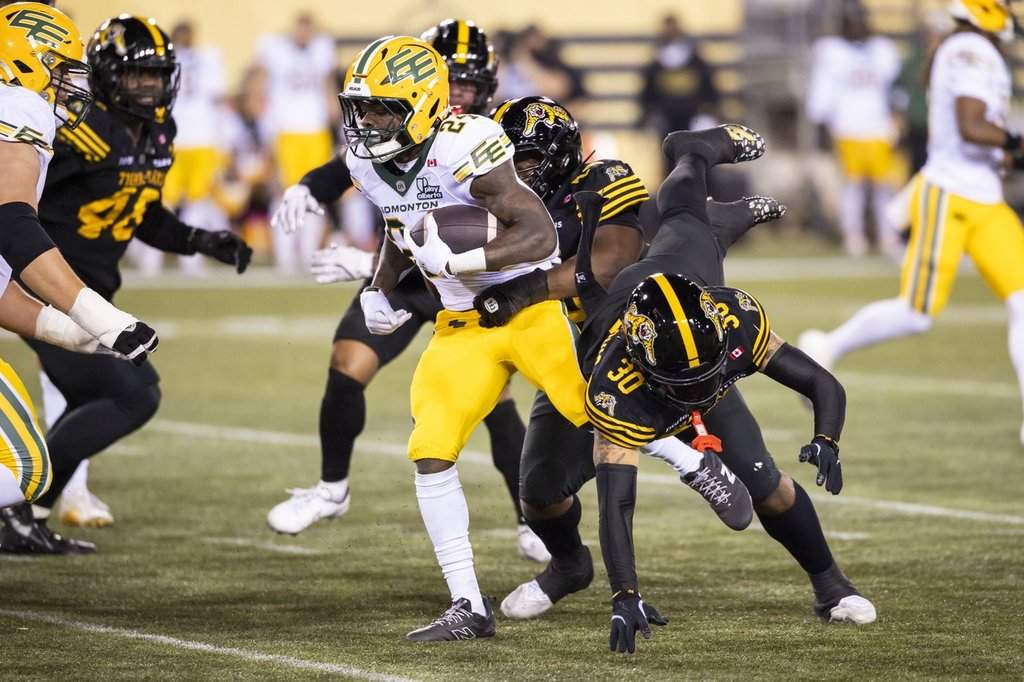
In professional gridiron football, outcomes are rarely determined by statistical accumulation across sixty minutes. They are forged in the crucible of late-game leverage, where diminishing clock time amplifies the cost of execution errors and compresses strategic optionality. The Edmonton Elks twenty-seven to twelve victory over the Hamilton Tiger Cats provides a clinical case study in variance mitigation during a fourth-quarter script. By evaluating the structural mechanics of how the Elks secured a fifteen-point margin through late-game scoring sequences, we can deconstruct the functional failure modes that trigger fourth-quarter collapses for trailing defensive units.
The Cost Function Of Late Game Clock Management
When a team holds a precarious or narrow advantage entering the final frame, their offensive play-calling calculus shifts from maximizing expected points per drive to minimizing defensive exposure time and maximizing field position leverage. Conversely, the trailing defense faces an asymmetric penalty function. Every sustained opponent drive erodes the time coefficient available for a multi-score comeback, forcing defensive coordinators out of stable base coverages and into high-variance situational structures.
The Edmonton success vector in the fourth quarter was built on three distinct operational advantages:
- Erosion of Defensive Containment: Sustained interior running schemes force linebackers to step downhill, creating intermediate passing windows that exploit zone drop depth deficiencies.
- Red Zone Conversion Efficiency: Converting yardage accumulation into six points rather than three alters the mathematical probability curve, removing single-score safety nets from the trailing opponent.
- Defensive Line Fatigue Thresholds: Fourth-quarter pass rush success correlates directly with snap distribution over the preceding three quarters. As front-seven rotation slows down due to conditioning degradation, offensive line protection metrics stabilize.
Deconstructing The Hamilton Fourth Quarter Defensive Failure
To understand why the Tiger Cats conceded a decisive fourth-quarter point differential, one must examine the structural integrity of their defensive shell under acute time constraints. A trailing defense operating with under fifteen minutes remaining must solve a two-variable optimization problem: prevent explosive plays that yield immediate scores while generating negative-yardage defensive stops to preserve clock.
When Hamilton faced Edmonton's late drives, their defensive front failed to maintain gap integrity. This structural breakdown stems from two distinct mechanical failures:
- Premature Linebacker Seepage: Anticipating run plays designed to drain the clock, the second-level defenders committed prematurely to the line of scrimmage, sacrificing leverage against play-action and intermediate crossing routes.
- Secondary Disconnect: The defensive backfield, forced to play off-coverage to prevent deep vertical completions, surrendered underneath hitch and out routes that converted manageable third-down situations.
This dynamic creates a compounding loop. Each successful conversion by the offense forces the defense to extend its time on the field, accelerating physical exhaustion and degrading reaction-time metrics in coverage assignments.
Variance Reduction Through Ground Game Persistence
A common strategic error among analysts is evaluating late-game offense solely through passing volume. In reality, protecting a lead requires maximizing clock-drain efficiency. Every play that keeps the clock running reduces the total number of possessions available to the opponent.
Edmonton utilized multi-tight-end personnel groupings and unbalanced lines to dictate defensive spacing. By shifting the point of attack away from traditional guard-tackle gaps, they forced the Hamilton defensive front to lateralize. Lateral movement consumes greater energy than vertical penetration, compounding the fatigue differential that manifests decisively in the final ten minutes of regulation.
When the Elks punched in their fourth-quarter touchdowns, they were not merely capitalizing on raw athleticism; they were cashing in the compounding interest of sixty minutes of physical attrition. The defensive line that stood firm in the first quarter could no longer anchor against double-team blocks when leverage was compromised by structural fatigue.
Strategic Operational Forecast For Late Game Execution
The twenty-seven to twelve final scoreline masks the narrow margin of error that separates a controlled victory from a late-game collapse. Teams that consistently close out matches in the fourth quarter rely on three immutable operational guardrails:
- Strict Adherence to Clock-Neutral Play Calling: Abandoning conservative shells too early invites opponent momentum, while excessive conservatism stalls drives and hands possession back with optimal field position.
- Rotational Freshness on the Defensive Line: Maintaining pass-rush efficacy requires a minimum of eight functional linemen to combat fourth-quarter tackle degradation.
- Punitive Red Zone Execution: Forcing field goals instead of surrendering touchdowns is the singular defensive metric that keeps a trailing team within a two-score threshold.
Moving forward, evaluating the resilience of defensive units in the fourth quarter requires looking beyond raw yards allowed. The primary diagnostic metric is structural breakdown frequency under high-leverage constraints. Defensive systems that fail to preserve gap integrity when fatigued will consistently surrender late-game separation, regardless of their first-half efficiency.