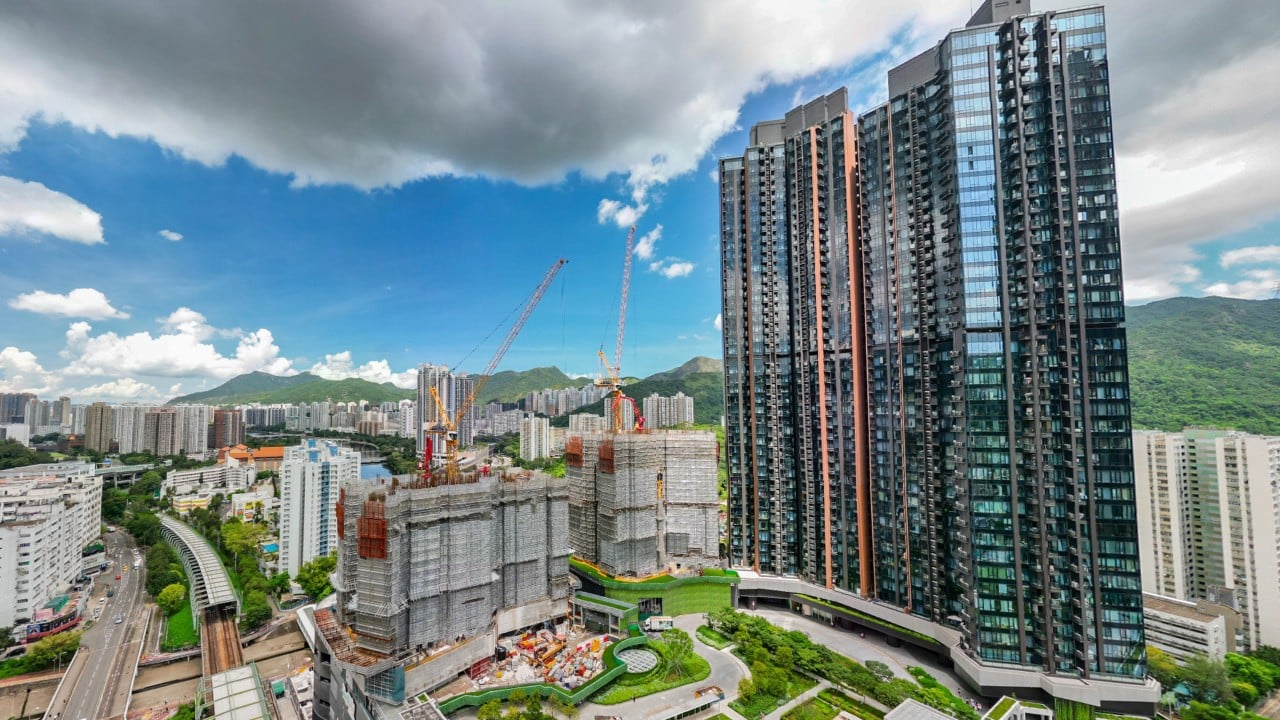
Mr. Lam stands on the 42nd floor of a skeleton. That is what he calls the unfinished luxury tower in Kai Tak, a district once defined by the roar of jet engines and now defined by the silent, frantic pulse of the crane. He is sixty-four years old. His knuckles are white as he grips a site map. He isn't an architect or a construction foreman. He is a buyer. Or, more accurately, he is a man trying to catch a falling star before it burns out.
For three years, the narrative of Hong Kong real estate was written in shades of gray. High interest rates acted like a cold front, freezing the gears of the world’s most expensive housing market. Developers sat on a mountain of unsold units—roughly 21,000 "leftover" flats—waiting for a sun that refused to rise. Then, the government did something drastic. They scrapped the "spicer taxes," the heavy levies designed to curb speculation.
The dam didn't just crack. It vanished.
The Hunger of the Empty Room
To understand why people are sprinting toward sales offices, you have to look past the spreadsheets. You have to look at the dinner tables. In Hong Kong, space isn't just square footage; it is the ultimate scoreboard of a life well-lived. When the taxes dropped, a psychological switch flipped from wait and see to now or never.
Developers, sensing the shift, didn't raise prices. They did the opposite. They began "clearing stock" with a ruthless efficiency that bordered on a fire sale. They priced new units at levels not seen since 2019, or even earlier. They realized that holding onto a finished building is like holding onto a block of ice in the July heat. It’s better to sell the water than watch it disappear into the ground.
Consider the hypothetical case of Sarah, a thirty-something analyst. For half a decade, she lived in a "nano-flat" where she could reach the stove and the shower without taking a step. She watched the market like a hawk, paralyzed by the thought of buying at the peak. When New World Development or Henderson Land drops a batch of units at a 20% discount compared to the neighboring tower built three years ago, Sarah isn't just looking at a mortgage. She is looking at a bedroom with a door. A window that doesn't face a concrete alley.
She is one of thousands. In the first few months of 2024, the volume of primary market transactions tripled. The "stock" that analysts worried about—the glut of inventory—is being swallowed by a population that has been hungry for a decade.
The Mathematics of Scarcity
The irony of this sudden feeding frenzy is that while the "old" stock is being cleared, the "new" supply is actually shrinking. This is the invisible pincer movement that creates a sense of urgency.
In the world of urban planning, there is a long lead time between a government land sale and a person moving into a kitchen. Because developers were hesitant to start new projects during the high-interest-rate era of 2022 and 2023, the pipeline began to dry up.
- Land Sales: The government's revenue from land auctions hit multi-year lows because developers stopped bidding.
- Construction Starts: New project initiations plummeted as borrowing costs made large-scale builds risky.
- Completion Gaps: We are approaching a window where, once the current "clearance" is over, there will be a significant pause before the next wave of buildings is ready.
Mr. Lam knows this. He remembers the 1990s. He remembers the early 2000s. He knows that in a city with 7.5 million people and a geography that consists mostly of vertical mountains and protected country parks, the "excess supply" is a temporary illusion.
"They tell you there are 20,000 flats," he says, pointing toward the harbor. "But they don't tell you there are 100,000 people tired of living in their parents' living rooms."
The numbers bear him out. While the headlines focus on the "stockpile," the reality is that the private housing supply for the next three to four years is projected to drop. This isn't a surplus problem. It is a timing problem. The developers are clearing the shelves today because they know they won't be able to restock them easily tomorrow.
The Psychological Pivot
The shift in Hong Kong isn't just about tax law; it’s about the death of the "fear of falling." For years, the fear was that if you bought today, the price would be lower tomorrow. But when prices hit a five-year low and the government signals that they want the market to move, the fear changes.
It becomes the "fear of being left behind."
This is a powerful, primal motivator. When you see your neighbor signing a contract, and the news reports that a development sold out 300 units in a single afternoon, the "wait and see" strategy starts to look like a "lose out forever" strategy.
The developers are playing this perfectly. By pricing "at cost" or even slightly below historical profit margins, they are creating a floor. They are telling the public: This is as low as it gets.
But there is a human cost to this speed. For the developers, "clearing stock" means repairing their balance sheets. It means paying down the massive debts they accrued when interest rates were near zero. For them, every flat sold is a breath of oxygen.
For the buyers, it is a gamble on the future of the city. To buy in Hong Kong right now is to make a bet that the city’s status as a global financial hub is not a relic of the past, but a durable reality of the future. It is a bet that the talent being recruited from mainland China under new visa schemes will need places to live. These "New Hong Kongers" are a critical part of the clearing process. They don't have the baggage of the 2019 protests or the pandemic gloom. They see a world-class city with a sudden, temporary discount.
The Echo in the Concrete
As the sun begins to set over Kai Tak, the shadow of the towers stretches across the old runway. Mr. Lam watches a young couple talking to an agent near the entrance of the sales suite. They are holding a brochure, their fingers tracing the outlines of a two-bedroom floor plan.
The agent is talking fast, citing the "shrinking supply" and the "limited-time incentive." He is using the language of the trade. But the couple isn't listening to the statistics. They are looking at each other. They are imagining where the sofa will go. They are imagining a life that fits inside those walls.
The macro-economic reality is that the supply-demand curve is rebalancing. The surplus is being liquidated. The pipeline is narrowing. The banks are slowly, painfully adjusting to a new world of "higher for longer" rates.
But the micro-economic reality is much simpler. It is the sound of a key turning in a lock for the first time.
The "stock" that the newspapers talk about isn't just inventory. It isn't just "units" or "assets." It is the physical manifestation of a city's resilience—or perhaps its stubbornness. Hong Kong has been counted out a dozen times in a dozen different decades. Every time, people pointed to the cranes and said there was too much, or to the prices and said there was too little.
Yet, here is the truth of the concrete: Every window in every tower represents someone’s belief that tomorrow will be worth the mortgage.
Mr. Lam folds his map and puts it in his pocket. He has made his decision. He isn't buying an investment. He is buying a piece of the sky before the developers stop building it. He walks toward the sales office, his footsteps echoing in the cavernous, half-finished lobby.
Behind him, the cranes are still. They are waiting for the next cycle, the next wave, the next generation to realize that in a city built on a rock, the only thing more valuable than the land is the courage to own it.
The city isn't emptying. It is just changing hands.