Salt stings the corners of your eyes before the sun even clears the limestone karsts of the Andaman Sea.
At 5:30 AM on the southern coast of Thailand, near the quiet island of Koh Libong in Trang province, the water is deceptive. From the wooden bow of a longtail boat, the turquoise shallows look like a postcard untouched by human hands. You can see the ripples of white sand six feet below. You can hear the distant, rhythmic chug of a single-cylinder diesel engine echoing off the cliffs.
If you look closely at the seabed, however, the illusion breaks.
Where there should be thick, waving meadows of lush green seagrass, there are vast, barren scars of gray mud. The underwater pastures are disappearing. And for the gentle, barrel-chested giants that depend on them, starvation is no longer a distant ecological projection. It is happening right now, in real time, beneath the keel.
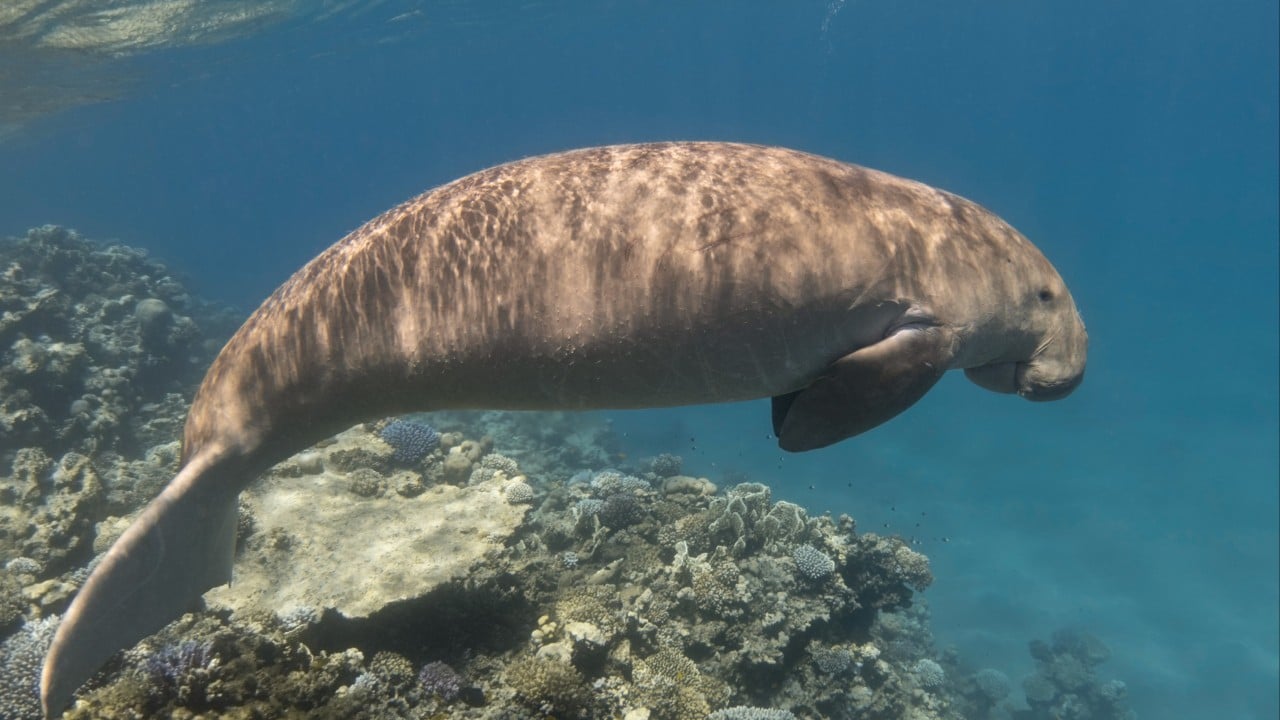
For decades, the dugong—a shy, herbivorous marine mammal closely related to the manatee—has been the undisputed icon of southern Thailand’s coastal waters. Locally known as phayun, these animals can grow up to ten feet long and weigh nearly nine hundred pounds, yet they possess the temperament of a timid calf. They have no dorsal fin, no sharp teeth, and no natural defense against a world that is warming faster than their food can grow.
In recent years, something went terribly wrong in the Andaman. Rising sea temperatures, erratic monsoon patterns, and coastal sediment runoff triggered a massive die-off of seagrass beds along the Thai coast. Between 2023 and 2024 alone, dozens of emaciated dugongs washed ashore, their ribs protruding beneath thick, scarred skin, their stomachs entirely empty. Wildlife officials watched in horror as the population—already fragile, hovering at roughly two hundred individuals across Thai waters—began to collapse.
When a species is slipping through your fingers, traditional conservation methods often move too slowly. You cannot easily tag a dugong without stressing it to the brink of heart failure. You cannot keep them in captivity without disrupting their complex social bonds and delicate gut microbiomes.
So, Thai marine biologists and local fishermen turned to a radical, distinctly unglamorous lifeline. They went hunting for poop.
The Anatomy of a Floating Clue
To understand why grown scientists are spending their mornings scooping marine mammal waste out of the ocean with fine-mesh nets, you have to understand how difficult it is to study a ghost.
Dugongs are notoriously elusive. Unlike dolphins, they do not leap into the air or ride the bow waves of passing boats. They surface quietly, take a single breath through nostrils positioned high on their snouts, and vanish back into the murky water for up to six minutes at a time. Tracking their health by sight alone is nearly impossible; by the time a dugong looks visibly thin from a boat, it is often too late to save it.
Consider a hypothetical day on the water with Niran, a composite figure representing the local Koh Libong fishermen who have traded their nets for conservation work, alongside marine veterinarians from Thailand’s Department of Marine and Coastal Resources.
Niran stands at the bow, shielding his eyes against the glare, scanning the surface not for a shadow, but for a plume. A healthy dugong eats up to eighty pounds of seagrass every single day. Think of them as the lawnmowers of the ocean floor—slow, methodical, and constantly grazing. Because their diet is pure, fibrous vegetation, what comes out the other end doesn't sink like stone. It floats.
"Over there," Niran might say, pointing a calloused finger toward a faint, greenish-brown slick drifting thirty yards off the port side.
To the untrained eye, it looks like a clump of decaying seaweed or floating driftwood. To the team on the boat, it is a biological black box.
The engine cuts. The boat drifts silently toward the target. A researcher leans over the gunwale, dipping a sterile plastic container into the warm salt water to scoop up the specimen before the current breaks it apart or scavengers devour it.
Inside that foul-smelling sample lies everything the scientists cannot ask the animal directly.
Reading the Gut Like a Fingerprint
Think of a dugong’s digestive tract as a bustling, microscopic city. Just like humans, these animals rely on trillions of specialized gut bacteria to break down tough plant cellulose and extract life-sustaining nutrients. When a dugong is thriving on a diverse buffet of nutrient-rich seagrass, that internal city hums with efficiency.
When the seagrass dies off, the city begins to crumble.
Desperate for calories, starving dugongs begin eating whatever they can find—low-nutrient algae, rotten roots, or tough, indigestible weeds. Their gut microbiome shifts dramatically. Harmful bacteria multiply, inflammation sets in, and the animal enters a fatal downward spiral where even if it finds food, its body can no longer properly absorb it.
By collecting fresh fecal samples directly from the water, Thai researchers can perform non-invasive health checkups on wild dugongs without ever touching a hair on their snouts.
Back in the laboratory, technicians extract DNA from the waste to identify the exact individual—creating a genetic census of who is surviving and who has vanished. They analyze hormone levels to detect chronic stress or pregnancy. Most crucially, they sequence the gut bacteria and examine undigested plant fibers under a microscope.
If a sample shows high levels of stress hormones and a gut full of desperate, low-grade algae, the researchers know that a specific pod in a specific bay is in immediate danger of starvation.
It is forensic medicine applied to the ocean. Instead of waiting for a carcass to wash up on a tourist beach, scientists can map the invisible starvation crisis while the animals are still swimming.
The Human Toll of an Empty Sea
It is easy to view wildlife conservation from a safe, academic distance, treating the loss of a species like a sad statistic in an annual report. Living alongside the people of Trang strips away that detachment immediately.
For the indigenous Urak Lawoi people and the Muslim fishing communities of Koh Libong, the dugong is not just a tourist draw or an entry on the IUCN Red List. In local folklore, the phayun was once a woman who craved seagrass so deeply during her pregnancy that she wandered into the ocean and transformed into a creature of the sea. harming one is considered a profound taboo, a betrayal of kin.
The connection is also fiercely practical. Healthy seagrass meadows do not only feed dugongs; they act as the primary nurseries for the crabs, shrimp, and reef fish that put rice on the tables of coastal families. Seagrass locks massive amounts of carbon into the ocean floor—far more efficiently per acre than tropical rainforests—and buffers fragile coastlines against the fury of tropical storms.
When the seagrass vanishes, the dugongs are simply the first to fall. The fishermen are next.
I remember standing on the wooden pier at Ban Batu Puteh during low tide, watching the mudflats stretch out toward the horizon. An older fisherman named Somchai—whose family had worked those waters for four generations—pointed toward a channel where he used to see ten or fifteen dugongs grazing together every evening. The water was flat, glassy, and entirely empty.
He didn't speak in the language of climate models or biodiversity metrics. He spoke about silence. He explained that when the dugongs are gone, the sea feels dead, like a house where everyone has moved away and left the lights off.
That vulnerability—the quiet terror of watching your entire world become uninhabitable in slow motion—is what drives the frantic pace of the conservation effort today. You can feel the anxiety in the boat crews. Every patrol is a race against the tide, the heat, and the clock.
The Emergency Feeding Experiment
Collecting data from floating waste was only half the battle. Knowing a dugong is starving does not fill its stomach.
Faced with an unprecedented wave of deaths, Thai marine authorities and local volunteers launched an emergency intervention that had rarely been attempted at scale in the wild: they began feeding them.
Because wild dugongs are deeply suspicious of humans and unnatural objects, scientists couldn't simply dump piles of lettuce off the back of a boat. Instead, conservationists harvested healthy seagrass from unaffected regions, bundled it carefully, and anchored it to the seabed using biodegradable ropes and weighted stakes in areas where starving dugongs were known to frequent.
They also experimented with locally grown vegetables—cabbage, bok choy, and morning glory—testing them first on rescued animals in rehabilitation centers to ensure the terrestrial plants wouldn't cause fatal gas or bloating in their sensitive digestive systems.
Then, they watched and waited.
For days, the underwater cameras showed dugongs swimming cautiously around the anchored bundles, sniffing the unfamiliar offerings with their sensitive, bristle-covered snouts before retreating into the blue. The tension among the researchers was palpable. If the animals refused the supplemental food, the rescue mission would fail before it truly began.
Finally, a young male approached a bundle of transplanted seagrass, nudged it with his muzzle, and took a bite. Within days, others followed.
Now, the poop-hunting patrols serve a vital second purpose. By collecting waste near the feeding stations, researchers can track whether the starving dugongs are actually eating the emergency rations, how their gut bacteria are responding to the supplemental diet, and whether their stress hormones are finally beginning to drop.
The Fragile Line Between Rescue and Reality
There is a tempting urge to turn this story into a neat triumph of human ingenuity over nature’s fury. It would be comforting to say that a handful of dedicated biologists, some clever DNA sequencing, and a few underwater salad bars have solved the crisis.
They haven't.
Emergency feeding is a tourniquet, not a cure. You cannot hand-feed hundreds of wild marine mammals indefinitely, nor can you outrun the broader warming of the Andaman Sea with buckets of bok choy. Coastal development continues to send silt choking over the remaining seagrass beds. Illegal fishing gear still tangles around slow-moving bodies. Boat propellers still carve deep, fatal gashes into the backs of animals that must rise to the surface to breathe.
Even the poop patrols face maddening odds. A sudden squall can scatter a sample in seconds. Heavy rains dilute the water, making visual tracking nearly impossible. Some days, the boats return to the pier after six hours under a blistering sun with nothing in their cooler boxes except warm seawater and a lingering sense of dread.
Yet, when the sun drops behind the limestone islands and the boats tie up at the wooden docks of Koh Libong, nobody talks about giving up.
You see it in the way the researchers carefully label each vial before packing it in ice for the long drive to the lab in Phuket. You see it in the way the local fishermen wake up before dawn, volunteering their boats, their fuel, and their intimate knowledge of the tides to help scientists read the faint, drifting clues left behind by the ghosts of the Andaman.
Out on the water, survival rarely looks like a grand, cinematic victory. Sometimes, it looks like a muddy boat, a pair of rubber gloves, and a determined refusal to let a gentle giant vanish without a fight.