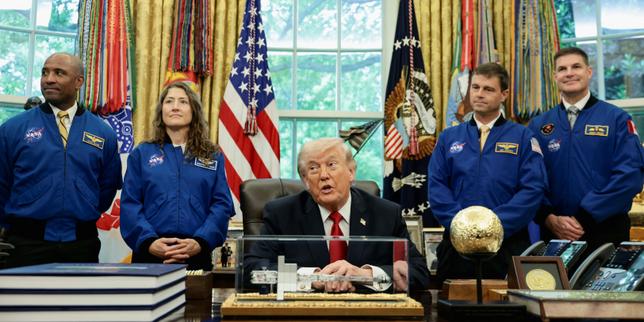
Donald Trump stands on a stage, but he is looking at a map that isn't there. It is a map of 1845, bleeding into 2026. When he talks about the red dust of Mars, the icy expanse of Greenland, or the sovereign borders of Canada, he isn't just discussing real estate or geopolitics. He is summoning a ghost. It is the ghost of the "Frontier," that jagged, moving line that once defined the American soul by promising that there was always, somewhere over the next ridge, a place where a man could outrun his past and build a kingdom from nothing.
The problem with the modern world is that it feels finished. Every square inch of the planet is mapped by satellites, tagged by GPS, and taxed by a government. We are living in the "After." After the gold rushes, after the moon landing, after the internet connected everyone and made us all equally bored. Trump’s rhetoric taps into a primal, itchy claustrophobia. He is betting that Americans are tired of being managers of a finished world and are desperate to be pioneers of an unfinished one.
The Geography of Ego
Consider the audacity of the Greenland proposal. On paper, it was a diplomatic absurdity—a "for sale" sign slapped on a sovereign territory of Denmark. But look closer at the emotional machinery. Greenland is a vast, white void on the map. To the administrative mind, it is a strategic location for Arctic mineral rights. To the pioneer mind, it is a blank canvas.
When Trump suggests "buying" a country or a continent, he is using the language of the boardroom to satisfy the hunger of the campfire. He is casting himself as the ultimate homesteader. He knows that the American myth was built on the idea that land equals liberty. If the domestic frontier is closed, if the suburbs are paved over and the cities are too expensive, the only solution is to expand the borders of the possible. Even if those borders are made of permafrost or vacuum.
The Red Dust and the Iron Will
The fascination with Mars follows the same internal logic. While NASA often frames space exploration as a collaborative, scientific endeavor—a search for microbial life or atmospheric data—the Trumpian vision is explicitly colonial. It is about "flags and footprints." It is about the "Manifest Destiny" of the 19th century being strapped to a Falcon 9 rocket.
Imagine a hypothetical worker in a struggling Rust Belt town. To that person, a scientific paper about Martian soil acidity means nothing. But the idea of an American colony on a new world—a place where the rules haven't been written yet—is a powerful hit of dopamine. It suggests that the American story isn't over. It suggests we aren't just a declining empire managing our own decay.
Space becomes the safety valve. In the 1800s, if you failed in New York, you went to Ohio. If you failed in Ohio, you went to California. Today, if you feel the walls closing in, there is nowhere left to go. By pivoting to Mars, the political narrative creates a "somewhere else." It’s a masterful piece of psychological redirection. It doesn't matter if the technology isn't ready or if the costs are astronomical. The idea of the frontier is what keeps the engine running.
The Border as a Mirror
Then there is the friction with Canada and the talk of northern influence. This is where the myth of the frontier becomes uncomfortable and modern. The old pioneers didn't respect borders; they drew them. By questioning the static nature of our northern neighbors or suggesting that the U.S. should have more say over "the North," there is an implicit rejection of the post-WWII international order.
This order is based on treaties, soft power, and consensus. The frontier is based on strength, proximity, and the "right of discovery."
We see this tension play out every day in our own lives. We feel it when we stare at our screens, trapped in digital algorithms that decide what we see and think. We are over-regulated and under-inspired. When a leader stands up and speaks as if the world is still wild—as if we could simply take Greenland or settle Mars or redraw the map—it feels like a breath of cold, fresh air, even if it’s factually impossible. It’s the thrill of the outlaw.
The Invisible Stakes
The real danger isn't that we will actually go to war over Greenland or land a thousand people on Mars by Tuesday. The danger is the erosion of reality in favor of the myth.
The original American frontier was won at a terrible cost—displacement, violence, and environmental exhaustion. It was a brutal process. By sanitizing that history and presenting it as a shiny, high-tech future, we ignore the hard work of fixing the land we already inhabit. It is easier to dream of a fresh start on a dead planet than it is to fix the politics of a living one.
But the myth is a hell of a drug.
The human element here is a deep, quiet yearning for scale. We want to be part of something larger than a quarterly earnings report or a political poll. We want to be part of an epic. Trump understands that humans are narrative-driven creatures. We don't want "policy." We want a "frontier." We want to believe that the horizon still holds secrets, and that we are the ones destined to uncover them.
The Horizon is a Ghost
We are currently caught in a loop. One side of the national psyche wants to conserve, protect, and manage. The other side wants to break, build, and expand. This isn't a debate about science or geography. It is a war between the Accountant and the Explorer.
The Explorer is often reckless, selfish, and wrong. But the Explorer is also the one who gets us out of bed in the morning. When the frontier was officially declared "closed" in 1890, it sent a shockwave through the American consciousness. It felt like the end of childhood. Since then, we have been trying to reopen it.
We try to reopen it through the internet. We try to reopen it through "disruptive" technology. And now, we are trying to reopen it through a geopolitical reimagining of the globe and the solar system.
It is a quest for a new beginning in a world that has seen too much. We look at the map of the world and see a finished puzzle. Then we look at the man pointing to the blank spaces—the white ice of the north and the red dust of the stars—and for a second, we forget the weight of the present. We see the ghost of the pioneer, standing on the edge of the world, waiting for the sun to rise on a place where the rules don't exist yet.
The horizon hasn't moved. We have just forgotten how to look at it without flinching. At the end of the day, the American frontier isn't a place you can find on a map or buy with a checkbook. It is a fever dream we refuse to wake up from, a restless, beautiful, and dangerous lie that tells us we never have to stop moving.