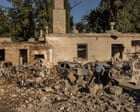
The sirens in Kyiv scream a familiar, bone-chilling warning. Another massive attack on the Ukrainian capital and its surrounding region confirms that the Kremlin has abandoned any pretense of tactical precision, opting instead for a sustained campaign of attrition designed to exhaust both air defense stockpiles and the civilian will to resist. When Russian missiles and drones saturate the airspace, the objective extends far beyond hitting specific military targets. This is a deliberate attempt to force a collapse of the national energy grid and psychological infrastructure.
The scale of these raids has shifted significantly since the early months of the conflict. Military planners in Moscow now prioritize the saturation of defensive networks. By launching a mix of high-speed ballistic missiles, cruise missiles, and low-cost Iranian-designed loitering munitions simultaneously, they create a target-rich environment intended to overwhelm the Patriot and NASAMS systems protecting the city. The logic is brutal. Force the defenders to expend expensive, limited interceptors on cheaper drones, eventually leaving the skies open for heavier, more destructive munitions.
Understanding the failure of this approach requires a look at the math. The Russian military establishment persists in the belief that terrorizing the civilian population will force the Ukrainian leadership to negotiate under duress. History shows the exact opposite. Every wave of destruction reinforces a singular reality. The Ukrainian population has hardened. The resilience displayed by residents in Kyiv, who return to work or school mere hours after an explosion, illustrates the complete breakdown of the intended psychological impact.
The Evolution of Aerial Saturation
The technical methodology behind these strikes has changed. Early in the conflict, Russian forces relied on massive, singular salvos of cruise missiles. These were relatively easy for modern radar to track and intercept. The current doctrine involves a complex choreography. Attack planners now utilize a multi-vector approach, sending drones in staggered waves to probe for gaps in radar coverage before the primary missile strike arrives.
This shift indicates a move toward what defense analysts define as suppression of enemy air defenses. It is a desperate play for efficiency. If the Russian aerospace forces cannot establish air superiority—a goal they failed to achieve in the opening days of 2022—they must instead attempt to dismantle the protective umbrella from the ground up. This explains the repeated targeting of substations and transformer hubs. The intent is not just to turn off the lights. It is to create a cascade of failures that forces the Ukrainian military to redistribute its limited air defense assets to protect critical civilian infrastructure, thereby thinning the defenses protecting front-line troop concentrations.
The problem for the planners in Moscow is the persistent unpredictability of the Ukrainian response. The integration of Western-supplied technology with legacy Soviet-era hardware has created a defensive hybrid that is far more agile than anticipated. When a barrage occurs, the response is not a static reaction. It is a dynamic network that shares data across the entire front. This allows for the precise deployment of mobile interceptor teams, preventing the total degradation of the protective screen that the Kremlin demands.
Resource Constraints and the Drone Paradox
Supply chains dictate the rhythm of this conflict. Russia’s reliance on domestic production of long-range missiles is hampered by the persistent need for Western-manufactured microelectronics. Despite international sanctions, these components continue to find their way into the Russian supply chain, often through complex black-market networks involving third-party nations. However, the volume required for a sustained campaign of massive attacks is unsustainable at current rates.
This creates a drone paradox. By switching to a high volume of cheaper, slower unmanned vehicles, Russia avoids some of the resource strain of building advanced cruise missiles. But these drones are easily intercepted by conventional anti-aircraft guns and electronic warfare jamming. They serve as a nuisance, a distraction, and an alarm system, but they rarely achieve the catastrophic damage required to break a city. When the headlines trumpet a massive attack, the reality on the ground often involves a majority of these systems being neutralized far from their intended targets.
The focus on Kyiv acts as a lightning rod. By concentrating assets on the capital, the Russian military misses opportunities to strike logistics hubs further east or south. It is a political decision rather than a strictly military one. The optics of burning buildings in the capital carry more weight in the Russian state media cycle than the tactical reality of a village captured on the periphery of the Donbas.
Infrastructure as a Battlefield
Electricity is the new frontline. By repeatedly hitting the Ukrainian power grid, the Russian military is attempting to render the country uninhabitable during the winter months. This is an attempt to weaponize the climate. If the power, heat, and water systems fail, the resulting internal migration creates massive logistical strain on the central government.
Yet, the recovery efforts are remarkably efficient. The utility workers in Ukraine have become experts in rapid repair. They anticipate the strikes, preposition equipment, and restore power in record time. This cat-and-mouse game has forced a shift in the nature of urban survival. Businesses in Kyiv now operate as micro-grids, utilizing private generators and satellite internet to bypass the central infrastructure entirely. This decentralization makes the city harder to break. It proves that technological warfare has a ceiling. When you attack the infrastructure, you only accelerate the civilian adaptation to a new, more robust way of living.
The Long War of Attrition
The sheer frequency of these attacks forces us to reconsider the definition of victory in this conflict. If the Russian objective is to exhaust the Ukrainian supply of interceptors, they are playing a dangerous game. Every missile launched by Russia is one less that can be used to defend their own territory or held in reserve for a geopolitical contingency elsewhere. The depletion of the Russian arsenal is a documented fact.
The Western response has been to provide consistent, if slow, replenishment of defensive systems. The transfer of long-range interceptors has turned the skies over Kyiv into one of the most protected environments on the planet. This level of defense is not perfect, and debris from intercepted missiles continues to pose a significant threat to life and property, but the goal of the campaign—the total incapacitation of the capital—remains unachieved.
We are witnessing the limits of air power when it is detached from ground maneuverability. A massive attack may shatter windows and destroy energy infrastructure, but it cannot occupy a city. It cannot change the fundamental reality that the defending forces are dug in, supplied, and motivated. The Kremlin continues to fire because they have no other options left on the board. They have invested so much political capital into the idea of a submission-inducing air campaign that they cannot stop without admitting failure.
The cycle of violence continues because the alternative is a humiliating retreat from the entire offensive strategy. So the sirens will sound again tomorrow, and the next day. The missiles will fall, and the city will absorb the blow, adapt, and move forward. The war of attrition is not just about who has more bullets, but who can withstand the unrelenting pressure of daily destruction without surrendering their core intent. The Russian air campaign is not winning the war; it is merely maintaining the status quo of a brutal, unending stalemate.