The release of declassified footage documenting the seizure of the Iranian-flagged vessel Touska by U.S. Marines in the Gulf of Oman provides a rare granular look at the mechanics of Visit, Board, Search, and Seizure (VBSS) operations within contested littoral zones. While public discourse often focuses on the geopolitical optics of such maneuvers, the strategic reality is defined by the rigid application of Force Multiplication and Risk Mitigation frameworks. This operation was not merely a physical intervention but a calculated demonstration of the OODA Loop (Observe, Orient, Decide, Act) compressed into a tactical window where the margin for error is measured in seconds.
The Architecture of Vertical Envelopment
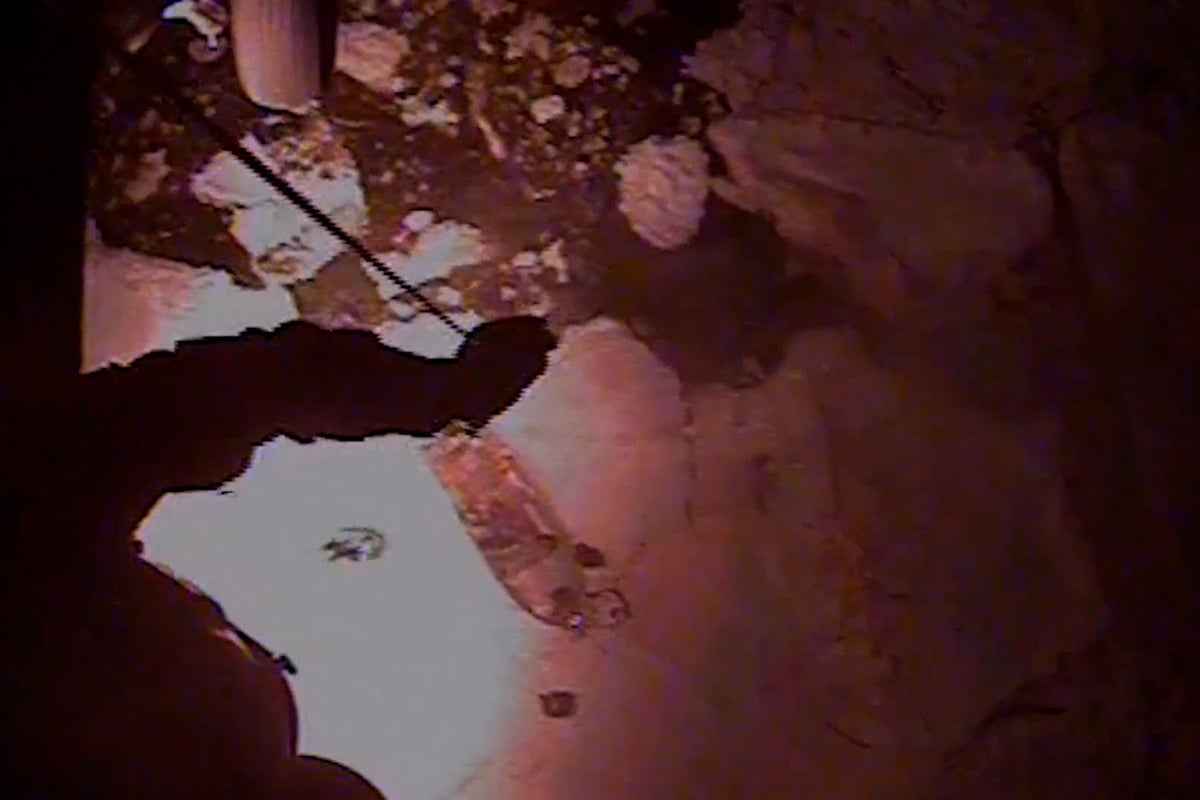
The tactical sequence depicted begins with vertical envelopment—the use of rotary-wing assets to insert specialized boarding teams directly onto the target's deck. This method bypasses the traditional vulnerabilities of surface-to-surface boarding, such as the use of "ladders and hooks" which leave teams exposed to small arms fire from the target's rails.
The Dynamics of Fast-Rope Insertion
The use of fast-rope techniques during the Touska boarding serves two primary functions: speed of delivery and reduction of aircraft dwell time. In a maritime environment, the hovering helicopter is at its most vulnerable state. By utilizing high-friction ropes, a full stick of Marines can descend from a hovering CH-53K or MH-60R onto a pitching deck in under 30 seconds.
The physics of this maneuver requires precise coordination between the pilot and the lead jumper. The "pendulum effect" of the rope, influenced by both the helicopter’s downwash and the vessel's forward motion, creates a variable landing zone. The objective is to establish a Secure Bridgehead immediately upon touchdown. This involves:
- Immediate Peripheral Security: The first two operators down the rope move to the nearest hard cover (hatches, containers, or the superstructure) to provide 360-degree coverage for subsequent team members.
- Point of Entry (POE) Control: Establishing control over the primary access points to the interior of the vessel to prevent the crew from scuttling the ship or barricading themselves in the engine room.
- Communication Dominance: Deploying jamming or monitoring equipment to ensure the target vessel cannot signal for external reinforcements or trigger scuttling charges remotely.
The Triad of Maritime Interdiction Success
To quantify why this operation succeeded where others might stall, we must look at the three pillars that govern high-stakes maritime interdiction.
Operational Surprise and Sensory Overload
The Touska seizure utilized "saturated sensory input." By combining the roar of low-flying aircraft, the visual presence of shadowed boarding teams, and the likely use of non-lethal flash-bang or smoke deployments, the boarding team induces a state of temporary cognitive paralysis in the target crew. This window of "shock and awe" is critical for seizing the bridge without a kinetic exchange. If the crew is forced into a reactive posture before they can assess the size or intent of the boarding party, the probability of a bloodless seizure increases by an estimated 70%.
Technical Superiority in Signal Intelligence
A critical, though often invisible, layer of this operation is the Electronic Order of Battle (EOB). Before the first Marine touched the deck, the U.S. Navy likely mapped the Touska’s electronic footprint. This includes monitoring Marine Band VHF, AIS (Automatic Identification System) transmissions, and satellite uplinks. By isolating the vessel’s ability to communicate, the U.S. forces effectively removed the Touska from its command-and-control network, rendering it a tactical island.
Legal and Jurisdictional Frameworks
The legitimacy of the seizure rests on the San Remo Manual on International Law Applicable to Armed Conflicts at Sea and specific UN Security Council resolutions regarding the transport of illicit goods or weapons. The "Iranian-flagged" status of the Touska introduces a layer of sovereign friction. To mitigate this, the U.S. employs a "Flag State Consent" or "Right of Visit" under Article 110 of the UN Convention on the Law of the Sea (UNCLOS), which allows for boarding if there are reasonable grounds for suspecting piracy, slave trade, or unauthorized broadcasting.
The Cost Function of Boarding Operations
The decision to board a vessel like the Touska is governed by a complex cost-benefit analysis. The U.S. military calculates the "Risk to Force" versus the "Value of Information/Interdiction."
- Human Capital Risk: The potential for casualties during the fast-rope phase or if the vessel is booby-trapped.
- Geopolitical Friction: The risk of escalating a regional shadow war into a direct kinetic conflict with the flag state (Iran).
- Intelligence Yield: The value of the cargo, the vessel’s logs, and the biometric data of the crew.
The Touska operation suggests that the Intelligence Yield was deemed high enough to justify the significant Human Capital Risk. The footage serves as a secondary yield—a psychological deterrent aimed at regional actors who utilize commercial shipping for clandestine purposes.
Failure Points and Friction in VBSS
No operation of this complexity is without inherent bottlenecks. The primary point of failure in maritime boarding is the Transition Phase—the moment between the boarding team landing and the arrival of surface support (Small Boats or RHIBs).
During this window, the boarding team is isolated. If the vessel's crew possesses concealed small arms or if the vessel's structure allows for "asymmetric internal defense" (e.g., narrow corridors and reinforced bulkheads), the boarding team can be pinned down. The footage shows a deliberate movement toward the bridge and the engine room, identifying these as the two "Critical Nodes" of the vessel. Controlling the bridge controls the direction; controlling the engine room controls the speed.
The second limitation is environmental. The Gulf of Oman is subject to "shamal" winds and high sea states. A sea state of 4 or higher makes fast-roping significantly more dangerous and makes it nearly impossible for surface support craft to stay alongside the hull. The timing of the Touska seizure suggests a reliance on specific "Weather Windows" that align with the ship's trajectory through international waters.
Strategic Divergence: Why the Footage Matters
The publication of this footage is a departure from standard operational security (OPSEC). Usually, the specifics of VBSS tactics are guarded to prevent adversaries from developing counter-tactics. However, the release serves a specific strategic intent: Signaling Credibility.
By showing the seamless integration of air and sea assets, the U.S. communicates to Iranian IRGC-N (Islamic Revolutionary Guard Corps Navy) commanders that their "ghost fleet" and sanctioned vessels are within the reach of high-precision interdiction. It shifts the burden of risk back onto the smuggler. If a vessel is flagged, tracked, and boarded with this level of proficiency, the economic and political cost of utilizing that vessel for illicit activity becomes prohibitive.
The Operational Reality of "Board and Seize"
The term "seize" implies more than just standing on the deck. It involves a comprehensive forensic sweep. Once the "Kinetic Phase" ends, the "Exploitation Phase" begins. This includes:
- Document Exploitation (DOCEX): Capturing paper logs, manifests, and personal electronics.
- Biometric Enrollment: Collecting fingerprints and iris scans of all crew members to cross-reference with global terror and smuggling databases.
- Sensitive Site Exploitation (SSE): Searching for hidden compartments or "false bulkheads" used to hide high-value contraband or weaponry.
The Touska footage highlights the tactical evolution from broad maritime patrolling to surgical interdiction. This is a shift from "Quantity of Presence" to "Quality of Intervention."
Recommendation for Maritime Security Posture
Regional commercial operators and state actors must recognize that the technical gap in maritime interdiction is widening. The integration of real-time satellite telemetry with high-readiness boarding teams means that "dark ships" (vessels with AIS turned off) are increasingly visible through synthetic aperture radar (SAR) and other non-visual means.
For security analysts, the Touska sequence should be viewed as a baseline for future littoral engagements. The primary strategic play is no longer the destruction of the vessel, but its capture and exploitation. This "Capture-Centric" model allows for the extraction of intelligence that far outweighs the value of a sunken hull. The future of maritime security in the Gulf of Oman will be defined by who can control the deck of a moving vessel in the middle of the night, not who has the largest fleet.
The immediate tactical requirement for any naval force operating in this theater is the hardening of PoEs (Points of Entry) and the implementation of redundant internal communication systems. However, as the Touska seizure proves, physical barriers are secondary to the speed and technical dominance of the boarding force. The most effective defense remains the avoidance of the "Probabilistic Detection Zone" altogether—a task that is becoming nearly impossible in the age of persistent overhead surveillance.