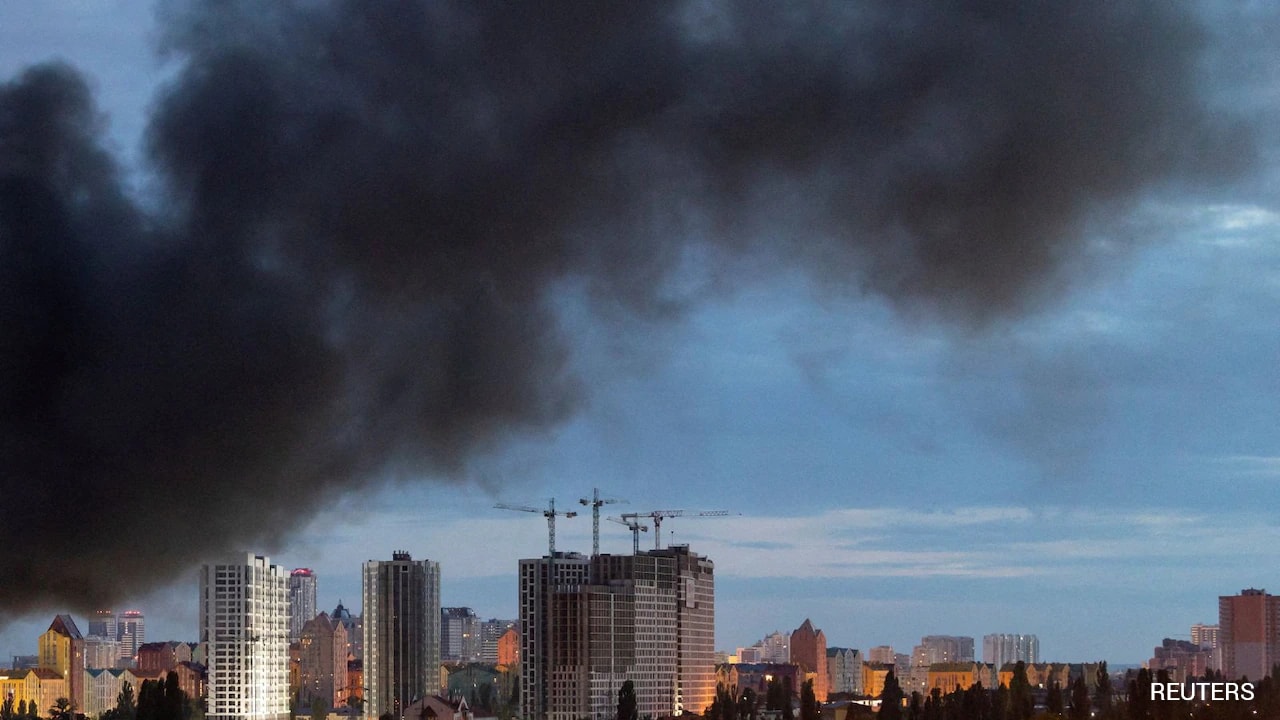
The mid-July 2026 escalation in long-range aerial strikes between the Russian Federation and Ukraine reveals a deep-seated structural asymmetry in contemporary attrition warfare. While standard media accounts report the human toll linearly—quantifying localized incidents such as the nine casualties across the Dnipropetrovsk, Kherson, Zaporizhzhia, and Samara regions—they fail to diagnose the underlying strategic mechanics. The current phase of the conflict is no longer defined by territorial maneuver, but by a competitive optimization of deep-strike cost curves, structural bottlenecks in global air defense manufacturing, and the deliberate targeting of economic infrastructure to induce domestic destabilization.
To evaluate this operational shift, the strategic vectors of both state actors must be parsed through quantified frameworks rather than observational prose.
The Strategic Geometry of Contemporary Deep-Strike Operations
The cross-border engagements of July 2026 demonstrate two fundamentally distinct operational doctrines. Russia relies on heavy, capital-intensive ballistic and cruise missile salvos integrated with mass-produced loitering munitions to overwhelm fixed air defense geometry. Ukraine utilizes low-signature, long-range unmanned aerial vehicles (UAVs) optimized for asymmetric economic disruption against Russian industrial nodes.
+-----------------------------------------------------------------------------+
| Russian Vector: Capital-Intensive Mass Interdiction                         |
| [Ballistic/Cruise Missiles + Geran Salvos] ---> [Saturated Air Defenses]    |
| Impact: Depletion of High-Cost Interceptors & Urban Infrastructure Attrition|
+-----------------------------------------------------------------------------+
| Ukrainian Vector: Asymmetric Industrial Disruption                          |
| [Low-Cost Long-Range UAVs] ---> [Energy/Logistics Throttle Nodes]           |
| Impact: Micro-Economic Deprivation (Syzran Refinery, Maritime Transport)    |
+-----------------------------------------------------------------------------+
The Three Pillars of the Russian Kinetic Vector
The Russian Federation's current offensive posture operates via a highly coordinated multi-tiered strike matrix designed to exploit critical gaps in Ukraine’s air defense architecture.
- Ballistic Saturation: The systematic employment of high-velocity ballistic missiles targeted at urban logistical centers and industrial enterprises, such as the strikes hitting the Kryvyi Rih industrial complex in the Dnipropetrovsk region. Ballistic profiles minimize reaction windows and demand specialized, high-tier interception assets.
- Volumetric Depletion: The deployment of low-cost loitering munitions in sustained nocturnal waves. These assets are not primarily deployed for absolute destruction, but to force the premature expenditure of finite Ukrainian surface-to-air missile (SAM) stockpiles.
- Strategic Distraction: Executing complex aerial maneuvers that force Ukrainian air defense command to realign radar footprints away from the front lines, creating localized vulnerabilities in battlefield interdiction.
The Cost Function of the Ukrainian Counter-Vector
Conversely, Ukraine's operational calculus relies on an asymmetric cost function. Lacking equivalent stockpiles of heavy ballistic systems, Kyiv utilizes long-range UAVs to target high-value economic and logistical infrastructure inside the Russian Federation and occupied territories.
The strike on the Syzran oil refinery in the Samara region—located approximately 800 kilometers from the Ukrainian border—illustrates this mechanism. By utilizing a low-cost composite drone to damage fractional distillation towers, Ukraine imposes a disproportionate financial and industrial penalty. The repair of specialized refining infrastructure requires component parts restricted by international sanctions, turning a low-cost tactical strike into a multi-month economic bottleneck. Similarly, UAV operations targeting maritime assets in the Sea of Azov and the Azov-Black Sea maritime canal disrupt the secure transit of military logistics, shifting the burden of domestic security onto Russian internal defense forces.
The Global Interceptor Deficit and Air Defense Bottlenecks
The structural crisis underlying Ukraine's defensive posture is not a failure of tactical execution, but an inescapable reality of global defense manufacturing capacity. The contemporary theater has exposed a critical global imbalance: the consumption rate of advanced air defense interceptors far outpaces western industrial production capacity.
The Interception Asymmetry Formula
The operational strain on air defense networks can be modeled by analyzing the relationship between vector influx volume and interceptor replenishment rates. Let $V_i$ represent the volume of incoming ballistic and cruise threats, and $C_d$ represent the unit cost of a low-tier loitering munition used as a precursor decoy. The defensive burn rate ($B_r$) is dictated by the mandatory deployment of high-tier interceptors ($I_h$) required to guarantee a high probability of kill ($P_k$) against complex ballistic profiles.
$$B_r = \sum (V_i \cdot P_k) + \alpha C_d$$
Where $\alpha$ represents the systemic friction coefficient caused by sensory saturation. When $\ B_r \ $ structurally exceeds the international manufacturing replenishment rate ($R_m$), a systemic air defense deficit occurs.
This mathematical reality explains the operational strain observed throughout July 2026. While the United States has granted authorization for Ukraine to integrate domestic manufacturing concepts with U.S.-designed Patriot air defense systems, the lead time for heavy industrial assembly lines spans several months to years.
The Geopolitical Supply Chain Split
The capability bottleneck is further exacerbated by shifting geopolitical priorities in Washington and Brussels. The intensification of military engagements in the Middle East has created an acute supply chain friction point, as global stockpiles of Patriot interceptors and standard missile variants are diverted across multiple competing theaters. Consequently, Russia's escalation of ballistic strikes since early July deliberately exploits this specific window of international supply chain fragmentation.
Structural Impact on Maritime and Industrial Supply Chains
The tactical outcomes of these exchanges directly alter the logistics of energy production and maritime transport. The geographical distribution of the recent strikes signals a shift away from purely administrative targets toward vital infrastructure nodes.
The Maritime Logistics Throttle
The damage inflicted on a tanker in the Azov-Black Sea maritime canal, combined with ongoing drone strikes in Taganrog Bay, establishes a persistent risk premium for regional commercial shipping.
- Insurance Capital Escalation: Commercial maritime insurers respond to localized hull damage by dramatically increasing War Risk Additional Premiums (WRAPs), rendering standard transport routes economically unviable for un-subsidized merchant fleets.
- Naval Asset Redirection: To secure critical maritime supply lines, Russia is forced to redeploy naval patrol vessels from offensive or auxiliary postures to fixed escort duties within internal waterways.
- Intermodal Bottlenecks: Disruption within the Black Sea maritime infrastructure forces a rapid transition to rail and overland logistics networks, overloading domestic supply lines that are already operating at peak capacity.
Industrial Attrition Mechanics
The targeting of domestic industrial enterprises within Ukraine, alongside Russian refining nodes, represents a mutual strategy of structural degradation. When an industrial enterprise in Kryvyi Rih or an energy node in Odesa is compromised, the broader impact is felt throughout the downstream supply chain. The loss of localized electrical generation or heavy manufacturing capacity permanently degrades the host nation’s long-term defense sustainability, turning tactical aerial engagements into permanent structural deficits.
The Paris Diplomatic Framework and Geopolitical Leverage
The timing of these intensified kinetic operations is directly linked to the diplomatic calendar. The escalation occurred precisely twenty-four hours before scheduled diplomatic assemblies in Paris, where Ukraine’s international allies aimed to negotiate multilateral frameworks to pressure Moscow toward a cessation of hostilities.
In modern conflict dynamics, kinetic escalation on the eve of diplomatic summits serves as a rational mechanism for leverage optimization. For Moscow, a high-intensity demonstration of ballistic dominance signals to Western co-signatories that the financial and material cost of sustaining Ukraine's air defense umbrella will continue to escalate exponentially. This kinetic pressure is calculated to induce war fatigue among European partners and encourage concession-oriented frameworks.
For Kyiv, executing deep strikes into the Samara and Rostov regions serves as a counter-demonstration of strategic reach. It signals to international stakeholders that Ukraine retains the asymmetric capacity to penalize Russian state revenue streams, thereby justifying continued investments in long-range precision weaponry and domestic defense initiatives.
Strategic Play: Optimizing Asymmetric Air Defense Realignment
To counter the systemic interceptor deficit before next-generation manufacturing lines become fully operational, defensive command structures must abandon the doctrinal expectation of total airspace sanitization. Resources must be strictly partitioned through an objective tier-based asset valuation framework.
High-altitude, scarce ballistic interceptor systems must be explicitly reserved for irreplaceable industrial bottlenecks and sovereign command-and-control nodes. Urban residential centers and secondary infrastructure must rely on mobile, kinetic anti-aircraft artillery units and localized electronic warfare (EW) jamming webs to disrupt the guidance systems of low-cost loitering munitions. Accepting localized kinetic impact on non-strategic assets is a brutal but mathematically necessary prerequisite to preserve the core industrial base required to sustain a multi-year war of attrition. Non-strategic distribution of top-tier interceptors guarantees systemic failure when facing sustained, asymmetric volume.
This video provides an analytical overview of the evolving geopolitical and military dynamics governing the conflict's current long-range strike phase. Russia Strikes Ukraine as UN Reports Highest Civilian Death Toll Since 2022