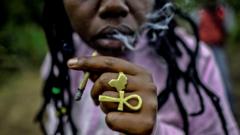
The Kenyan High Court just handed down a ruling that everybody saw coming, but for all the wrong reasons. On July 15, 2026, Justice Bahati Mwamuye dismissed a petition by the Rastafari Society of Kenya to exempt its members from the country's draconian cannabis laws. The media is running its standard, lazy playbook: portraying this as a simple clash between conservative state laws and a marginalized religious minority.
They are missing the entire point.
This ruling is not a failure of religious exemption. It is a stark exposure of the fundamental flaw in how modern states define "legitimate" belief systems. By demanding that Rastafarians "prove" cannabis is an essential tenet of their faith, the court did not just uphold a drug ban; it asserted the state’s authority to act as an arbiter of divine truth.
It is time to dismantle the naive consensus that religious freedom exists to protect the unorthodox. It does not. It exists to protect the highly organized, politically useful, and structurally orthodox.
The Fallacy of the Legal Litmus Test for Faith
Let us look at the legal mechanics of how the petition failed. The court ruled that the petitioners failed to establish a sound constitutional and legal foundation to prove cannabis is an "essential tenet" of Rastafari.
Consider the sheer absurdity of this legal standard. To gain a constitutional right to worship, a decentralized, anti-colonial, and deeply personal spiritual movement is expected to present a rigid, centralized catechism that satisfies a secular judge. It is a catch-22 designed to ensure minority faiths always lose.
If a faith does not have a Vatican, a Canterbury, or a written code dating back a thousand years, the state simply decides its rituals are optional hobbies.
When the state demands that a religion prove a practice is "essential," it is asking a court of law to play theologian. If a Rastafarian tells you that smoking "ganja" or "holy herb" is their bridge to Jah, by what secular jurisprudence can a judge declare, "No, it is not"? The moment a court begins parsing which parts of a spiritual path are load-bearing and which are decorative, the concept of religious freedom is already dead.
The Hypocrisy of "Selective" Toleration
Kenya is a country that prides itself on its post-colonial identity, yet its legal framework remains fiercely tethered to British colonial-era moral panics. The Narcotic Drugs and Psychotropic Substances (Control) Act of 1994, which carries a 10-year prison sentence for simple possession, is a direct inheritance of prohibitionist structures designed to control populations, not protect public health.
The supreme irony is that the Kenyan state happily tolerates other, more mainstream religious practices that bypass standard civic laws:
- Financial Exemptions: Mainstream churches handle millions of shillings tax-free, often with zero state oversight on how those funds are acquired or spent.
- Noise Pollution: Neighborhoods are blasted daily with early morning calls to prayer and late-night, high-decibel church crusades that openly violate environmental noise regulations, with absolute impunity.
- Medical Neglect: Certain mainstream Christian sects routinely refuse life-saving medical treatments, blood transfusions, or vaccinations for minors on religious grounds, and the state rarely intervenes until a child dies.
Yet, a Rastafarian smoking a naturally occurring herb in the quiet of their temple is deemed an existential threat to the fabric of Kenyan society. This is not about public safety. It is about social class, respectability politics, and who gets to define what "God" looks like.
The Economic Absurdity of the Cannabis Status Quo
Even the High Court judge, while dismissing the petition, had to admit the glaring contradiction on the ground. Justice Mwamuye noted that the widespread recreational use of cannabis in Kenya suggests the current law is "too harsh" and that the "status quo appears untenable."
Underneath the moral grandstanding of the ruling lies a massive, hypocritical black market. Kenya’s draconian laws do not stop people from consuming cannabis; they merely ensure that the profits go directly to corrupt police officers taking bribes and cartel bosses running street distribution.
Imagine a scenario where Kenya legalized, regulated, and taxed cannabis instead of throwing young men into overcrowded cells for possessing a joint.
According to data from countries that have taken the leap, the economic windfall is undeniable. Yet, Kenya chooses to spend millions of taxpayers' shillings policing a plant, filling prisons with peaceful adherents of a faith that preaches non-violence, pan-Africanism, and clean living.
The state is actively choosing to fund a police state over a regulated market. It is an economic tragedy masquerading as moral righteousness.
The Real Danger of the Ruling
The danger of this ruling goes far beyond the Rastafarian community. By validating the state's power to dissect and reject minority religious practices, the High Court has drawn a dangerous line in the sand.
If the state can decide that Rastafarians do not "need" cannabis to worship, what is stopping it from deciding that other minority groups do not "need" their specific dietary laws, their specific dress codes, or their specific holy days?
Once you accept the premise that the government gets to write the rulebook for your relationship with the divine, you no longer have religious freedom. You have a state-licensed permit to worship, subject to renewal based on how quiet you keep and how well you conform.
The Rastafari Society of Kenya has announced they will appeal the decision. They should. But the rest of the public needs to wake up and realize that this is not a niche battle about a joint. It is a battle over who owns your conscience: you, or the state.