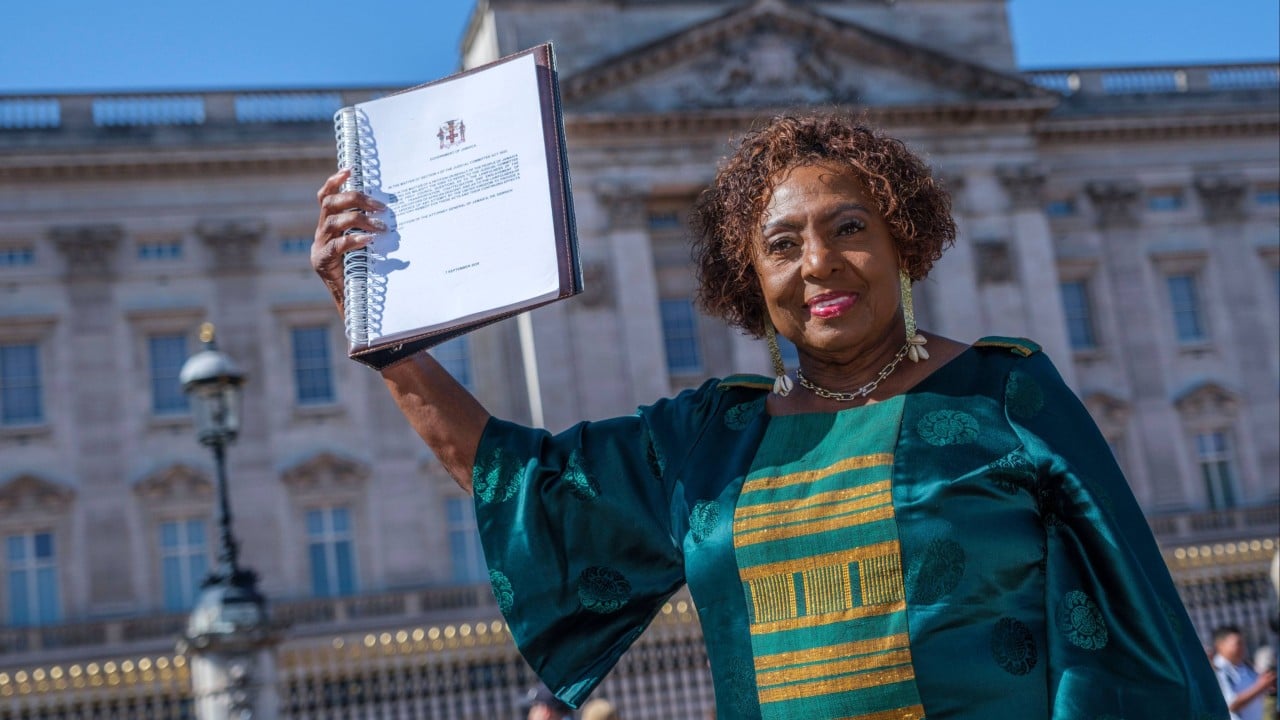
Another state visit, another petition marched up to the steps of a British monarch, and another round of headlines pretending international law works like a Kickstarter campaign. Jamaican politicians love nothing more than flying to London, dropping the word reparations into a microphone, and flying back home to coast on the applause of a frustrated electorate. It plays well on the evening news. It looks militant. It feels like historical justice finally knocking on Buckingham Palace's heavy oak doors.
It is also an expensive distraction from domestic failure.
Strip away the diplomatic theater and the carefully choreographed photo ops outside the UK Foreign Office, and you are left with a simple truth that local leadership refuses to own: demanding a check from London is far easier than fixing the structural rot in Kingston.
The standard narrative sold to the public runs on pure moral clarity. Britain grew wealthy on the sugar and slave trade, Jamaica suffered generational plunder, therefore a debt is owed. No serious historian disputes the ledger of colonial extraction. The British Empire extracted staggering amounts of wealth from the Caribbean, leaving behind economies engineered solely for export and societies stripped of capital. The moral case has been settled for decades. Everyone agrees the crime happened.
The lazy consensus breaks down the moment you ask the operational question. Who gets the money?
When Jamaican ministers file petitions targeting King Charles III, they talk in grand abstractions about national development, health infrastructure, and educational parity. But cash transfers between sovereign states or royal houses do not magically bypass corrupt procurement processes or systemic institutional decay. If the British Crown wired ten billion pounds directly into the Consolidated Fund of Jamaica tomorrow, the political elite would descend on the windfall like locusts. Bureaucratic bloat, political patronage networks, and entrenched corruption would absorb the capital before a single new hospital wing opened its doors.
We have historical precedents for this exact dynamic. Foreign aid packages and sovereign settlements routinely fail when the recipient state lacks the internal governance architecture to deploy capital productively. Throwing money at a post-colonial economy without reforming the domestic tax base, the legal system, and the security apparatus is like pouring water into a bucket with a rusted-out bottom. You stay busy pouring, but the bucket never fills.
Governments in Kingston weaponize the reparations debate as a perpetual smoke screen. Whenever inflation spikes, murder rates climb, or the Jamaican dollar slides against the greenback, a minister suddenly remembers that Buckingham Palace owes a debt. It is a brilliant deflection mechanism. It shifts public anger away from local incompetent governance and points it straight across the Atlantic. Why hold your Member of Parliament accountable for broken sewage lines when you can stare angrily at a portrait of a British monarch instead?
The monarchy knows this game better than anyone. King Charles and his advisors handle these petitions with a masterclass in polite evasion. They express "deep sorrow," acknowledge the "painful history," and quietly redirect the conversation to commonwealth partnerships and shared futures. They can afford to be gracious because they know a petition is legally toothless. Under international law, sovereign immunity shields modern states from retroactive liability for historical atrocities committed by previous regimes centuries ago. There is no international court with jurisdiction to garnish the royal estate for seventeenth-century sugar plantations.
Local activists and politicians who pretend a legal breakthrough is just one more petition away are either profoundly naive or deeply cynical. They are selling a fairy tale to a population that deserves harsh, unvarnished reality.
Real economic sovereignty is not something you beg a former colonial power to hand over on a silver platter. It is built from the ground up through aggressive internal restructuring. Look at nations that actually clawed their way out of economic subordination. They stopped waiting for historical apologies and started rewriting their own tax codes, dismantling domestic monopolies, investing heavily in technical education, and enforcing strict anti-corruption laws that put white-collar thieves behind bars regardless of their political party affiliation.
Jamaica has some of the highest electricity costs in the Western Hemisphere, a stagnant manufacturing sector, and a brain drain that ships its sharpest minds straight to Miami and Toronto. None of those crises are caused by King Charles. They are sustained by a domestic oligarchy and an unimaginative political class that prefers managing a stagnant economy to risking the upheaval required to modernize it.
Filing petitions in London costs nothing and buys months of favorable headlines. Building a competitive, transparent domestic economy requires taking on powerful local vested interests, rewriting labor laws, and facing down domestic cartels. That is why politicians prefer the plane ride to the UK.
The next time a Jamaican minister packs a leather briefcase with legal briefs destined for the British monarchy, do not look at London. Look at the balance sheets back home. Look at the crumbling infrastructure in Montego Bay and the underfunded classrooms in rural parishes. That is where the real debt is owed, and that is where the people tasked with fixing it are looking the other way.
Stop waiting for a royal check that will never clear. The accountability you are looking for is sitting in Kingston, and it is time to stop letting them off the hook.