The air inside the lab didn’t smell like glory. It smelled of ozone, scorched copper, and the stale sweat of men who hadn’t slept since Tuesday. Archimedes wasn't thinking about "redefining the rules of engagement" when he looked out at the Roman fleet bobbing in the Syracuse harbor. He was thinking about light. Specifically, how to catch a sunbeam and turn it into a physical weight that could snap a mast like a dry twig.
History records the burning mirrors of Syracuse as a legend, a whispered tale of ancient death rays. But the reality of scientific breakthroughs in warfare is never about the gadget itself. It is about the moment a human being realizes that the physical laws of the universe—the same ones that govern a falling apple or a rising tide—can be bent to end a life from a distance.
Every era has its Syracuse. Every generation stumbles upon a way to make the impossible lethal.
The Chemistry of Fear
Before 1915, poison was something you slipped into a tea cup or found on the tip of a dart. It was intimate. It was personal. Fritz Haber changed that. He didn't just invent a weapon; he invented an atmosphere.
Imagine standing in a muddy trench in Ypres. The wind shifts. You see a sickly, yellow-green cloud creeping across the earth. It looks like a living thing. It moves with a slow, heavy grace, hugging the contours of the dirt, spilling into the very holes where you’ve hidden for safety. This wasn't a bullet you could dodge or a shell you could hear screaming from the sky. This was the air itself turning against you.
Haber’s mastery of nitrogen and chlorine meant that for the first time, a soldier's own lungs became the site of the battlefield. The breakthrough wasn't just the chemistry. It was the psychological realization that we could weaponize the most basic requirement for life. When the "rules" of war were rewritten here, they were rewritten in the gasping breaths of men who realized that nowhere—not even the air—was neutral anymore.
The Sound of the Invisible
War used to be a spectacle of sight. You saw the cavalry charge; you saw the banners fly. Then came the submarine.
Suddenly, the ocean was no longer a surface. It was a volume. The development of SONAR (Sound Navigation and Ranging) during the early 20th century turned the silent deep into a grid of pings and echoes. It forced us to develop a new sense. We had to learn to "see" with our ears.
Think of the operator sitting in a cramped, humid hull, headphones pressed so tight his ears bleed. He isn't looking at a screen with high-definition graphics. He is listening for a heartbeat. He is listening for the rhythmic thrum of a propeller miles away, hidden by a billion tons of seawater. SONAR didn't just find boats. It stripped away the last great hiding place on Earth. It proved that science could reach into the darkness and pull out a target.
The Split Atom and the End of Scale
On a Tuesday in 1945, the scale of human conflict broke.
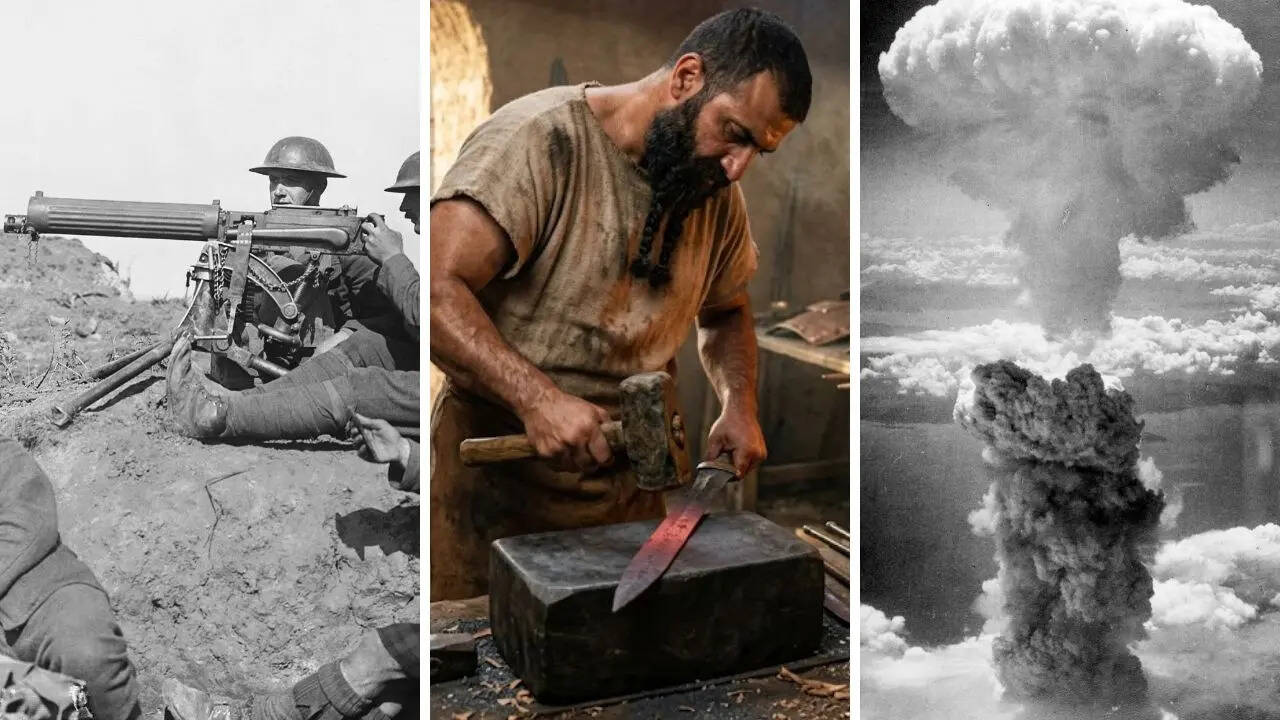
Up until that point, if you wanted to destroy a city, you needed a thousand bombers, ten thousand men, and a month of raids. After the Manhattan Project, you only needed one plane. And one heart of plutonium.
The breakthrough of nuclear fission wasn't just a triumph of physics; it was a moral vertigo. J. Robert Oppenheimer famously quoted the Gita, but the men on the ground felt something more visceral. They felt the heat of a second sun. They saw shadows burned into concrete. The rules of war didn't just change; they became irrelevant. War had always been about winning. Suddenly, it was about preventing the end of everything.
We moved from the era of "How do we beat them?" to "How do we live with the fact that we can erase them?" The science was complex—$E=mc^2$—but the human result was a simplicity so terrifying it froze the world for forty years.
The Silent Eye in the Sky
In 1957, a rhythmic beep-beep-beep drifted down from the vacuum of space. Sputnik was a small metal ball, but it was a spear through the chest of traditional sovereignty.
Before satellites, a nation had borders. You had walls. You had airspace. Then, science put a camera where no wall could reach. The development of orbital surveillance took the "fog of war" and burned it away with high-resolution lenses.
Consider the modern commander. They aren't squinting through binoculars from a hilltop. They are looking at a digital feed from 200 miles up. They can see the heat signatures of engines warming up in a desert. They can see the shape of a briefcase in a man's hand. This breakthrough turned the entire planet into a glass house. Privacy died, and with it, the ability to move an army in secret. The rules were rewritten to favor the one who could process the most data, not the one with the bravest soldiers.
The Algorithm of Intent
We used to think of weapons as hardware. Steel, lead, gunpowder. Today, the most devastating breakthroughs are lines of code.
Cyber-warfare and the rise of autonomous systems have shifted the battlefield into the realm of the abstract. If you can shut down a power grid with a keystroke, do you need an army? If an AI can decide to fire a missile in three milliseconds—faster than any human synapse can fire—who is actually in charge of the war?
The human element here is a strange, receding tide. We are creating systems that think for us, target for us, and eventually, might kill for us without a single person having to look another in the eye. It is the ultimate distance. It is Archimedes’ mirror, but the mirror is made of silicon, and the sun is the collective data of the human race.
The Biology of the Targeted
In the quiet corners of high-security labs, we are currently rewriting the rules again. This time, the weapon is the map of ourselves: the genome.
The breakthrough of CRISPR and gene editing means that we are approaching a day where a virus could be tuned. Not a blind plague that kills everyone, but a selective one. A weapon that looks for a specific genetic marker. It is the most terrifying evolution of the chemical clouds of Ypres.
This isn't about a better bomb. It’s about the fact that our very identity—our DNA—could become the trigger.
We often talk about these breakthroughs as if they are milestones of progress. We use words like "innovation" and "discovery." But look closer at the faces of the people who make them. Look at Haber, whose wife took her own life in protest of his gas. Look at the scientists at Los Alamos who signed petitions begging the government not to drop the bomb they had just spent years building.
Science is a tool. It is a sharp, cold, indifferent tool.
The rules of war change because we find new ways to ignore our instincts. We find ways to kill from further away, with more efficiency, and with less personal cost. Each breakthrough is a layer of insulation between the finger and the trigger.
The Roman ships in Syracuse eventually burned. Not because the sun changed, but because a man figured out how to focus it. We have spent two thousand years focusing the sun, the atom, the gene, and the bit. We are very good at the science. We are still struggling with the reflection in the mirror.
The next rule won't be written in a lab. It will be written in the moment someone decides not to use what they’ve built.
But history is a long, loud argument to the contrary. The mirrors are always polished. The code is always running. The wind is always shifting.
And somewhere, in a lab that smells of ozone and scorched copper, someone is looking at a sunbeam and seeing a sword.