Salt crusts on the eyelashes of a nineteen-year-old sailor standing watch on a destroyer deck, five hundred miles from the nearest familiar kitchen. He cannot see the shore. He cannot see the enemy. He sees only the endless, grey-green swell of the Arabian Gulf, repeating itself to the horizon like a bad dream.
He is holding a pair of heavy binoculars, scanning the gray water for anything that doesn't belong. A dhow riding low in the waves. A fast attack craft cutting a white scar across the surface. A silent, submerged shadow slipping beneath the thermocline.
For months, he has stood here while commanders miles away talk about mathematics, logistics, and endurance. They talk about iron rings and choke points. They speak of sea control as if it were an abstraction drawn on a whiteboard in a Pentagon briefing room.
It is not a whiteboard. It is a choke hold.
Pete Hegseth recently laid out a blunt assessment that cut through the usual diplomatic fog: the United States Navy possesses the raw capability to maintain an indefinite naval blockade against Iran. No hesitation. No expiration date. Just a steel curtain dropped across the shipping lanes of West Asia, held tight for as long as political will and engine oil hold out.
To read that claim in a headline is to encounter a sterile fact. To understand what it means requires looking closer at the mechanics of isolation, the history of naval strangulation, and the quiet, grinding reality of what happens when the sea itself becomes a wall.
The Geography of Suffocation
Look at a map of the region. The Persian Gulf is not an ocean; it is a bathtub with a very narrow drain.
That drain is the Strait of Hormuz. At its narrowest point, the shipping channels are barely two miles wide inbound and two miles wide outbound, squeezed between the rugged mountains of Oman and the flat, sun-baked coast of Iran. Through this tiny corridor flows a massive artery of global energy. A significant portion of the world's petroleum output threads this needle every single day.
When a superpower talks about a blockade, it is not talking about parking a single battleship in the middle of the ocean and waiting. It is talking about controlling that drain.
Imagine a tollbooth on a highway where the toll-taker has an aircraft carrier.
Every tanker, every container ship, every fishing boat becomes a variable in a massive, high-stakes equation. To enforce an indefinite blockade means stopping every suspicious vessel, boarding them in open water, checking manifests, turning back contraband, and daring anyone to test the resolve of the perimeter.
Historically, naval blockades are the ultimate war of attrition. They do not rely on sudden, thunderous explosions. They rely on silence. They rely on the quiet realization in a capital city thousands of miles away that the shelves are emptying, the foreign reserves are dropping, and the fuel tanks are running dry.
During the British naval blockade of Germany in the First World War, the guns were often quiet, but the impact was devastatingly real. People remember the trenches of the Somme, but many forget the silent hunger in Berlin. Blockades work by turning time into a weapon.
Inside the Circle
Let us step aboard one of those grey-hulled sentinels patrolling the outer perimeter.
The air conditioning hums a constant, low-frequency drone that never stops, day or night. Below decks, the smell of diesel, coffee, and damp wool hangs thick in the passageways. Sailors move with the practiced, rolling gait of people who have forgotten what it feels like to stand on solid ground that doesn't tilt.
Why can the United States maintain this indefinitely? The answer is not just about ships. It is about a logistical machine so vast and terrifyingly complex that most people cannot comprehend it.
A modern carrier strike group is an island that travels at thirty knots. It carries its own floating fuel stations, its own repair shops, its own floating hospitals, and its own mobile airfields. When a gasket blows in the middle of the night thousands of miles from home, a tender ship delivers a replacement. When the crew runs low on fresh vegetables, a replenishment ship pulls alongside in the dark, transferring pallets of food across a roaring expanse of black water while both vessels plow forward at high speed.
This is the hidden engine behind Hegseth's claim. The capability is not a matter of whether the Navy can do it for a week or a month. The United States Navy is structurally built to exist at sea. Ships are designed to stay deployed for months at a time, rotating crews via air transport while the hulls remain on station.
Yet, capability is not the same as cost. And cost is where the abstract theory of a blockade collides with messy reality.
The Price of Constant Vigilance
A blockade is a two-way street of tension.
When you lock a door from the outside, you must stand by that door forever. You cannot walk away to check on other rooms. Every destroyer assigned to patrol the Gulf is a destroyer not present in the South China Sea. Every squadron of F-35s flying combat air patrols overhead is burning through flight-hour limits that were meant to last decades.
Consider the enemy on the other side of the wall. Iran is not a passive spectator waiting to starve quietly. Over decades, Tehran has built a doctrine designed specifically to make a naval blockade a nightmare to enforce.
They call it asymmetric warfare. Instead of matching the United States ship for ship—a game they know they would lose in an afternoon—they built swarms of fast attack craft armed with heavy machine guns and anti-ship missiles. They built underground missile silos carved into coastal cliffs. They planted thousands of naval mines along the seabed, waiting for an excuse to turn the shipping lanes into a minefield.
A blockade means every single one of those small, fast boats becomes a potential threat. It means every helicopter taking off from a flight deck is playing a high-stakes game of hide-and-seek with coastal radar batteries.
The sailor on watch knows this. He cannot see the missiles hidden in the coastal caves across the water, but he knows they are there. He knows that an indefinite blockade is not a static wall; it is a living target. It invites constant provocation. It invites drones buzzing the flight deck. It invites cyberattacks on navigation systems. It invites the slow, corrosive erosion of nerves among crews who must maintain 100% alertness against a threat that can materialize in three minutes.
When Theory Meets the Shore
Step away from the gray water for a moment. Look at what happens on the other side of the iron circle.
In Tehran, a merchant walks through the Grand Bazaar. He touches rolls of imported fabric, but his mind is on the ledger. The cost of shipping has multiplied. Insurance rates for vessels entering the Gulf have spiked to astronomical levels. Cargo ships are lingering further out in the Indian Ocean, hesitant to take the final step into the narrow waters where the gray ships wait.
This is the true objective of naval strangulation. It is designed to squeeze the economy until the pressure inside the country forces a shift in behavior.
But history teaches us a stubborn lesson about blockades. Human beings are remarkably resilient, and authoritarian governments are exceptionally good at shifting the pain of a blockade onto the population while insulating the ruling elite. The merchant in the bazaar pays more; the ordinary worker finds basic goods out of reach. Yet the leaders in their fortified compounds continue to fund their programs, finding workarounds through land borders, smuggling networks, and sympathetic neighbors.
A blockade can choke an economy, but it rarely achieves a clean, tidy collapse on a predictable timeline. Instead, it creates a permanent state of low-grade crisis—a cold war fought with customs forms, boarding axes, and radar sweeps.
The Weight of the Horizon
Back on the deck of the destroyer, the sun is beginning to dip below the horizon, painting the sky in violent shades of purple and burnt orange.
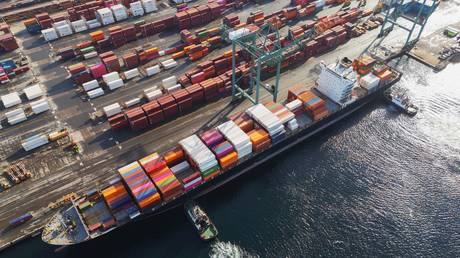
The young sailor blinks against the glare reflecting off the water. His shift is almost over, but the sea will not change. The dark shape of a distant container ship moves slowly across the twilight, its navigation lights blinking a rhythmic red and green. It is waiting for clearance. It has been waiting for hours.
Behind it, thousands of miles of open ocean stretch back to home ports where families are sleeping, eating breakfast, and walking under quiet trees, entirely insulated from the artificial gravity of this narrow strip of water.
Hegseth is right about the metal and the machinery. The ships can stay. The fuel can be burned. The patrols can be flown.
The real question is not whether the United States Navy can maintain an indefinite blockade. The machine is too big, too powerful, and too disciplined to fail at the mechanics of it. The real question is how long a superpower wishes to stand on a rolling deck, staring into the dark, holding a door shut against a world that refuses to stand still.
The horizon remains empty, except for the grey ships, waiting for the next blip on the radar.