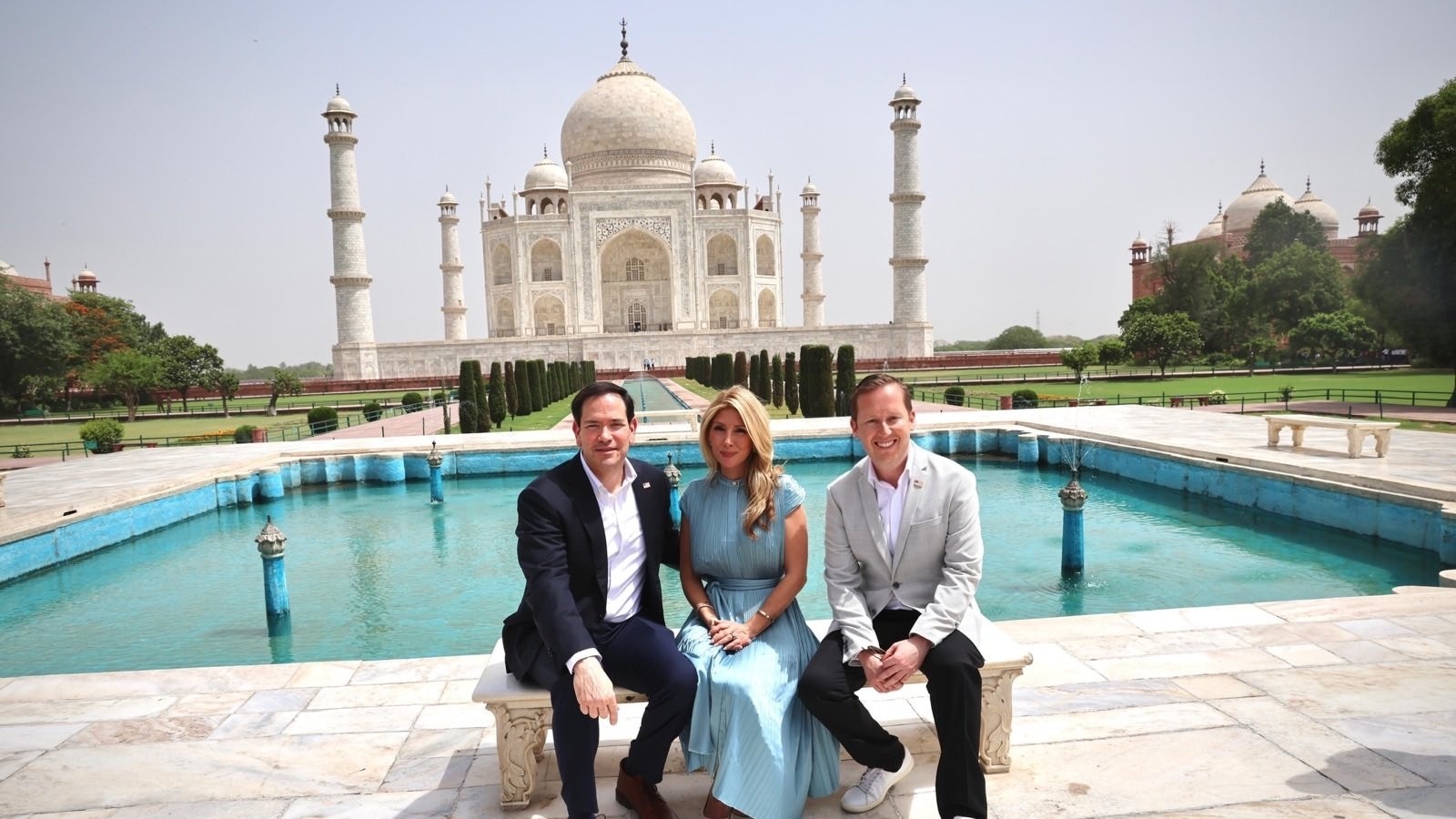
You really can't make this stuff up. US Secretary of State Marco Rubio decided to take a quick break from a high-stakes diplomatic marathon to play tourist at the Taj Mahal. He ditched his tie in the blistering 40-degree Agra heat, smiled for the cameras with his wife Jeanette, and signed the guestbook calling the monument one of the love treasures of the world. He even cracked a joke about how the only other Taj Mahal he knew was Donald Trump’s failed casino in Atlantic City.
It was supposed to be a textbook, drama-free diplomatic photo-op ahead of the Quad foreign ministers' meeting in New Delhi. Then Iran's consulate in Hyderabad logged onto X and chose absolute chaos.
The Iranian consulate reposted Rubio’s picture with a caption dripping with historic condescension. They claimed that if Rubio actually knew history or architecture, he wouldn't have dared to pose there. The post argued that the Taj Mahal was built out of love for a Mughal emperor’s Iranian wife and crafted by the genius of Iranian architects. They used the moment to slam Washington for threatening to wipe out Iranian civilization during ongoing military tensions.
It was a masterclass in weaponized trolling. The only problem? Iran got its own history lesson completely wrong.
The Architectural Fact Check Iran Didn't See Coming
Geopolitical snark is great, but it works a lot better when your facts are straight. The Iranian consulate tried to claim the Taj Mahal as a purely Persian triumph to score points against an American diplomat. It completely backfired because the history of the Taj Mahal is far more complex than a simple nationalist flex.
Let's dissect the consulate's claim that the monument was built for an Iranian wife. They're talking about Empress Mumtaz Mahal, originally named Arjumand Banu Begum. While it is true that her family was of Persian nobility, she wasn't from Iran. She was born in Agra, India. She lived her entire life in India and died giving birth in Burhanpur. Calling her an Iranian wife is a massive stretch that completely ignores her identity as a Mughal royal born and bred on Indian soil.
Then there is the claim about Iranian architects. This is where the consulate’s history lesson really falls apart.
The Taj Mahal wasn't imported wholesale from Isfahan. It is the ultimate evolution of Indo-Islamic architecture. This unique style blended Persian, Islamic, Ottoman Turkish, and indigenous Indian traditions. The chief architect of the complex was Ustad Ahmad Lahori. Guess where he was from? Lahore. He wasn't a Persian transplant; he was a resident of the Mughal Empire.
While Lahori certainly incorporated stunning Persian elements, like the massive dome and the charbagh garden layout, he relied heavily on local talent. Thousands of stonecutters, masons, and inlayers from across India worked alongside artisans from Central Asia. The iconic white marble didn't come from Iran either. It was hauled from the quarries of Makrana in Rajasthan, India.
Why the Internet is Laughing at this Diplomatic Tiff
The internet loves a good ratio, and the Iranian consulate's post quickly turned into a historical battleground. Scholars and casual onlookers immediately pointed out the irony of a diplomatic mission weaponizing a 17th-century monument to love while the US and Iran are locked in tense, real-time negotiations to end a brutal conflict.
The clash felt especially absurd because of Rubio's casual attitude during the visit. While the consulate was busy typing out furious paragraphs about civilizational destruction, Rubio was joking with reporters about Atlantic City bankrupcy filings. The contrast between Washington's relaxed tourist diplomacy and Tehran's intense, passive-aggressive digital posture couldn't have been wider.
It also highlighted a deeper tension. Just days before this photo-op, Iran formally rejected comments from Rubio accusing them of holding the global energy market hostage in the Strait of Hormuz. The consulate wasn't actually mad about Rubio sitting on Princess Diana's famous marble bench. They were using art history as a proxy war because they're losing the messaging battle over oil sanctions and military strikes.
What this Means for US India Ties
If Iran’s goal was to drive a wedge between the US and India by reminding everyone of the subcontinent's Islamic and Persian past, it didn't work. Rubio's four-day trip is laser-focused on strengthening security and economic ties between Washington and New Delhi, specifically to counter China's rising dominance in the Indo-Pacific.
Indian officials largely ignored the Twitter drama. They were too busy coordinating tight security for Rubio's upcoming meetings with the Quad alliance, which includes Japan and Australia. Local authorities in Agra did face some minor backlash for clearing out sections of the Taj Mahal and making regular tourists wait 100 meters away under a blazing sun, but that's standard protocol for a visiting top-tier US official.
If you're trying to win a geopolitical argument on social media, don't use art history as a weapon unless you have an academic receipt. Trying to claim an iconic Indian heritage site as an exclusive triumph of Iranian genius doesn't make the US look uneducated. It just makes the person tweeting look incredibly desperate for a win.
Next time a foreign diplomat visits a global wonder, the best move for rival embassies is to keep the text short, keep the history accurate, or simply leave the app closed.