The salt water stings when it gets into the cuts on your hands. Anyone who has spent long hours pulling drift plastic from the high-tide line knows this. It is a slow, Sisyphean ache. You bend down, your fingers close around a bleached fragment of a polyethylene container or a tangled knot of discarded fishing line, and you drop it into a mesh sack. By the time you reach the end of the cove, the sack is heavy, your lower back is throbbing, and you look back to see the tide already rolling in, depositing a fresh, glittering mosaic of modern convenience across the sand.
We are drowning in things that refuse to die.
Plastics were engineered to be immortal. That was their triumph and their curse. They defied rot, resisted rust, and ignored the patient, chewing teeth of bacteria that had spent millions of years breaking down organic matter. A single polypropylene bottle tossed into a coastal current can drift for centuries, fragmenting slowly into microplastics that infiltrate the food web, settling into the tissue of fish, birds, and eventually, us. For decades, our collective response has been industrial denial paired with manual labor. We build bigger landfills. We host weekend beach cleanups. We pat ourselves on the back for recycling a fraction of our waste while the rest accumulates in the silent gyres of the open ocean.
Then there is sunscreen.
We smear it on our children's shoulders before a day at the beach, trusting the creamy white lotion to protect their skin from the merciless summer sun. We rarely think about what happens next. When we plunge into the surf, those chemical UV filters wash off our skin by the ton. Oxybenzone and octinoxate drift down onto fragile coral reefs, blocking photosynthesis, bleaching vibrant ecosystems into ghost towns of white calcium carbonate. We protect ourselves by poisoning the very cradle of marine life.
It is a terrible irony. The modern world is built on a series of chemical compromises. Every convenience demands a hidden toll.
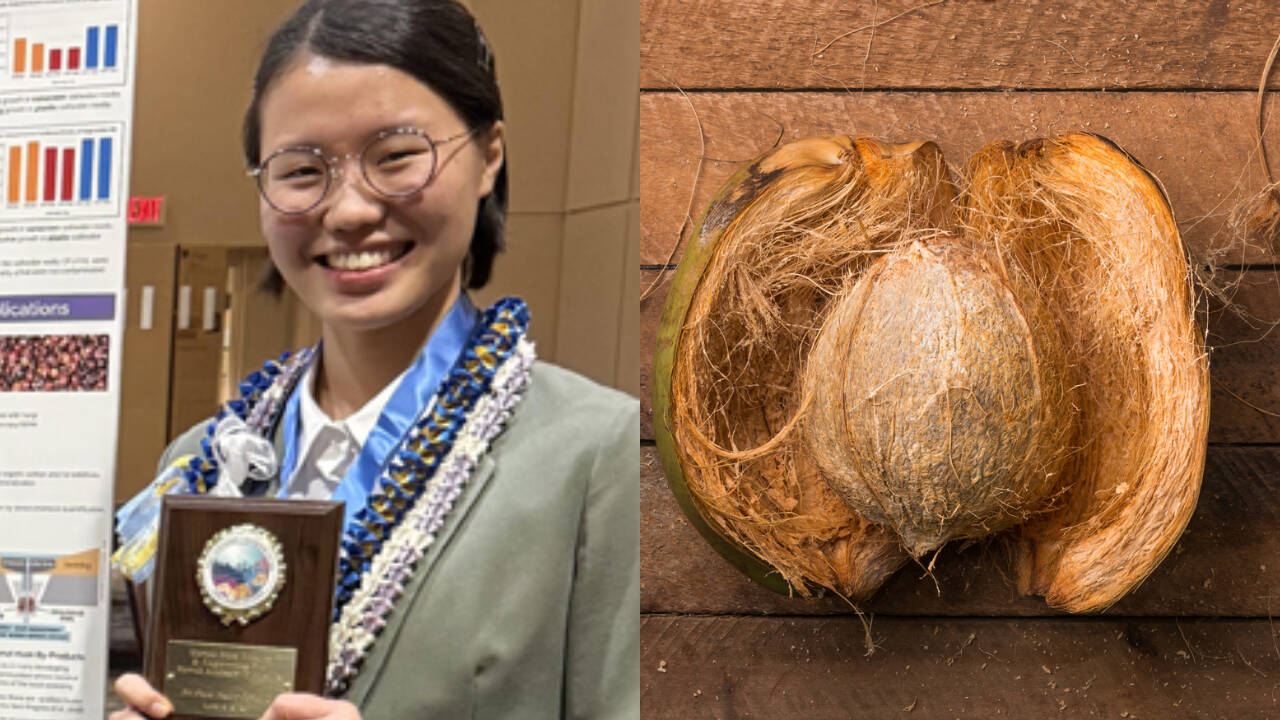
Enter a teenager from Hawaii named Vera Wang.
Pause for a moment and strip away the usual media framing. Forget the breathless tropes of the prodigy working magic in a sterile laboratory with glowing test tubes. The reality is much quieter, much dustier, and infinitely more human. Picture a basement workspace or a high school science lab lit by the harsh, flickering hum of fluorescent tubes. The air smells faintly of damp soil, old paper, and yeast.
Vera Wang did not look at a plastic-choked beach and decide to invent a corporate machine. She looked at the microscopic underworld beneath our feet.
Nature is infinitely patient. When humans introduced synthetic polymers into the ecosystem a little over a century ago, the planet did not simply surrender. Evolution is a relentless tinkerer. Given enough time, life finds a way to metabolize novelty. Fungi, in particular, are the great alchemists of the earth. They do not merely live in their environment; they digest it. They are the quiet cleanup crew of the forest floor, secreting powerful enzymes that can unlock stubborn carbon chains.
Wang began collecting soil samples from local environments, searching for wild strains of fungi capable of doing the impossible. This is where the story shifts from abstract environmental despair to the thrilling, methodical patience of experimental science. Imagine the tedium of it. Dozens of petri dishes. Weeks of waiting in the dark. Contaminated samples ruined by errant mold spores. The quiet frustration of checking an incubator day after day only to find dead colonies.
Most experiments fail. That is the dirty secret of science that textbooks rarely mention.
Yet persistence has its own gravity. Wang isolated specific fungal strains that demonstrated an uncanny appetite. Not for decaying wood or fallen leaves, but for the very materials we consider indestructible. Polyurethane. Polyethylene. The stubborn petrochemical chains that line our landfills and choke our waterways.
When exposed to these fungal cultures, the plastic did not merely soften or warp. It degraded. The fungi were metabolizing the synthetic polymers, using the carbon bonds as a source of nourishment. They were eating our trash.
Crucially, Wang's investigation did not stop at structural plastics. She turned her attention to the chemical ghosts we leave behind in the water: sunscreen filters. These complex organic compounds are notoriously difficult to filter out of municipal water treatment systems. They linger in aquatic ecosystems, mimicking hormones and disrupting aquatic life. Yet certain fungal enzymes possess a unique molecular architecture, a biological key that can unlock and break down these stubborn sunscreen compounds into harmless byproducts.
Consider what this means. We are not talking about a magical silver bullet that will instantly clear the Pacific Garbage Patch overnight. Science is rarely a Hollywood movie. The strains discovered by Wang operate on biological time, which is vastly different from our frantic, quarterly-earnings-driven human schedule. Fungi require specific temperatures, moisture levels, and nutrient balances to thrive. Scaling a biological remediation process from a petri dish to an industrial waste treatment plant is a monumental engineering hurdle.
The transition from a promising high school science project to a viable global solution involves years of genetic sequencing, bioreactor design, and rigorous peer review. Skeptics will rightly point out that introducing foreign or enhanced fungi into open ecosystems carries its own ecological risks. What happens if the organism mutates? What are the metabolic byproducts of plastic digestion? Are they toxic?
These are not reasons to dismiss the discovery. They are the necessary friction of progress.
We live in an era defined by a pervasive sense of helplessness. Turn on the news, and the environmental ledger is always written in red. We are told that our individual choices—reusing a mug, declining a plastic straw—are mere drops in an ocean of systemic failure. It is easy to succumb to a paralyzed apathy, believing the mess we have made is simply too vast to undo.
That is why Vera Wang's work matters so profoundly, and it has very little to do with trophy cases or science fair ribbons.
It matters because it rewrites our relationship with the natural world. For centuries, our industrial model has been adversarial. We conquer nature, we extract from nature, we pave over nature, and we dump our waste where nature cannot see it. We treat the planet as a warehouse with an endless back room.
The fungal remediation of plastics suggests an entirely different paradigm. It suggests that the answers to our most destructive technological blunders are already written in the biological code of the earth, waiting for someone curious enough to look.
Imagine walking along that same stretch of coastline twenty years from now. The salt water still stings the small cuts on your hands. The tide still rolls in, relentless and indifferent. But instead of collecting fragments of plastic that will outlive your grandchildren, perhaps you are dropping off a concentrated slurry of specialized fungal spores into designated coastal filtration pods. Perhaps the plastic washed ashore is already softening, pitted with microscopic channels where life is quietly reclaiming what humans cast away.
We are not saved yet. The mountain of waste remains high, casting its long shadow across our future. But standing at the edge of the water, watching the foam catch the last amber light of the evening, the silence feels a little less empty. The earth is still working. And so must we.