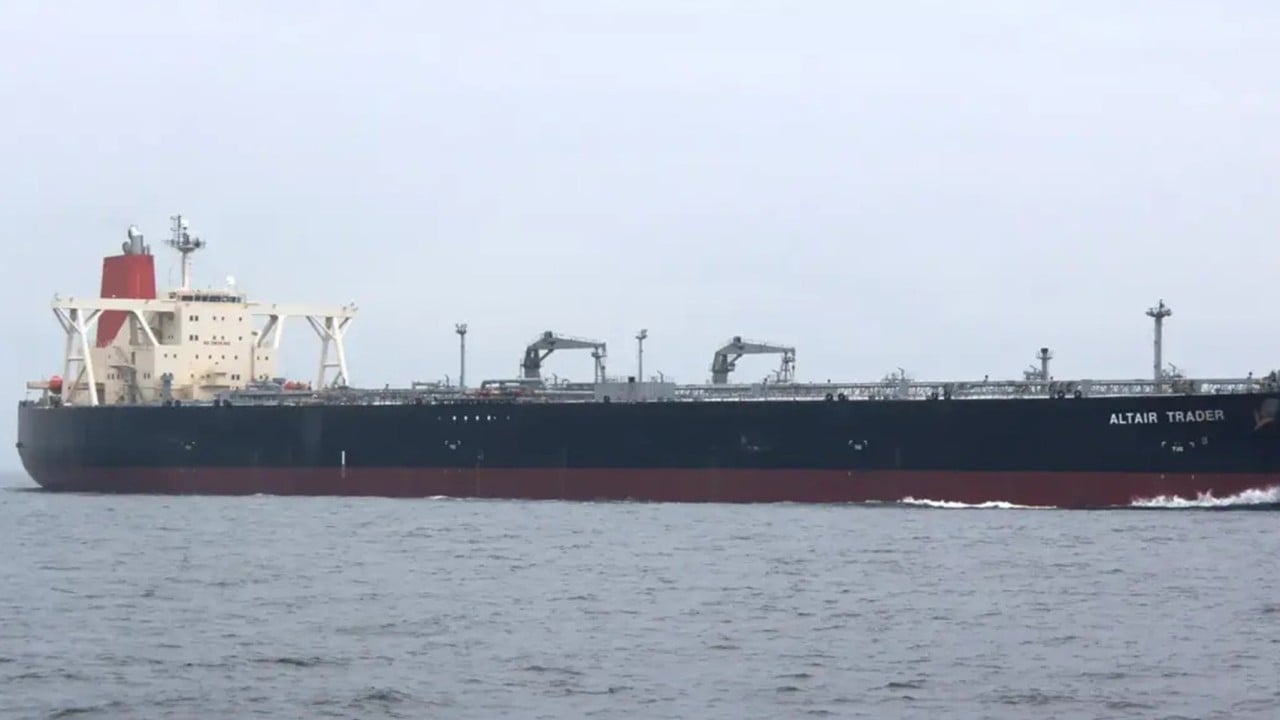
The sea at midnight does not care about borders. To a captain standing on the darkened bridge of a supertanker, the horizon is nothing more than a charcoal line where black water meets blacker sky. Down below, the engine room thrums with a heavy, rhythmic heartbeat, consuming thousands of gallons of heavy fuel oil every hour to push two million barrels of crude across the planet.
On paper, that cargo belongs to a company registered in a glass-fronted office building in Hong Kong. The paperwork lists a shell corporation with a name that sounds like a manufacturer of office furniture. The flag snapping in the salt wind on the stern belongs to a tiny island nation that the captain has never visited. You might also find this connected story insightful: The Anatomy of Deterrence Failure: Strategic Calculus in the Iran Proxy Corridor.
None of that matters to the men and women sitting in Treasury department offices in Washington, staring at satellite thermal imagery and encrypted ledger sheets. To them, that ship is a moving violation. It is a conduit for millions of dollars feeding a machine of regional conflict, slipping through the dark spaces of global maritime law.
And today, the net just tightened around them. As highlighted in latest coverage by The New York Times, the implications are significant.
The Mechanics of Shadows
We tend to think of international sanctions as heavy, blunt instruments. We imagine steel doors slamming shut, ports closing overnight, and cargo ships turning around in disgrace.
Reality is far messier.
Consider what happens when a nation like Iran finds its primary export locked out of traditional Western financial plumbing. The oil does not stop coming out of the ground. Geological pressure beneath the Khuzestan province does not check the daily political news cycle. The wells pump day and night, filling vast steel storage tanks until they bulge.
When you have millions of barrels of crude and a desperate need for hard currency, you do not advertise your buyers. You cultivate a gray market.
This is where the shadow fleet is born. It is a sprawling, decentralized ecosystem of aging tankers, obscure corporate registries, and clever financial maneuvering. A ship changes its name over lunch in a port half a world away. Its automatic identification transponder goes quiet for three days while it drifts off the coast of Malaysia, executing a clandestine ship-to-ship transfer under a moonless sky. Crude oil leaves the hold of an Iranian flagged vessel and pours into the rusted tanks of a ship flying a flag of convenience.
By the time that oil reaches a refinery, its origin story has been rewritten half a dozen times.
The United States government targeted this exact shell game by imposing sweeping sanctions on a network of Chinese and Hong Kong based shipping firms and maritime entities. These are not massive, household name conglomerates. They are the invisible gears of the gray market. They provide the management, the insurance cover, the crew payroll, and the port access that allow sanctioned Iranian crude to find a willing buyer, usually tucked away in the sprawling industrial ports of East Asia.
Why Paper Trails Matter More Than Hull Plates
When I first started tracking maritime compliance, I made the mistake of looking at the ships. You trace a hull. You note the IMO number stamped into the steel frame. You think you have tracked the culprit.
Then you realize the hull is just a rented coat.
The real architecture of evasion lives in the filing cabinets of corporate registry agents in jurisdictions with lax oversight. A company is formed in a high-rise office in Hong Kong. Three weeks later, it opens an account at a regional bank. A month after that, it acquires an aging, twenty-year-old Suezmax tanker that was due for the scrapyard.
Suddenly, that rusty vessel has a new manager, a new certificate of financial responsibility, and a new destination.
The Treasury Department knows this dance well. That is why the recent sanctions did not just name vessels; they went straight for the corporate throats. By designating specific shipping companies and management firms based in mainland China and Hong Kong, regulators are making a calculated bet. They are telling international banks, insurance syndicates, and port authorities a simple truth: if you touch these corporate entities, you risk being severed from the U.S. financial system entirely.
It is a financial quarantine.
Insurance is the hidden leash of the high seas. No modern tanker can leave a dock without Protection and Indemnity insurance—coverage that runs into the billions of dollars for spill cleanup and liability. When sanctions hit a management firm, standard Western insurers run for the exits. The ship is forced into murky alternative insurance pools, often backed by domestic entities in the purchasing countries. The risk profile skyrockets. The margin for error narrows.
The Human Equation
Behind every regulatory designation in the Federal Register is a chain of human choices.
Imagine a compliance officer in a mid-sized shipping logistics firm in Shanghai. She spends her mornings cross-referencing customer manifests against ever-expanding sanctions lists. Her computer screen is a grid of flashing warnings and corporate entity numbers. She is not a geopolitical strategist. She is a professional trying to ensure her company does not violate compliance thresholds that could freeze corporate accounts.
When a new sanctions package drops, her morning turns into an emergency room triage.
She has to flag three vessels managed by a sister company in Hong Kong. She has to notify the charterers that their cargo of fuel oil cannot be offloaded at the planned terminal without triggering immediate secondary sanctions. Deals worth tens of millions of dollars evaporate in the span of an unreturned phone call.
Down on the docks, the crew of the targeted tanker waits. They have been anchored three miles outside territorial waters for a week, waiting for clearance that will never come. The fresh provisions are running low. The diesel for the auxiliary generators is being rationed. The sailors, often recruited from maritime academies in Southeast Asia or Eastern Europe, scroll through their phones on spotty satellite connections, wondering if their wages for the month are going to clear.
They are pawns in a grand economic chess match, floating on thirty thousand tons of volatile hydrocarbons.
The Cost of Compliance
We live in an interconnected financial ecosystem that relies on trust, transparency, and the undisputed dominance of the U.S. dollar. When Washington decides to squeeze an adversary's revenue stream, it pulls levers that ripple across every continent.
The enforcement actions against these Chinese and Hong Kong shipping firms are not isolated events. They are part of an ongoing, high-stakes game of cat and mouse. Every time regulators close one loophole—identifying a phantom fleet operator or freezing an obscure Hong Kong bank account—the brokers of the gray market adapt. They split companies into smaller fragments. They use cryptocurrency for transactional layers. They register ships under even more obscure flags.
It is an endless escalation.
Yet, these sanctions carry real weight because the alternative is worse. If the international community allows a parallel, unregulated maritime economy to operate with absolute impunity, the entire architecture of global trade rules begins to fray. If oil can move without oversight, insurance, or legal accountability, then borders and laws on land become mere suggestions at sea.
Out on the water, the tanker shifts slightly against the swell. The night watchman adjusts his collar against the damp sea breeze, watching the distant, twinkling lights of the container port on the coast. He does not know about Office of Foreign Assets Control designations, and he does not care about geopolitical leverage. He only knows that his engines are idling, the papers are stalled, and the dark water stretches out forever in every direction.


