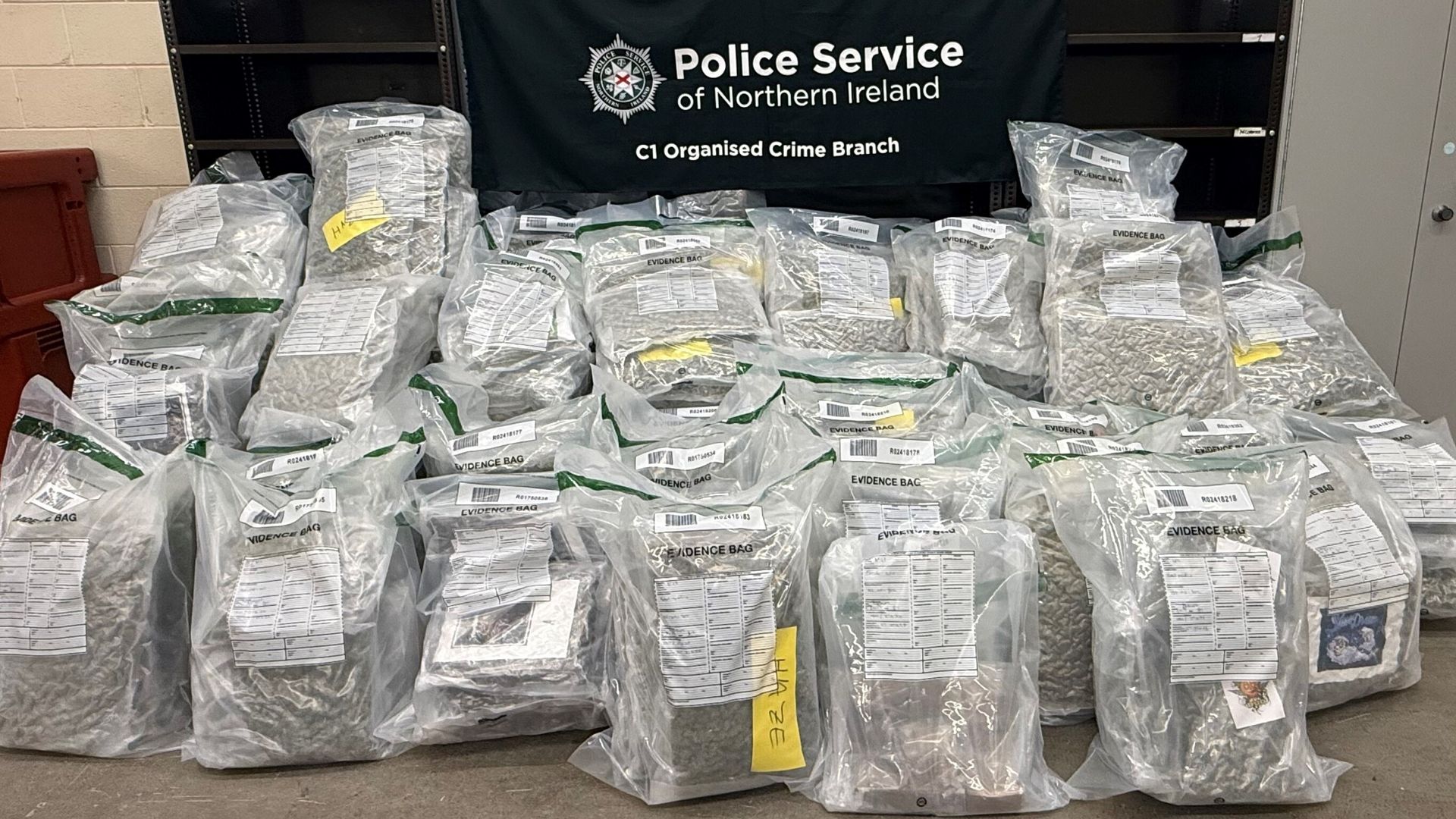
The recent seizure of a high-value shipment at a major port, initially valued at roughly £4 million, represents a tactical victory for law enforcement but a strategic footnote in the broader war on narcotics. While the flashing blue lights and the visual of stacked bricks make for compelling headlines, they rarely tell the story of the logistics that allowed that container to cross an ocean in the first place. The reality of modern smuggling is not one of shadows and speedboats. It is a game of high-volume commercial logistics where the "dark" economy mimics the legitimate one with terrifying precision.
The Mathematical Certainty of the Breach
To understand why a £4 million haul is both a massive loss for a specific criminal cell and a rounding error for the industry, one must look at the sheer scale of global maritime trade. Millions of containers move through UK ports every year. Border authorities cannot physically inspect more than a tiny fraction of these without grinding the national economy to a halt. Smugglers know this. They operate on a principle of mathematical probability, spreading risk across multiple shipments. If you enjoyed this piece, you should look at: this related article.
When a shipment is intercepted, it is often the result of intelligence-led policing rather than a lucky find during a routine check. This suggests that for every container pulled aside, several others—possibly dozens—safer and more discreet, have already cleared the gates. The street value of the seized goods is often inflated for public relations purposes, calculated by the gram at its final destination rather than the bulk price paid at the source. This discrepancy masks the true financial impact on the cartels, who often view these seizures as a cost of doing business, much like a legitimate retailer accounts for "shrinkage" or theft.
Logistics as a Weapon
The sophisticated nature of these operations requires more than just a source and a buyer. It requires a middle tier of logistical experts who understand how to manipulate manifest data, exploit the "trusted trader" status of shell companies, and identify the specific ports where oversight is stretched thinnest. For another look on this development, refer to the latest coverage from The Guardian.
Smuggling rings have moved away from the crude methods of the past. They now use front companies that engage in legitimate trade for months or even years to build a clean history. They ship timber, scrap metal, or perishable goods—items that are difficult to search thoroughly without specialized equipment or that carry a time sensitivity that discourages long delays. By the time a "dirty" shipment is flagged, the paperwork often points to a ghost entity or a hijacked identity, leaving investigators with a warehouse full of evidence but no clear path to the architects.
The Problem with Port Infrastructure
The physical layout of modern ports is designed for speed. Automation and "just-in-time" delivery models mean that cargo moves from ship to shore to truck in a matter of hours. Every minute a container sits in a holding bay is money lost for the shipping line and the importer. This economic pressure creates a natural friction between the goals of the Department for Transport and the requirements of Border Force.
- Automation Gaps: While automated cranes and gates reduce human error, they also remove the "gut feeling" of experienced dockworkers who might notice something amiss.
- Secondary Ports: As major hubs like Felixstowe or Dover increase their security tech, smaller, regional ports become more attractive. These locations often have fewer dedicated specialized units, making them the path of least resistance for mid-tier trafficking rings.
- Internal Threats: No amount of X-ray technology can defeat a corrupted insider. The recruitment of port staff, from crane operators to administrative clerks, remains the most effective tool in the smuggler's kit. Access to the terminal operating system allows a "red flagged" container to be cleared or moved to a blind spot before an inspection can take place.
The Economic Engine of the Black Market
We must stop viewing these seizures as isolated criminal acts and start viewing them as a distorted branch of international trade. The £4 million figure is a testament to the massive demand within the UK domestic market. As long as the demand remains constant, the supply chain will adapt. If one route is closed, another opens. If one port becomes too risky, the cargo is rerouted through a different country entirely, perhaps entering the UK via a less scrutinized ferry terminal after being "cleansed" in a European warehouse.
The financial structures behind these shipments are equally resilient. Money is moved through informal value transfer systems or laundered through complex networks of small businesses that deal primarily in cash. This means that even when the physical product is seized, the capital required to fund the next ten shipments remains intact. The "kingpins" are rarely anywhere near the docks; they are sat in boardrooms or villas thousands of miles away, insulated by layers of deniability and digital encryption.
Tactical Success vs Strategic Failure
Success is currently measured in kilograms and pounds sterling. This is a flawed metric. If the goal of law enforcement is to reduce the availability and harm of narcotics, then a single large seizure that does not result in a price spike on the street is a failure. It indicates that the market is so saturated that the loss of £4 million worth of product didn't even cause a ripple.
True disruption would require a shift in focus from the border to the banking system and the digital infrastructure that facilitates these trades. However, following the money is significantly harder and more expensive than scanning a box. It requires international cooperation that is often hampered by bureaucracy and conflicting national interests.
The Reality of the "Suspected" Haul
In the immediate aftermath of a seizure, the word "suspected" is a legal necessity, but it also points to the long road ahead for the prosecution. Forensic analysis, the extraction of data from encrypted devices, and the painstakingly slow process of checking international manifests can take years. By the time a case reaches court, the criminal organization involved has likely rebranded, replaced its lost personnel, and refined its methods to avoid the same mistake.
The public sees the win. They see the van being loaded with bags of evidence and the official statements about "striking a blow" against organized crime. But those within the industry know the truth. The border is a sieve, and while we have caught a few large stones, the sand is still pouring through at a record pace.
A Systemic Overhaul
Focusing purely on the point of entry is a reactive strategy that will always be one step behind. To actually dent the operations of high-level trafficking groups, there must be a move toward predictive profiling and deep-tissue financial investigation. This means moving beyond the ports and into the specialized world of trade finance and maritime law.
We need to look at the companies that own the containers, the brokers who facilitate the shipments, and the obscure insurance firms that provide cover for high-risk routes. Until the cost of losing a shipment outweighs the potential profit of the ten that get through, the cycle will continue. The £4 million haul is not the end of a story; it is a signal that the pipeline is wider than we are willing to admit.
Stop looking at the drugs on the table and start looking at the systems that put them there. The next shipment is already on the water, hidden in plain sight, protected by the very efficiency of the global economy we rely on every day.