You stand before the refrigerator, holding a knife and looking down at a crisp, beaded head of romaine. It is supposed to be the beginning of health. It is supposed to be the clean, crunchy antidote to a heavy week, the leafy green anchor of a quiet Tuesday night dinner. You wash it under cold water, watching the droplets bead and scatter across the ruffled leaves. You dry it carefully. You chop it.
You do not think about a farm five hundred miles away. You do not think about the dust, the irrigation water, or the microscopic hitchhiker that cannot be seen by the naked eye.
Yet, public health announcements rarely arrive with sirens. They arrive as dry dispatches from federal agencies, heavy with clinical nomenclature and bureaucratic distance. Recently, the Food and Drug Administration issued a quiet, chilling alert: Cyclospora found at a Mexican farm linked to a lettuce outbreak.
To the casual reader, it is a headline to skim before scrolling on to local weather or sports. To the epidemiologist, it is the opening movement of an invisible, silent chase across borders, supply chains, and human bodies.
The Geography of a Single Leaf
Consider how that lettuce reached your counter.
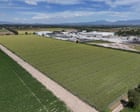
Modern agriculture is an astonishing, fragile miracle of logistics. A seed goes into the earth in a sprawling valley where the sun burns bright and consistent. Workers tend to the crop under wide, open skies. Water is pumped from deep underground or drawn from local canals to sustain rows of green that stretch toward the horizon like geometric carpets.
(Note: In this hypothetical reconstruction of a supply chain, we look at the mechanics of modern farming—not to point fingers at a single worker, but to understand how a microscopic organism travels from soil to salad bowl.)
Water is the lifeblood of the farm, but water is also a memory. It remembers everywhere it has been. If an irrigation canal passes near livestock grazing land, or if heavy seasonal rains runoff across fields where oversight is imperfect, water can become a silent courier. It picks up what it shouldn't. It deposits it onto the broad, receptive surfaces of leafy greens.
Cyclospora cayetanensis is not a bacterium like E. coli or Salmonella. It is a microscopic parasite, a single-celled protozoan that thrives in tropical and subtropical regions. It does not alter the look, smell, or taste of the lettuce. A contaminated leaf looks just as vibrant, just as dewy, and just as appetizing as a pristine one. There is no warning label on the cell wall.
When the harvest begins, hands move swiftly down the rows. Knives flash. Heads of lettuce are severed from their roots, tossed into crates, rushed to cooling sheds, packed into corrugated boxes, loaded onto refrigerated trucks, and dispatched northward. They cross international borders in the belly of eighteen-wheelers, passing through customs checkpoints where paperwork is inspected, but parasites remain invisible.
Within days, that lettuce is sitting on a supermarket shelf, waiting for you.
The Anatomy of an Outbreak
Outbreaks do not happen all at once. They happen in whispers.
It starts with a trickle of unrelated complaints across different states. A doctor in Ohio sees a patient with relentless, exhausting gastrointestinal distress—cramps, nausea, profound fatigue, a low-grade fever that refuses to break. A week later, a clinic in Pennsylvania reports a similar cluster. In Texas, public health investigators notice an unusual statistical blip in parasite-related diagnoses.
This is where the detectives of epidemiology begin their work. They do not wear fedoras or carry magnifying glasses; they carry spreadsheets, interview questionnaires, and telephone headsets. They conduct what are known as case-control studies. They call the sickened individuals and ask an intensely detailed, deeply personal inventory of everything they ate over the last two weeks.
What did you have for lunch on Thursday? Did you eat out? Did you buy groceries at the local chain or the neighborhood market? Do you remember the brand of the bagged salad?
When dozens of strangers, living hundreds of miles apart, with nothing else in common, point to the exact same brand or type of lettuce, a pattern emerges from the static. The traceback investigation begins. Federal and state authorities trace the lot numbers, the distributor manifests, the shipping containers, and finally, the farm of origin.
In this case, the trail led southward, stopping at a specific farm in Mexico where environmental samples and water tests confirmed the presence of the parasite.
The machinery of government response grinds into motion. Advisories are drafted. Warnings are issued. Do not eat. Do not serve. Check your refrigerators. Throw it out.
What We Talk About When We Talk About Safety
We live in an era of profound disconnect from our sustenance. For most of human history, people knew the dirt their food grew in. They
The Invisible Passenger Hiding in Your Salad
health
You stand in the aisle of your local grocery store, bathed in the hum of fluorescent lights. You pick up a plastic clamshell container of romaine lettuce. It looks crisp. It looks innocent, washed and pre-cut, promising a quick, virtuous weeknight dinner. You drop it into your basket alongside cherry tomatoes and cucumbers, trusting an invisible contract. You trust that the food system protecting your table has vetted every mile of that green leaf's journey from soil to shelf.
Most days, that contract holds. But sometimes, an uninvited passenger catches a ride.
Consider what happens miles away from that grocery cart, under the relentless sun of a Mexican agricultural field. Rows of green stretch toward the horizon, tended by hands that harvest the earth's bounty day after day. Water flows through irrigation channels, keeping the crops alive in a thirsty climate. But water carries secrets.
Picture a microscopic parasite, a single-celled organism called Cyclospora cayetanensis. It is invisible to the naked eye, a tiny oocyst waiting for the right host. It does not belong on a dining room table, yet it slips quietly onto the leaves of crops like lettuce, clinging to the surface through harvesting, packaging, shipping, and refrigeration. It does not care about expiration dates or food safety certifications. It only waits.
Recently, federal investigators traced a stubborn, looping outbreak of cyclosporiasis directly back to such a farm in Mexico, identifying contaminated agricultural water as the silent vector. The Food and Drug Administration stepped in with cold statements, trace-back investigations, and public health warnings. To bureaucrats, it was a data point on a spreadsheet. To the people who bought those bags of lettuce, it was an entirely different reality.
In a quiet suburban kitchen, Sarah poured the bagged greens into a colander, rinsing them under the tap just like she always did. She tossed them with olive oil, lemon juice, and grilled chicken, serving dinner to her family with a light heart.
Two weeks later, the fatigue hit. Then the rolling stomach cramps, an unrelenting nausea, and a fever that turned her bedroom into a sweatbox. For days, she drifted in a fog of illness, losing weight, missing work, and wondering what she had eaten to betray her own body. Her doctor ran tests, scratched his head, and finally uttered a word most people have to spell out: cyclosporiasis.
It is a peculiar kind of violation when your food makes you sick. We eat to live, to fuel our bodies, to gather with people we love. When the very act of nourishment introduces a microscopic invader, it fractures our sense of safety. You start looking at fresh produce with suspicion. You wonder if that triple-washed label is just a marketing whisper meant to quiet your anxieties.
Understanding Cyclospora requires looking at how a microscopic protozoan manages to travel thousands of miles across international borders without losing its punch. Unlike bacteria like E. coli or Salmonella, which can multiply rapidly on food left at room temperature, Cyclospora requires something different. Once it is shed in human feces and finds its way into water used for crop irrigation or washing, it needs time outside a host to sporulate—to mature into the infectious stage that wreaks havoc on the human digestive tract.
This means that contamination is often an environmental chain reaction. A compromised water source, a heavy rainstorm, a breakdown in sanitation infrastructure—these are the gears that turn behind the scenes of a foodborne illness outbreak. When the FDA tracks an outbreak, they are playing a high-stakes game of molecular detective work, matching genetic fingerprints of the parasite found in patients with samples pulled from irrigation ponds and packing sheds miles away.
The modern global supply chain is a marvel of human engineering. You can eat fresh strawberries in January and crisp leafy greens in the dead of winter. We take this culinary luxury for granted, forgetting that it relies on a staggering choreography of logistics, refrigeration, and international trade. But that same speed and scale mean that a single contamination event at an overseas farm can ripple across multiple states, landing in dozens of grocery store chains before anyone realizes a problem exists.
Public health advisories often tell us to cook our food thoroughly to kill pathogens. But how do you cook a salad? Lettuce is meant to be eaten raw, its cellular structure intact, offering a crunch that heat destroys. Washing helps, but Cyclospora has a tough outer shell and an affinity for clinging to the microscopic nooks and crannies of leafy greens. Standard kitchen rinses rarely wash it away completely.
This leaves us in a strange psychological space. We cannot live in fear of every leaf of spinach or head of romaine. To do so would mean retreating from fresh, nutrient-dense foods that form the bedrock of a healthy life. Instead, we have to recognize that the safety of our food supply is a fragile equilibrium maintained by constant vigilance, regulatory oversight, and agricultural innovation.
When the FDA points a finger at a specific farm in Mexico, it is not just assigning blame. It is tightening a screw in a massive, sprawling machine that desperately needs calibration. It forces growers to upgrade water treatment systems, improve sanitation protocols, and rethink how precious resources are managed in regions prone to water scarcity.
Next time you stand in that grocery aisle, looking down at the neat rows of greens, let the reality wash over you without fear. The system isn't perfect, but it is watched over by scientists tracing invisible clues, by inspectors testing water samples, and by a community of growers learning how to do better.
You take the container home. You wash your hands. You prep the meal. You sit down at the table, look across at the people you love, and you eat, carrying forward that quiet, everyday act of trust in the world we share.