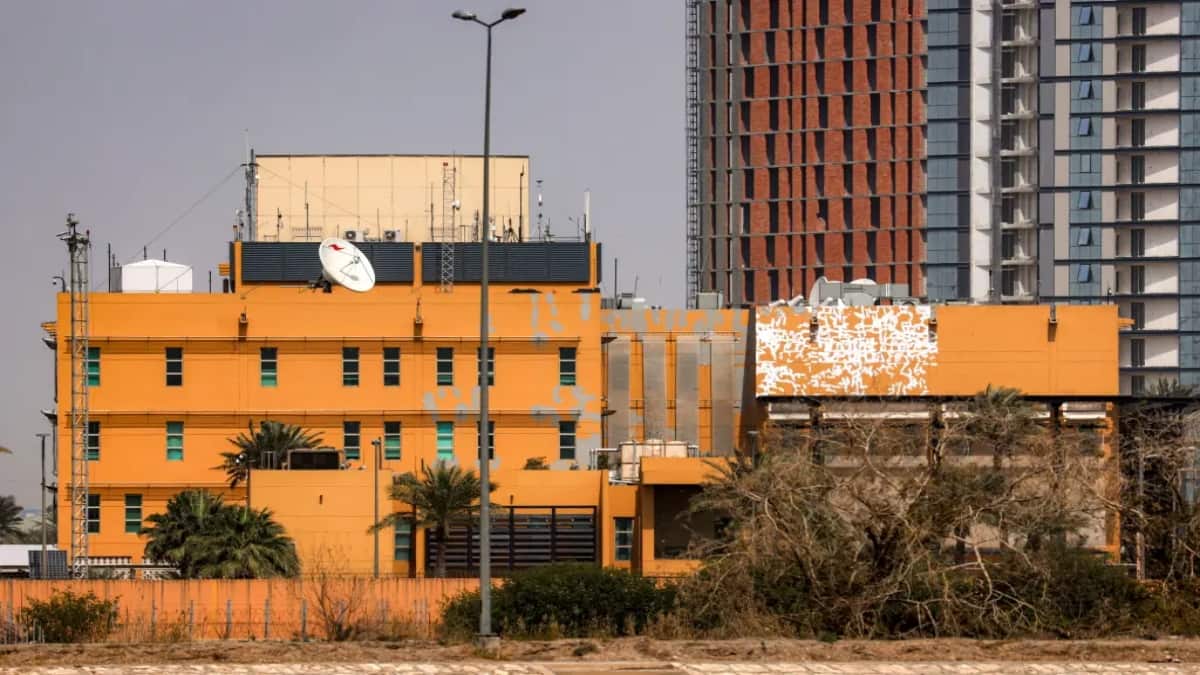
The air in Baghdad doesn't just sit; it presses. It carries the scent of dust, diesel, and the faint, metallic tang of history being written in real-time. For an American working within the high concrete blast walls of the International Zone, that air is filtered, air-conditioned, and monitored. But lately, the air has grown heavy with a different kind of pressure.
It is the pressure of a ticking clock.
When the State Department issued its recent, blunt directive—leave the country, but do not seek refuge at the embassy—it wasn't just a routine travel advisory. It was a rhythmic thumping of a drum that has been beating since the geopolitical tectonic plates of the Middle East began to shift violently once again. The message was clear: the safety net has been retracted. If you are there, you are on your own.
Consider a hypothetical contractor named Elias. Elias has spent three years in Iraq, helping to rebuild telecommunications infrastructure. He knows the tea shops in Karada. He knows which checkpoints take ten minutes and which take two hours. To Elias, Iraq isn't a headline; it's a neighborhood. But when he reads a Level 4 "Do Not Travel" advisory that specifically warns of kidnapping and improvised explosive devices, the neighborhood suddenly feels like a maze where the exits are vanishing.
The core of the threat isn't a monolith. It is a flickering constellation of Iran-aligned militia groups. These are not shadow figures; they are deeply integrated into the fabric of the region's security and politics. When tensions spike between Washington and Tehran, these groups often look for the nearest available leverage. Often, that leverage is a person like Elias.
The warning issued by the U.S. government contains a chilling paradox. Citizens are urged to depart using commercial options while they still exist. Yet, the very place that usually serves as a sanctuary—the massive, fortress-like U.S. Embassy in Baghdad—has draped a "closed" sign over its consular services. The logic is brutal but practical. Gathering American citizens in one place creates a target. In the eyes of the State Department, the embassy is no longer a lifeboat; it is a lightning rod.
This isn't merely about politics. It is about the physics of risk.
Since October 2023, the frequency of rocket and drone attacks against facilities housing U.S. personnel has fluctuated with the rhythm of broader regional conflicts. Each explosion is a data point. Each siren that wails over the Green Zone is a reminder that the "security" provided by those twelve-foot T-walls is an illusion of geography, not a guarantee of safety.
The "People Also Ask" sections of our collective anxiety often seek simple answers. Is it safe to go to the Kurdistan region? The government says no, citing the same risks of terrorism and armed conflict that plague the south. Can the embassy help if things go wrong? The official answer is a quiet, devastating "limited ability."
When a government tells its people to stay away from its own sovereign soil—which an embassy technically is—it is admitting that the traditional rules of engagement have dissolved.
For those currently on the ground, the logistics of leaving are a frantic puzzle. It means checking flight schedules out of Baghdad International Airport while wondering if the road to the airport is monitored. It means deciding what to pack in a single suitcase and what to leave behind in a rented apartment that might be looted or reclaimed before the week is out. The human element of a "Level 4" warning isn't found in the text of the PDF; it’s found in the shaking hands of a dual-national mother trying to decide if today is the day she takes her children to the terminal.
We often view these international flashpoints through the lens of grand strategy. We talk about "spheres of influence" and "proxy forces." We treat countries like pieces on a mahogany board. But for the people living in the gaps between those pieces, the reality is much more granular. It’s the sound of a phone vibrating with a security alert at 3:00 AM. It’s the calculation of whether a trip to the grocery store is worth the exposure.
The "invisible stakes" here involve the slow erosion of the idea that an American passport is a shield. For decades, that navy-blue booklet felt like a suit of armor. In the current climate of Iraq, it can feel more like a bullseye.
The Iranian-backed militias, such as Kata’ib Hezbollah and Harakat al-Nujaba, operate with a degree of autonomy that makes traditional diplomacy nearly impossible. They are motivated by a desire to see all U.S. forces exit the country, a goal they pursue through a "thousand cuts" strategy. A rocket here. A drone there. A persistent atmosphere of dread that eventually makes the cost of staying higher than the cost of leaving.
Logic dictates that if the government tells you to go, you go. But logic doesn't account for the businessman who has invested his life savings in a local venture, or the journalist who feels a moral obligation to witness the unraveling. These people are now existing in a vacuum of protection.
The U.S. Embassy’s refusal to process citizens is a signal of a deepening siege mentality. It suggests that the perimeter is no longer considered impenetrable. If the fortress can't protect itself without becoming a mass casualty risk, it certainly can't protect the public.
This creates a ghost-like existence for those who remain. They move through the city with their heads down, avoiding the very institutions that were built to represent them. They become shadows in a landscape they once helped build.
The tragedy of the "Leave Iraq" order isn't just the potential for violence. It is the admission of a stalemate. It is the recognition that despite billions of dollars spent and decades of presence, the most powerful nation on earth has to tell its own people: "We are here, but we cannot reach you."
As the sun sets over the Tigris, the orange light hits the concrete barriers, casting long, jagged shadows across the pavement. In those shadows, people are making lists. They are deleting contacts from their phones. They are looking at the sky, not for the moon, but for the slow-moving lights of a drone.
The gates are closed. The warnings have been sent. The rest is just silence and the sound of a distant engine.
Deep in a dusty drawer in a home in Erbil or a flat in Baghdad, a passport sits next to a set of keys. Both are becoming relics of a time when the world felt slightly smaller and the walls felt slightly stronger. Now, there is only the road, the airport, and the hope that the gate stays open just long enough to pass through.