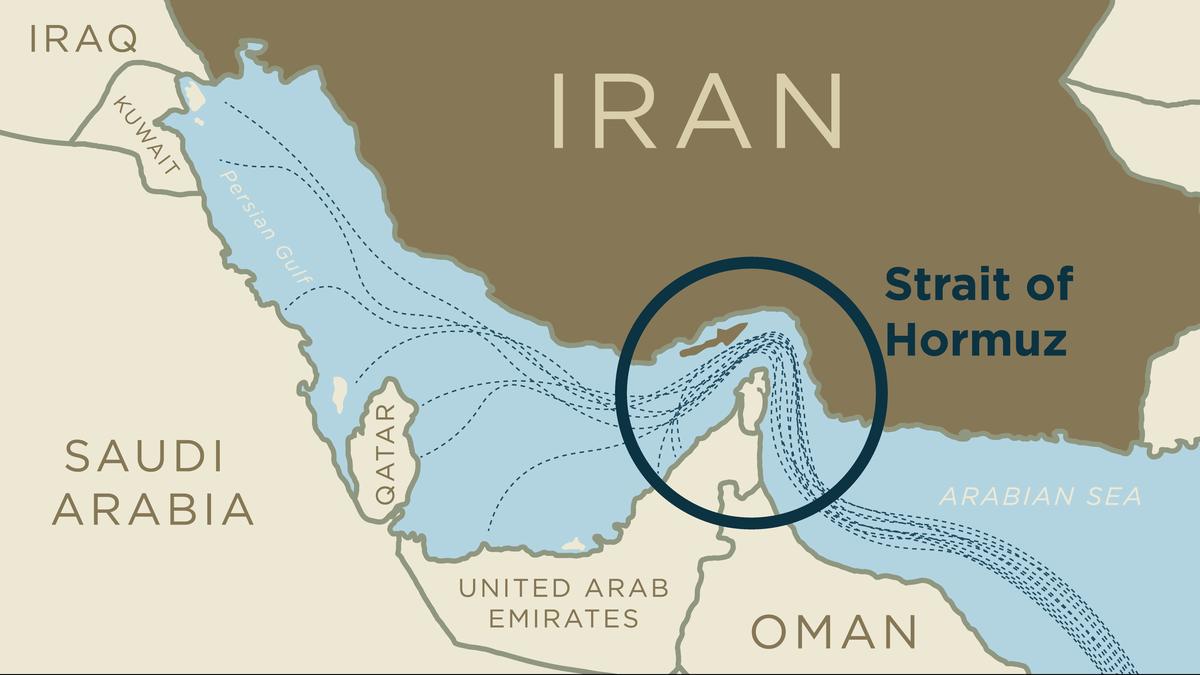
The steel hull of a VLCC—a Very Large Crude Carrier—is roughly the size of three football fields, yet when it enters the Strait of Hormuz, it feels like a needle trying to thread a moving eye. Underneath the bridge, the water is a deceptive, shimmering turquoise. But for the captain standing at the helm, that beauty is white noise. He is looking at the radar, watching the tiny, fast-moving blips of Iranian Revolutionary Guard patrol boats that buzz like hornets around his 300,000-ton behemoth. He knows that if one of those hornets decides to sting, the price of gas in a suburb in Ohio or a factory town in Guangdong shifts within the hour.
This is not a drill. It is the pulse of the global economy, and right now, that pulse is racing.
For decades, the Strait of Hormuz has been described as a "chokepoint." It is a clinical term for a place where the world’s jugular is exposed. Twenty-one miles wide at its narrowest, it carries one-fifth of the world’s daily oil consumption. If you have turned on a light, driven to work, or bought a plastic toy recently, you are tethered to this strip of water.
Lately, the tension there has moved from a simmer to a heavy, pressurized boil. The diplomatic dance between Washington and Tehran has stopped being a dance. It is now a stare-down. In the halls of the Pentagon and the bunkers of Tehran, the rhetoric is hardening into something brittle and dangerous. The U.S. has increased its footprint, sending advanced fighter jets and more naval muscle to the region. Iran, meanwhile, has doubled down on its claim that it owns the security of these waters.
The Man on the Deck
Consider a hypothetical engineer named Elias. He’s been working on tankers for twenty years. He remembers when the Strait was just another stretch of navigation. Now, he watches the horizon for "limpet mines"—magnetic explosives that can be slapped onto a ship’s hull by a passing speedboat. He hears the radio chatter where Iranian operators tell Western warships to "stay clear of the area" in broken but firm English.
Elias isn’t a politician. He doesn’t care about the intricacies of the 2015 nuclear deal or the nuances of regional hegemony. He cares about the fact that if the Strait closes, the world breaks.
If Iran follows through on its periodic threats to block the waterway, we aren't just talking about a spike in prices. We are talking about a systemic seizure. Most people think of oil as something we "use," but it is actually the lubricant of civilization. When the lubricant disappears, the machine grinds to a halt. Supply chains that are already frayed would snap. The cost of shipping a container from Shanghai to Rotterdam would skyrocket because the fuel to move it would become a luxury item.
The Architecture of a Standoff
The current hardening of positions isn't a fluke. It is the result of a long, slow erosion of trust. From the U.S. perspective, Iran is a destabilizing force using the Strait as a hostage-taking tool. From the Iranian perspective, the presence of the U.S. Fifth Fleet is an imperial intrusion in their backyard.
Iran has spent years developing "asymmetric" capabilities. They know they cannot win a traditional broadside-to-broadside naval battle against a U.S. carrier strike group. They don't need to. Instead, they have invested in swarms of fast-attack boats, sea mines, and coastal missile batteries.
Think of it like a giant trying to walk through a room filled with thousands of thumb-tacks. The giant is stronger, but every step is agony, and eventually, the giant might decide it isn't worth the walk. That is the Iranian strategy: making the cost of presence higher than the benefit of being there.
The Ghost in the Machine
Behind the steel and the salt water lies a more complex layer of this conflict: the digital one. The Strait is no longer just guarded by sailors with binoculars. It is monitored by drones that never sleep and cyber-warfare units that try to blind the opponent's sensors.
In recent months, GPS jamming has become a silent plague in the Gulf. Tankers find themselves "ghosting"—their positions on the map drifting miles away from their actual physical location. This isn't a glitch. It’s a weapon. When a ship doesn't know exactly where it is, it can accidentally wander into territorial waters, providing a legal pretext for seizure. It’s a high-stakes game of "I'm not touching you" played with billion-dollar assets and the lives of merchant sailors.
Why does this matter to you? Because the global market is a psychological construct as much as a physical one. Markets hate uncertainty. Every time a video emerges of a masked boarding party rappelling onto a deck, a trader in London hits a button. That button sends a ripple through the insurance industry. "War risk" premiums for ships entering the Gulf have surged. Those costs aren't absorbed by the shipping companies; they are passed down to you, hidden in the price of your morning coffee or your next smartphone.
The Echoes of History
We have been here before, yet it feels different this time. During the "Tanker War" of the 1980s, the U.S. and Iran engaged in a direct, if limited, naval conflict. Ships were re-flagged and escorted by destroyers. But the world was less interconnected then. Today, our "just-in-time" delivery systems mean that we have zero margin for error. We don't keep massive stockpiles of goods anymore; we rely on the constant, fluid motion of ships like the one Elias works on.
When the flow stops, the clock starts ticking. Experts suggest that if the Strait were fully blocked, global oil prices could leap toward $200 a barrel almost instantly. The economic shockwave would be more like a tsunami.
The Silent Weight of the Heat
If you stood on the coast of Bandar Abbas today, the air would be thick with humidity and the smell of diesel. You would see the silhouette of a gray warship on the horizon, a silent sentinel of a superpower thousands of miles from home. You would see the smaller, faster wakes of the local guardsmen.
The standoff has become a way of life, a grim routine where both sides have "hardened" their hearts because any sign of softening is viewed as a fatal weakness. The U.S. demands total freedom of navigation; Iran demands total recognition of its regional authority. There is no middle ground in a 21-mile-wide channel.
The tragedy of the Strait of Hormuz is that it is a physical place carrying a metaphysical burden. It is where the reality of our dependence on fossil fuels meets the reality of ancient geopolitical grudges. We like to think of ourselves as a high-tech, post-resource society, but we are still effectively at the mercy of a few narrow miles of water.
Night falls over the Gulf. On the bridge of the tanker, the lights are dimmed to preserve night vision. The crew speaks in whispers. They watch the infrared cameras, looking for the heat signatures of approaching boats. They are the frontline of a war that hasn't officially started, but one that the entire world is already paying for.
Every time the engine thrums and the ship moves another mile toward the open Arabian Sea, there is a collective, unspoken sigh of relief. But the ship behind them is just entering the funnel. The cycle begins again. The world holds its breath, waiting to see if today is the day the needle finally breaks.
The ocean is deep, but the shadows of the men standing over it are longer.