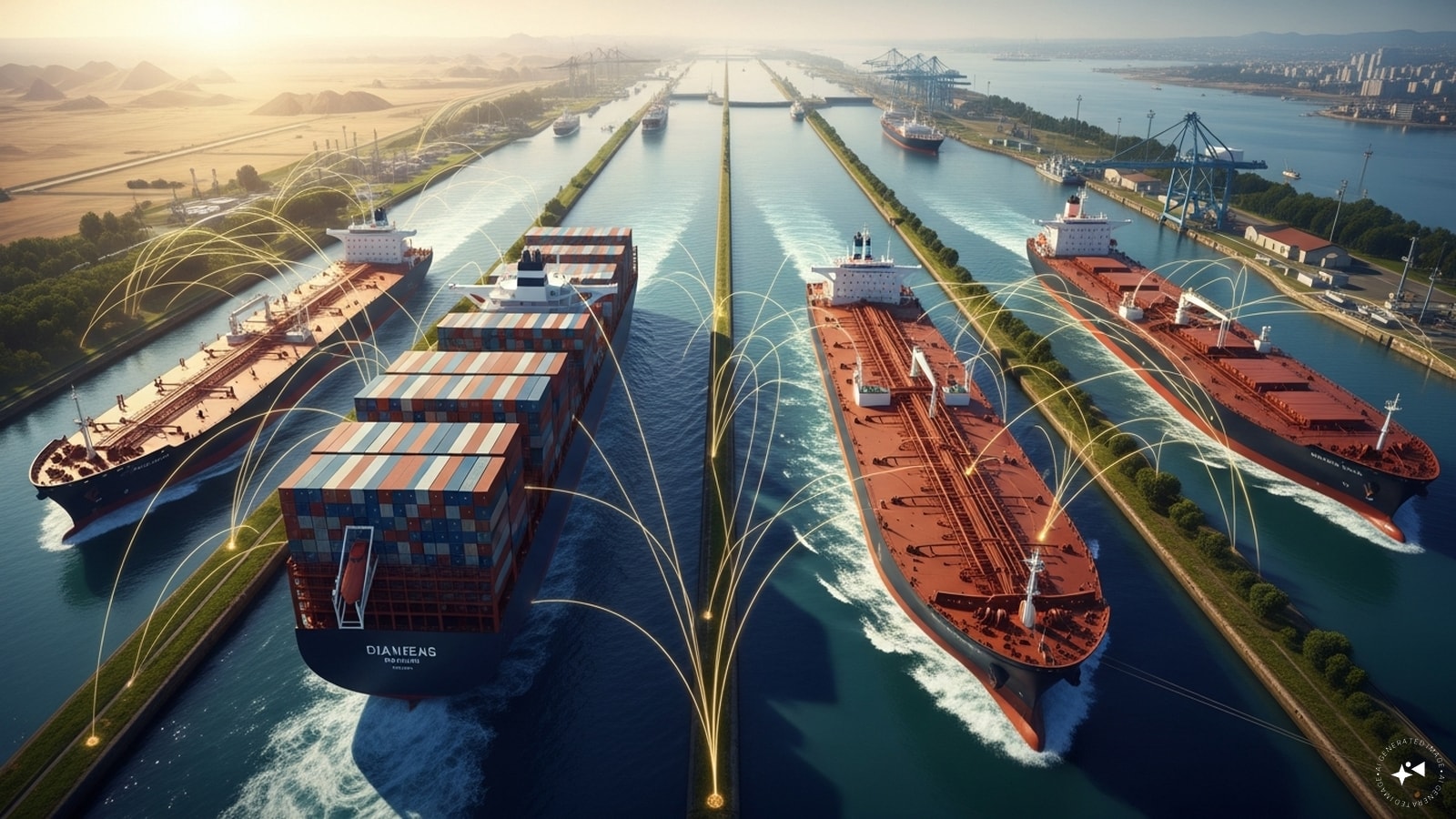
The sea is never as empty as it looks from the shore. If you stood on the jagged cliffs of the Musandam Peninsula at dawn, you would see them: a silent, steel procession of giants. These are the Ultra Large Crude Carriers (ULCCs), vessels so massive they have their own weather patterns on deck. They carry the lifeblood of the modern world through a passage that, at its narrowest, is barely wider than a few city blocks.
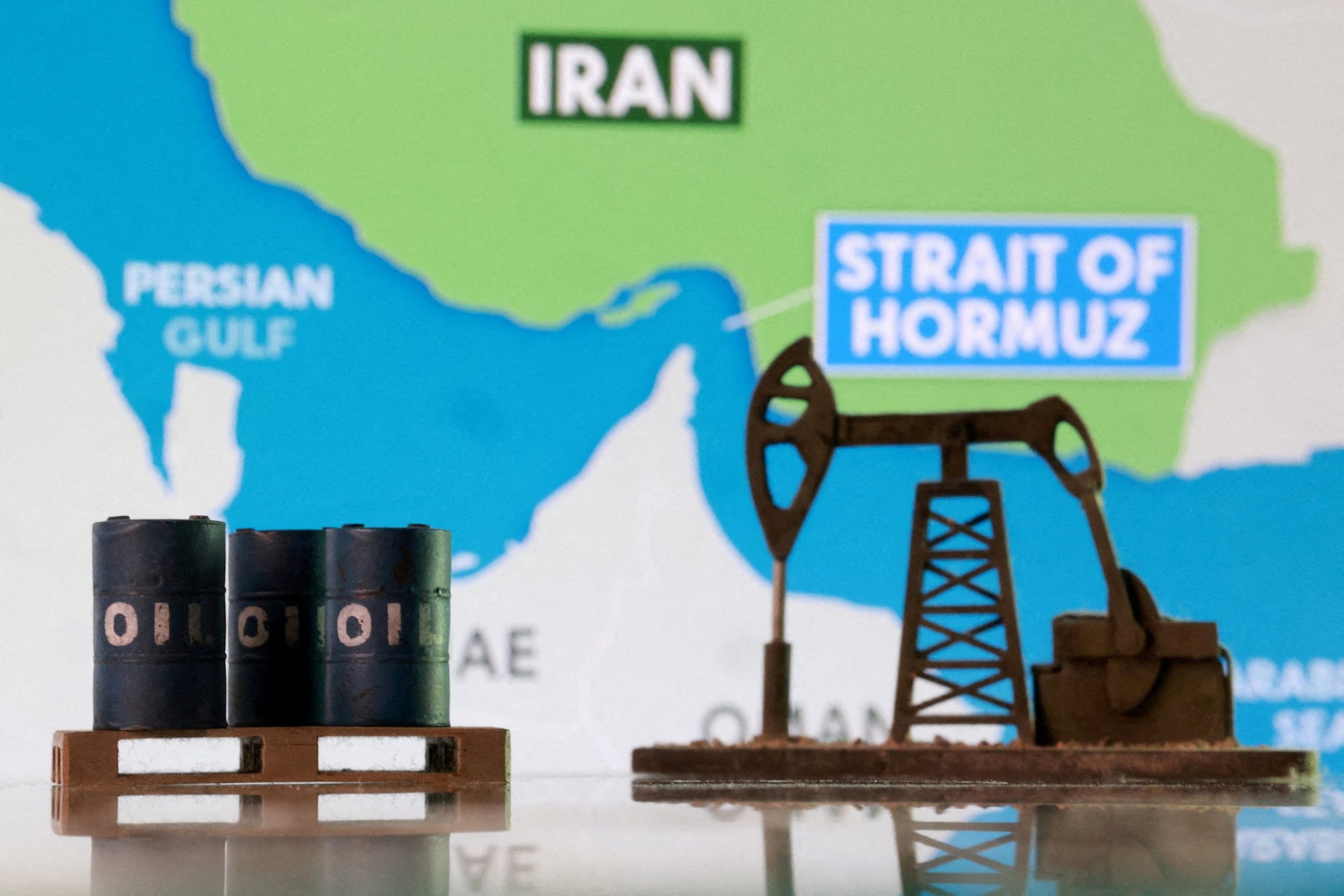
This is the Strait of Hormuz. It is the world’s jugular vein.
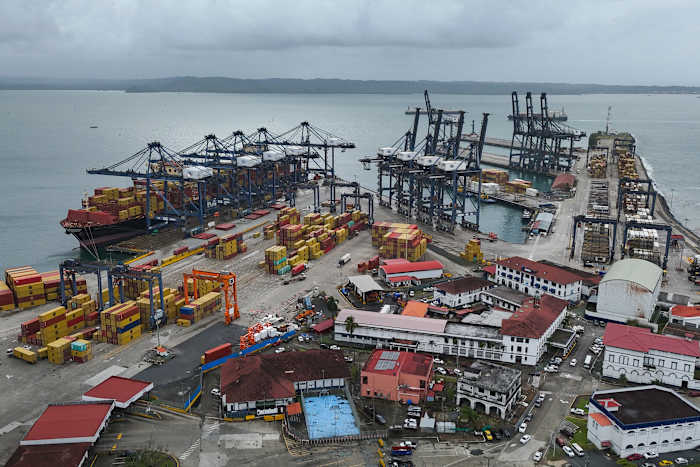
For decades, we have treated the great maritime canals—the Suez and the Panama—as the ultimate barometers of global trade. We watched with bated breath when the Ever Given wedged itself into the Egyptian sand, paralyzing billions in commerce. We track the droughts in Central America that force ships to wait weeks to pass through the Panama locks. But there is a price tag quietly forming in the Persian Gulf that makes the tolls of Suez and Panama look like pocket change.
Imagine a single transit costing $2 million. Not for a fleet. For one ship. One way.
The Geography of Anxiety
To understand the weight of that number, you have to look at the map through the eyes of a ship captain. Captain Elias—a composite of the men who have spent thirty years navigating these waters—doesn't see blue water. He sees a high-stakes obstacle course.
On one side, the rocky coast of Oman. On the other, the complex, heavily guarded shoreline of Iran. In between lies a shipping lane only two miles wide in each direction. Everything you own, from the plastic in your keyboard to the fuel in your tank, likely passed through this narrow throat.
When we talk about a $2 million "toll," we aren't talking about a fee paid at a booth. There is no central authority collecting a ticket for entering Hormuz. Instead, this is a "shadow toll." It is the accumulated cost of war risk insurance, private security details, and the sheer, agonizing price of delay.
In the Suez Canal, you pay for the convenience of a shortcut. In the Strait of Hormuz, you pay for the privilege of not being seized, struck by a drone, or caught in the crossfire of a geopolitical grudge match.
The Arithmetic of Risk
The math is brutal. When tensions in the region spike, insurance underwriters don't just nudge their rates; they rewrite the books overnight.
For a tanker carrying two million barrels of oil, a spike in "War Risk" premiums can add hundreds of thousands of dollars to a single voyage. Add to that the cost of specialized security teams—former commandos who pace the decks with binoculars and thermal imaging—and the daily burn rate of a vessel that costs $60,000 just to keep the engines humming.
But the real escalation comes from the threat of closure. If the Strait were to be blocked, even for a week, the "toll" isn't paid in dollars. It's paid in the total collapse of the "just-in-time" supply chain.
Consider the mechanics of a global economy that breathes through this pipe. About 20% of the world's liquid petroleum passes through here daily. That is roughly 21 million barrels. If that flow stops, the price of oil doesn't just go up; it teleports. We saw a glimpse of this during the "Tanker War" of the 1980s, but today's world is infinitely more interconnected. A disruption in Hormuz today is a factory shutdown in Germany tomorrow and a grocery price hike in Ohio by the end of the week.
The Suez Comparison
Why is this bigger than the Suez or Panama?
The Suez Canal is a feat of engineering, a man-made trench that saves ships a journey around the Cape of Good Hope. It is a choice. A ship can, if it must, go the long way around Africa. It is expensive and slow, but it is an option.
Hormuz is different. For the massive producers in Kuwait, Iraq, the UAE, and Qatar, there is no "long way around." The desert is vast, and the pipelines that exist to bypass the Strait are nowhere near capable of handling the volume. Without Hormuz, the oil stays in the ground. The tankers become floating warehouses of useless wealth.
The "toll" of $2 million represents the threshold of desperation. It is the price an operator is willing to pay to move cargo through a zone where the rules of normal commerce have been suspended.
The Ghosts in the Water
Navigating this stretch isn't just about the money, though. It’s about the psychological toll on the crew.
Elias remembers a time when the biggest worry was a mechanical failure in the heat. Now, his bridge crew scans the horizon for fast-moving boghammars—small, agile speedboats that can swarm a tanker like wasps. They watch the skies for "suicide drones," cheap pieces of technology that can disable a billion-dollar vessel in seconds.
There is a specific kind of silence that falls over a bridge when a ship enters the Strait. The radio chatter is constant—vhf channels filled with warnings, check-ins, and the occasional cryptic message from a naval patrol. Every radar blip is a question. Every fishing boat is a potential threat.
This tension has a price. It drives away experienced mariners. It forces shipping companies to offer "hazard pay" that inflates the bottom line. It creates a friction in global trade that acts like a hidden tax on every consumer on earth.
The Technological Shield
To combat the rising "toll," the industry is throwing money at technology. We are seeing the rise of "invisible" ships—tankers that turn off their AIS (Automatic Identification System) transponders to vanish from public tracking maps. They become ghosts, hoping to slip through the Strait unnoticed, though they are never truly hidden from the high-resolution eyes of military satellites.
Cybersecurity is the new frontline. A $2 million transit cost now includes the price of hardening a ship's navigation systems against GPS spoofing. In recent years, ships in the region have reported "phantom" positions, their instruments telling them they are miles away from their actual location, potentially luring them into hostile territorial waters.
Imagine steering a vessel the size of the Empire State Building through a needle's eye while your compass is lying to you.
The Fragility of the Status Quo
We live in a world that assumes the shelves will be full. We assume the power will come on when we flip the switch. This collective amnesia is only possible because of the men and women who pay the $2 million toll in stress, risk, and cold hard cash.
The Strait of Hormuz is a reminder that our high-tech, digital existence is still tethered to physical realities—to narrow strips of water and the iron hulls that traverse them.
The $2 million figure isn't an exaggeration. It's a warning. It’s the price of a world that has forgotten how thin the line is between abundance and total paralysis.
If you watch those ships from the cliffs of Musandam, they look slow. They look invincible. But they are moving through a space where a single mistake, a single missile, or a single miscalculation in a boardroom in London or Tehran can change the course of history.
The cost of crossing Hormuz is high. The cost of failing to cross it is unthinkable.
The giants continue their march. The radar sweeps. The insurance premiums tick upward. And the world waits, hoping the jugular vein remains open for one more day.
Steel and salt air. The thrum of the engine. The ghost on the radar. This is the reality of the most expensive water on Earth.