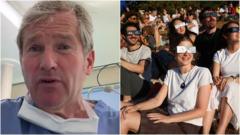
Solar retinopathy is not always immediate, and the absence of immediate pain tricks millions into believing their vision survived a celestial event unscathed. You woke up the morning after totality, blinked against the morning light, and noticed a strange, persistent smudge hovering right in the center of your field of view. Did the eclipse damage your eyes? If you skipped proper filtration or used cheap novelty glasses, the answer is likely yes, and that damage is written permanently into the microscopic architecture of your retina.
Most people assume that if a burn occurs, it will hurt. The human eye lacks pain receptors on the retina, meaning extreme thermal and photochemical injury can happen silently while you gaze upward. You feel nothing as photons fry the delicate photoreceptor cells. Hours later, the damage reveals itself as blurred vision, distorted shapes, or a permanent dark spot known as a scotoma.
Understanding how this happens requires looking past the magic of the cosmos and examining simple physics. The human eye acts as a biological magnifying glass. When you look directly at the sun without certified protection conforming to the ISO 12312-2 international standard, the crystalline lens focuses solar radiation onto a microscopic patch of tissue called the fovea centralis. This area packs the highest density of cone cells responsible for sharp, high-resolution, color vision.
The consequences are severe. Concentrated light triggers a photochemical reaction that floods retinal tissue with reactive oxygen species. These unstable molecules tear through cellular membranes and destroy the proteins required to translate light into electrical signals for the brain. The tissue does not simply bruise; it undergoes localized cell death.
Why Cheap Filters Fail the Safety Test
The market gets flooded with counterfeit safety glasses whenever a major celestial alignment approaches. Importers slap fake certification labels onto flimsy plastic frames or dark polymeric films that fail to block the invisible threats.
A legitimate solar filter reduces visible sunlight by a factor of one hundred thousand, while simultaneously blocking nearly all ultraviolet and infrared radiation. Counterfeits often let infrared radiation pass straight through. This invisible heat energy bakes the retina while the wearer assumes they are safe because the visible sunlight appears comfortably dim.
Independent optical laboratories routinely test seized batches of eclipse glasses following major events. The findings are sobering. A significant percentage of online purchases fail basic transmission tests, allowing dangerous levels of radiation to bypass the wearer's defenses. People trust a piece of cardboard bought from a general marketplace, unaware that substandard materials act as magnifying glasses rather than shields.
The Diagnostics of Photochemical Trauma
When a patient walks into an optometrist's office complaining of central blurriness post-eclipse, standard visual acuity tests often fail to capture the full scope of the injury. A person might still read the 20/20 line on a Snellen chart while missing letters in between because the damage creates patchy, micro-scotomas.
Clinicians rely on advanced imaging to map the destruction. Optical Coherence Tomography, commonly known as OCT, provides high-resolution cross-sections of the retinal layers.
Normal Retina:
[ Nerve Fiber Layer ] -> [ Photoreceptor Outer Segments ] -> [ Retinal Pigment Epithelium ]

Post-Eclipse Retina:
[ Nerve Fiber Layer ] -> [ MISSING OR DISRUPTED SEGMENTS ] -> [ Hyperreflective Scarring ]
An OCT scan of an injured retina reveals a distinct disruption in the ellipsoid zone, a band of tissue packed with the metabolic powerhouses of the photoreceptor cells. When that line breaks down on the monitor, the prognosis shifts from temporary strain to permanent structural loss. The bright reflection of scar tissue replaces the smooth, organized layers of healthy cells.
The Myth of Complete Recovery
Can solar retinopathy heal on its own? The answer depends entirely on the severity of the initial burn.
Mild cases often see partial improvement over three to six months as adjacent healthy cells shift or neural adaptation helps the brain ignore the tiny blind spot. Visual acuity might bounce back from 20/80 to near 20/25.
Severe burns, however, leave permanent scars. The fovea cannot regenerate destroyed cone cells. Once those specialized receptors die, they are gone forever. Patients must learn to adapt to a permanent distortion in their central vision, relying on eccentric viewing techniques where they look slightly to the side of an object to bring it into functional, undamaged peripheral focus.
Medical science offers few interventions once the photons have done their work. Anti-inflammatory drops and steroid therapies are sometimes prescribed in the immediate aftermath to manage secondary swelling, but they cannot resurrect dead neural tissue. Antioxidant regimens are occasionally recommended to combat lingering oxidative stress, yet their efficacy in reversing established solar burns remains unproven in rigorous clinical trials.
Hindsight and Public Health Communication
Public messaging surrounding solar events often focuses heavily on excitement rather than risk mitigation. Media outlets promote the spectacle with countdown clocks and viewing parties, while safety warnings are tucked away in fine print.
When millions of people point their unprotected or improperly protected eyes at the sky, a public health burden follows. Clinics see a surge of unexplained visual disturbances in the days immediately following the event. Many sufferers delay seeking care, hoping the blurriness will vanish with a good night's sleep, only to discover weeks later that the damage is permanent.
Education remains the only effective defense against solar retinopathy. Until public awareness shifts from viewing safety gear as a disposable accessory to treating it with the same respect as heavy industrial welding equipment, each major celestial alignment will leave a silent trail of preventable visual casualties in its wake.
The smudge in your vision is not going away. The distorted lines on your grid test are real, etched permanently into the most sensitive tissue in your body by a few seconds of unshielded stargazing.