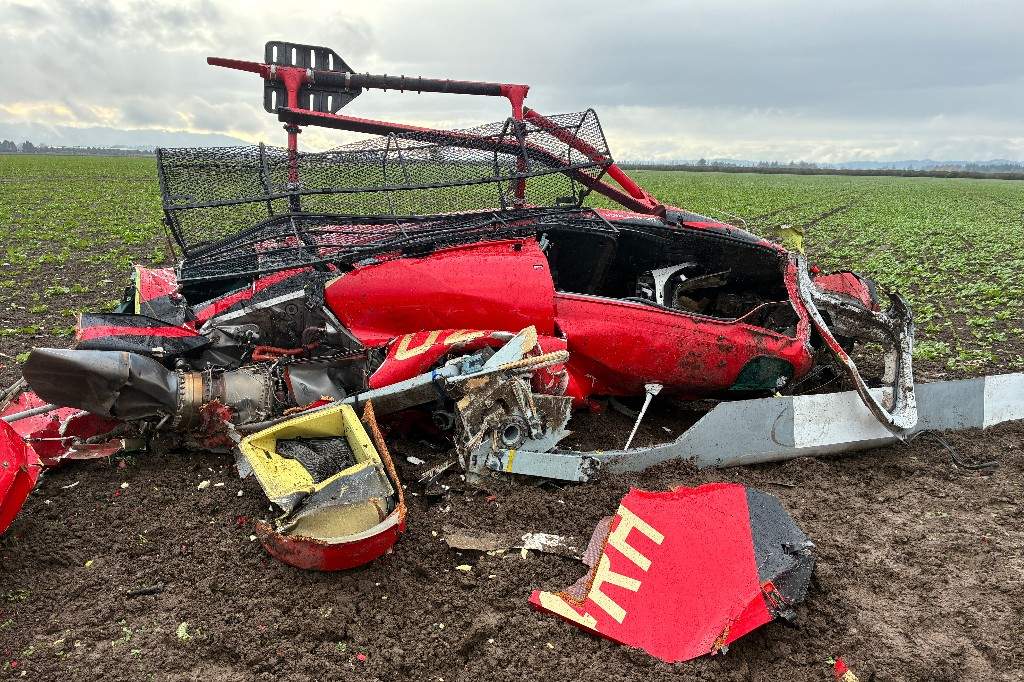
Two hundred feet.
In the grand, sweeping expanse of the Pacific Northwest sky—where Douglas firs stretch toward low-hanging clouds and the Willamette Valley opens like a green palm—two hundred feet is nothing. It is the length of a city block. It is the distance you walk from your front door to the corner mailbox. At ninety knots, inside the plexiglass bubble of a light helicopter, two hundred feet disappears in less than a second and a half.
When news broke of a midair helicopter collision near an Oregon airport that claimed three lives, the wire reports did what wire reports always do. They stripped the tragedy down to cold, clinical coordinates. Two aircraft. One shared patch of sky. Three fatalities. An investigation opened by the National Transportation Safety Board and the Federal Aviation Administration.
You read a headline like that over morning coffee, feel a brief, sharp pang of sorrow, and scroll on. It feels like a freak accident, an impossibly rare cosmic dice roll where two needles somehow collided in an ocean-sized haystack.
Except it wasn't a haystack. And if you have ever sat in the right-hand seat of a training helicopter, headset clamped tight over your ears, your eyes straining against the morning glare while your left hand makes micro-adjustments to the collective, you know the truth. The sky around a regional airport isn't empty. It is a crowded, invisible highway with no painted lines, no guardrails, and—far too often—no traffic lights.
The Architecture of a Blind Spot
To understand how two helicopters can occupy the exact same cubic yards of air near an Oregon airfield, you have to understand how small airports actually work. Most people picture aviation through the lens of major commercial hubs like Portland International or Seattle-Tacoma. At those giants, air traffic controllers sit in darkened rooms, staring at glowing radar sweeps, separating every steel tube by miles and thousands of feet. Nobody moves without permission.
Regional airports—the beating heart of flight training, agricultural spraying, medevac staging, and local charter work—operate under a completely different set of rules. Many are "non-towered" fields, or operate during hours when the control tower is closed. Even near towered airports, the surrounding practice areas and low-altitude corridors belong to a system called Visual Flight Rules, or VFR.
The core philosophy of VFR is two words: see and avoid.
On paper, it sounds entirely reasonable. Put two trained pilots in glass-walled cockpits, give them clear weather, and let them watch out for each other. In practice, "see and avoid" runs headfirst into the unforgiving biology of the human eye and the brutal geometry of flight.
Consider a hypothetical scenario that plays out every single day above Oregon’s flight corridors. Imagine an instructor and a student in a two-seat piston helicopter—say, a Robinson R22 or a Guimbal Cabri—practicing hovering autos or steep approaches near the boundary of an airport’s traffic pattern. A mile away, another helicopter is inbound from a cross-country leg, descending steadily toward the same general vicinity.
If both aircraft are on a collision course, something terrifying happens in the windshield of each cockpit. The other helicopter doesn't move.
Because their relative bearings remain constant, the approaching aircraft stays pinned to the exact same spot on the plexiglass canopy. The human eye is evolutionarily wired to detect lateral motion—a predator darting through tall grass, a car swerving into your lane. We are terrible at detecting an object that isn't moving across our field of vision, only growing slowly larger. At a distance of a mile, a light helicopter is smaller than the width of a pencil lead held at arm's length. It blends seamlessly into the mottled greens and browns of Oregon farmland or the glare of a coastal haze. By the time that dot blooms into a recognizable fuselage and spinning rotor disc, human reaction time—the two to four seconds it takes for the brain to register danger, signal the hands, and overcome the rotorcraft's inertia—has already run out.
Add to that the physical blind spots built into every airframe. Helicopter cockpits offer panoramic views, yes, but they still have structural door posts, overhead instrument consoles, and—most critically—the solid floor beneath the pilots' feet. An aircraft climbing from below is completely invisible to a pilot descending from above. Conversely, an aircraft descending from behind and above vanishes into the blind spot of the helicopter below it.
Two pilots can be doing everything right—scanning the horizon in ten-degree sectors, keeping their heads on a swivel, flying precisely on altitude—and still never see the machine that ends their lives.
The Human Weight of Three Empty Seats
When three people die in a midair collision involving two helicopters, the math tells an immediate, intimate story. One aircraft carried a solo pilot. The other carried two.
In the tight-knit aviation community of the Pacific Northwest, that configuration almost always points to the foundational relationships of flight: an instructor and a student, or two seasoned commercial pilots sharing a ferry flight, crossing paths with a solo aviator building hours or returning from a routine mission.
I remember the first time I truly understood the fragility of those relationships. Years ago, sitting in a cramped flight school trailer beside a rain-slicked tarmac in the Willamette Valley, I watched a student pilot pre-flighting his trainer before an afternoon solo. He was twenty-two, vibrating with that specific mix of terror and exhilaration that comes when your instructor finally unbuckles, steps out onto the skid, and tells you to take the pattern alone. His instructor stood twenty feet away, arms crossed against the chill, watching every movement of the student’s hands as he checked the tail rotor pitch links. There is no bond quite like it. An instructor literally hands a student the controls of a machine that wants to tear itself apart if mishandled, trusting their own reflexes to catch mistakes before they become irreversible.
That is who occupies those cockpits. Not reckless daredevils, not statistics in an NTSB preliminary report, but obsessive students memorizing emergency checklists at midnight, instructors living on ramen and flight hours, and utility pilots who treat the sky like a carpenter treats a workshop.
When an accident like the Oregon collision happens, the shockwave doesn't stop at the edge of the runway. It ripples through every hangar in the state. Pilots who knew the victims personally suddenly find themselves staring at their own logbooks, tracing the exact same practice routes they flew forty-eight hours earlier. Spouses who had made peace with the statistical safety of modern aviation are forced to confront the sudden, violent reality that statistics offer zero protection when two trajectories intersect.
Why Helicopters Face Unique Hazards Near Airfields
To an outside observer, a midair collision between two helicopters seems even harder to fathom than one between airplanes. Airplanes have to fly fast to stay aloft; they are locked onto long, rigid approach paths miles out from the runway. Helicopters can stop in midair. They can turn on a dime. They can land on a patch of concrete the size of a living room rug.
Paradoxically, that agility is part of what puts them at risk near airports.
Because helicopters don't need long runways, airports route them differently to keep them out of the way of faster fixed-wing traffic. While Cessnas and Pipers fly wide, rectangular patterns at 1,000 feet above the ground, helicopters are frequently directed to fly tighter, lower patterns—often at 500 feet—or to use dedicated helipads tucked near ramps, fuel farms, and training areas on the periphery of the airfield.
This compresses helicopter traffic into a much smaller vertical slice of airspace. Instead of spreading out across miles of sky, multiple rotorcraft end up funneling through the same low-altitude transition corridors, entering and exiting the airport environment at similar heights and airspeeds.
Then there is the radio problem.
Around non-towered airports—or in outlying practice areas just beyond a tower’s immediate jurisdiction—pilots rely on a Common Traffic Advisory Frequency, or CTAF. Everyone on that frequency broadcasts their position and intentions blindly into the ether: "Hillsboro traffic, Helicopter Four-Two-Alpha, three miles south, inbound for the west pad."
It works brilliantly—until it doesn't.
A pilot transitioning from one airspace sector to another might still be tuned to an approach controller's frequency, listening to radar vectors, while the helicopter a quarter-mile away is broadcasting on the local airport frequency. Neither pilot hears a word the other says. Sometimes, pilots on the exact same frequency step on each other’s transmissions, turning two crucial position reports into a single burst of unreadable static. Other times, a pilot simply misidentifies a landmark—calling themselves "over the river bend" when they are actually a mile further east—painting a false mental picture for every other aviator listening in.
The Technology Gap We Refuse to Close
Here is the part that makes experienced pilots clench their jaws when another midair collision makes the evening news: we already have the technology to stop this, and we have chosen not to require it everywhere it matters.
In 2020, the FAA mandated that aircraft flying in busy, controlled airspace carry ADS-B Out—a system that uses GPS satellites to broadcast an aircraft’s precise location, altitude, and velocity once every second. On a modern cockpit display, nearby aircraft equipped with ADS-B show up as crisp, unmistakable symbols, complete with directional arrows and altitude tags telling you whether they are climbing or descending. Coupled with traffic advisory audio, a computerized voice will literally call out in your headset: "Traffic, twelve o'clock, same altitude, less than one mile."
It is a massive leap forward from peering through bug-splattered plexiglass hoping to spot a speck against the trees.
Yet massive gaps remain. Many regional airports and outlying practice areas fall outside the airspace rings where ADS-B Out is legally required. Even more critically, the mandate only requires aircraft to broadcast their position (ADS-B Out)—it does not require them to carry the receiving equipment (ADS-B In) that displays other traffic in the cockpit. A pilot can be legally compliant, broadcasting their location to the world, while flying completely blind to the traffic displays that could save their life.
For smaller flight schools and private owners operating light helicopters on razor-thin margins, outfitting an entire fleet with full traffic-display avionics and active collision-avoidance systems costs tens of thousands of dollars per airframe. Portable receivers exist—devices the size of a paperback novel that suction-cup to a side window and beam traffic data to an iPad strapped to a pilot’s knee—but even those rely on pilots having the time and bandwidth to glance down at a screen during high-workload phases of flight.
And when you are fifty feet off the deck, or setting up an approach near a busy Oregon airfield, looking down at an iPad means taking your eyes off the outside world at the exact moment you need them most.
What the Wreckage Demands of Us
In the days and weeks following an Oregon midair crash, investigators will walk the debris field with clipboards and laser scanners. They will pull maintenance logs, download radar tracks, retrieve any onboard avionics memory cards, and listen to every archived second of regional radio transmissions. Months from now, a dry, technical docket will quietly appear on a government website, cataloging probable causes and contributing factors in sterile bureaucratic prose.
By then, the headlines will have moved on. The local news crews will have packed up their satellite trucks.
For the families left behind, however, the clock stopped in the middle of an ordinary day. For the aviation community, the lesson cannot be allowed to fade with the news cycle. Every midair collision is a brutal reminder that the sky is unforgiving of assumptions—the assumption that the frequency is quiet because nobody is there, the assumption that the other pilot sees you, the assumption that two hundred feet of separation is enough.
High above the Pacific Northwest, the rotors are spinning again. Student pilots are still climbing into cold cockpits at dawn, running their fingers down pre-flight checklists, feeling the familiar shudder as the engine catches and the blades begin to bite the air. They lift off into a sky that looks boundless, empty, and serene—trusting their eyes, their radios, and the silent, fragile compact shared by everyone who leaves the ground.


