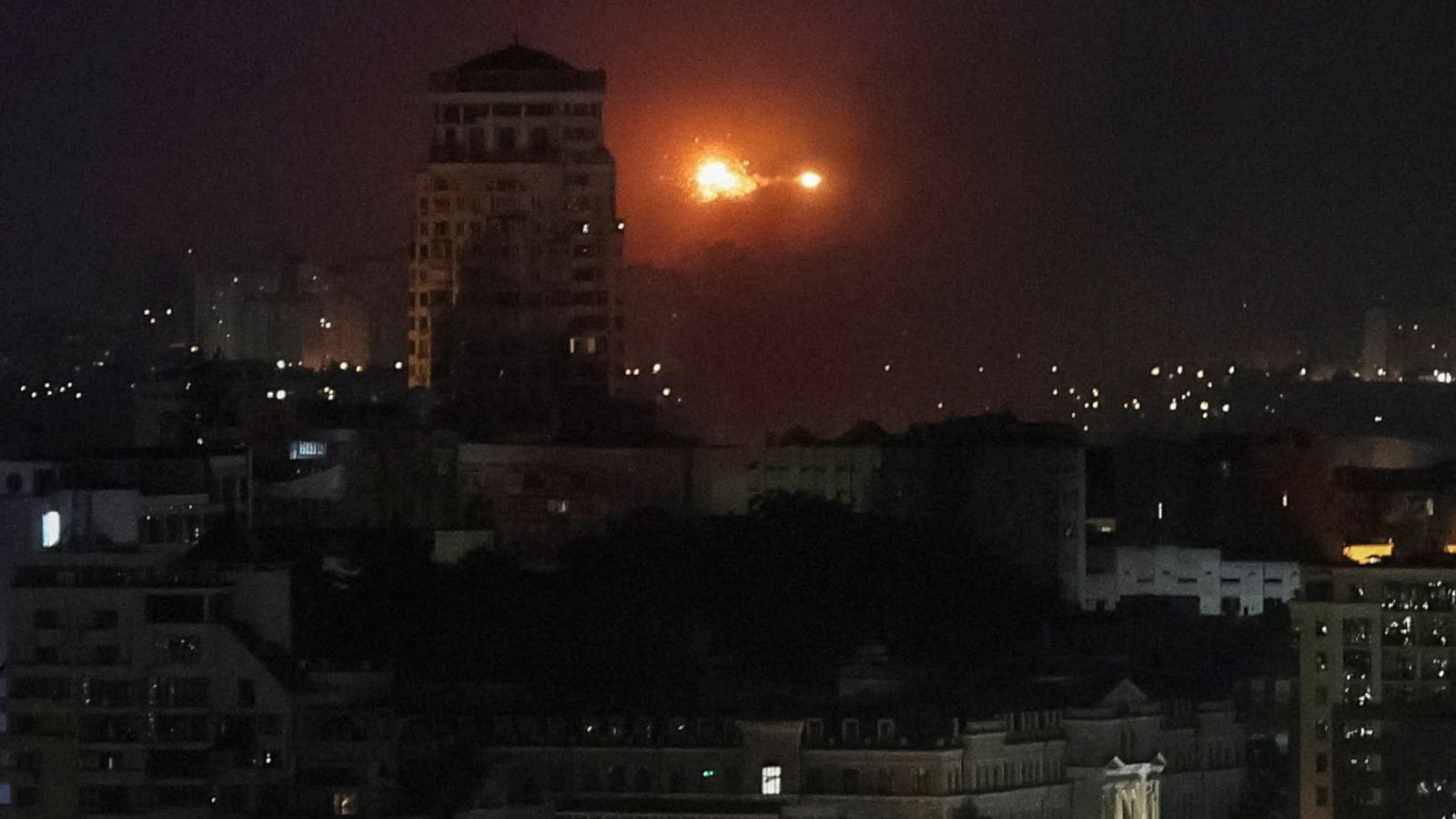
The strategic efficacy of a metropolitan air defense system is defined not by its overall interception volume, but by its vulnerability to asymmetric saturation. The overnight bombardment of Kyiv on July 6, 2026, which resulted in 11 confirmed civilian fatalities, 46 injuries, and structural failures across 15 residential buildings, exposes a critical operational inflection point. This strike, occurring less than 120 hours after a July 2 attack that claimed 31 lives, demonstrates a calculated shift in Russian strike architecture designed to exploit a widening deficit in Ukraine’s high-altitude terminal interceptors.
The tactical composition of the July 6 attack reveals the mechanics of the saturation vector. According to performance metrics released by the Ukrainian Air Force, the strike package comprised 419 total assets deployed in a synchronized, multi-axis profile:
- Low-Velocity Saturation Layer: 351 Shahed-type attack drones.
- Subsonic/Supersonic Cruise Layer: 33 Kh-101 and 6 Kalibr cruise missiles.
- High-Velocity Ballistic/Hypersonic Vector: 23 Iskander-M/S-400 ballistic missiles and 6 Zircon/Oniks hypersonic and anti-ship cruise missiles.
An analysis of the interception data reveals a stark divergence in operational success across these distinct layers. Ukrainian air defense units successfully neutralized 326 of the 351 drones (a 92.8% interception efficiency) and 37 of the 39 cruise missiles (a 94.8% efficiency). However, the system achieved a 0% interception rate against the 29 ballistic and hypersonic missiles. This outcome underscores that overall volume metrics—frequently cited at a misleadingly high 86.6% combined interception rate—obscure a catastrophic systemic failure at the high-velocity terminal engagement layer.
The Kinematic Decoupling of Terminal Defense
The operational failure to intercept any of the 29 ballistic or hypersonic assets highlights the rigid physics governing modern theater missile defense. Air defense architectures rely on matching specific interceptor profiles to the kinematic properties of incoming threats.
[Threat Vector: Ballistic/Hypersonic] -> [Requires: Patriot/SAMP/T] -> [Status: Inventory Depleted] -> [Result: Penetration]
[Threat Vector: Cruise/UAV]         -> [Requires: NASAMS/IRIS-T/Gepard] -> [Status: Operational]     -> [Result: Interception]
The low-velocity and subsonic cruise layers were successfully managed by point-defense frameworks, including mobile fire groups, Gepard anti-aircraft systems, and medium-range platforms like IRIS-T and NASAMS. These systems, while effective within their design parameters, lack the radar tracking velocity and kinetic energy required to counter ballistic trajectories.
Terminal defense against high-velocity vectors requires specialized kinetic energy or blast-fragmentation interceptors capable of operating in the upper atmosphere. In the Ukrainian theater, this capability is almost exclusively isolated to the MIM-104 Patriot and SAMP/T platforms. The systematic penetration of all 29 high-velocity assets indicates that these batteries were either out-positioned or, more likely, suffered from a critical depletion of interceptor stockpiles, specifically the MIM-104F (PAC-3) Missile Segment Enhancement (MSE) variant.
This structural deficit alters the calculus of strike economy. Russia’s concurrent utilization of 351 low-cost drones serves a dual analytical function: it forces the consumption of medium-range surface-to-air missiles (SAMs) and structurally delays radar acquisition timelines for the high-velocity vectors following in the secondary wave.
Multi-Axis Structural Damage Profiling
The physical consequence of this interceptor deficit was manifested in dense urban residential zones, primarily within Kyiv's Podilskyi, Darnytskyi, Obolonskyi, and Holosiivskyi districts. The structural failures observed in multi-storey residential blocks follow predictable kinetic pathways depending on whether they were subjected to direct ballistic impact or the cascade of intercepted debris.
In the historic Podilskyi district, a nine-storey residential structure suffered a total structural collapse from the fifth floor up. This specific damage profile—the erasure of upper vertical segments while leaving the lower foundation intact—is indicative of high-velocity kinetic energy transfer. When a ballistic asset or heavy supersonic missile impacts the upper levels of a reinforced concrete or brick frame building, the initial overpressure wave obliterates load-bearing columns. This triggers a localized progressive collapse, where the weight of the upper floors pancaking downward exceeds the structural design load of the mid-tier floors.
Conversely, the damage profile in the Darnytskyi district, characterized by fires consuming the 23rd through 25th floors of a 30-storey tower block, illustrates the secondary hazards of successful or partial interceptions. The descent of unspent solid rocket fuel, combined with the remaining kinetic energy of shattered missile hulls, acts as an incendiary accelerant. Modern high-rise residential architecture, while designed to resist standard thermal events, faces rapid systemic failure when multi-floor structural fires are initiated concurrently at high altitudes, complicating water-delivery mechanics and vertical rescue operations.
Geopolitical Signaling and Strike Timing
The temporal placement of the July 6 strike points to a clear strategic rationale. The attack was executed immediately prior to the NATO summit in Turkey, where U.S. President Donald Trump and Ukrainian President Volodymyr Zelenskyy are scheduled to negotiate frameworks aimed at concluding the conflict.
This creates a dual-pronged signaling dynamic. For international observers and Western allies, the strike exposes the immediate limitations of current military assistance frameworks. It demonstrates that without an immediate, continuous logistics pipeline of high-end interceptors, Western-supplied assets in metropolitan centers face compounding vulnerability.
For domestic audiences within the Russian Federation, the Ministry of Defense framed the operation as a retaliatory strike targeting Ukrainian military-industrial infrastructure, specifically citing drone production sites and air defense repair facilities. This positioning follows recent Ukrainian deep-strike operations using long-range attack drones against the Baltic Sea ports of Vysotsk and Ust-Luga. By targeting the capital’s administrative and urban center, the strike seeks to establish a strategic asymmetry: balancing Ukrainian economic disruption of Russian energy logistics with severe structural and psychological pressure on the Ukrainian center of gravity.
The Depletion Curve of Attrition Warfare
The primary bottleneck for Ukrainian defensive capability is no longer the availability of launch platforms, but the production-to-consumption ratio of advanced interceptor missiles. The global production capacity for PAC-3 MSE interceptors is fundamentally unaligned with the consumption rates demanded by modern peer-to-peer saturation warfare.
When a single strike deployment forces the consideration of firing multiple interceptors per high-velocity target to maximize probability of kill ($P_k$), a salvo of 29 ballistic threats can theoretically exhaust an entire metropolitan area's high-tier defensive reserve in under an hour. The second limitation is financial asymmetry: utilizing an interceptor costing upwards of $3 million to $4 million to counter assets, or to protect infrastructure against coordinated drone waves costing a fraction of that amount, creates a long-term economic drain that favors the offensive actor in an extended war of attrition.
The tactical imperative for the Ukrainian command structure is an immediate reassessment of asset protection priorities. If interceptor inventories cannot be replenished at a rate that matches the frequency of Russian strike packages, air defense commanders will be forced to make calculated triage decisions. This involves shifting coverage away from static civilian residential zones to concentrate remaining high-altitude assets exclusively around critical command-and-control nodes, energy generation infrastructure, and military logistics hubs. While this strategy reduces the vulnerability of vital state functions, it structurally accepts higher civilian casualty rates and accelerated urban degradation in metropolitan centers like Kyiv.
The July 6 bombardment serves as definitive proof that the current equilibrium of Ukraine's air defense network is unsustainable. The performance metrics of the engagement demonstrate that high interception percentages against low-tier threats are irrelevant if the high-velocity terminal defense layer is permitted to decay into absolute saturation.