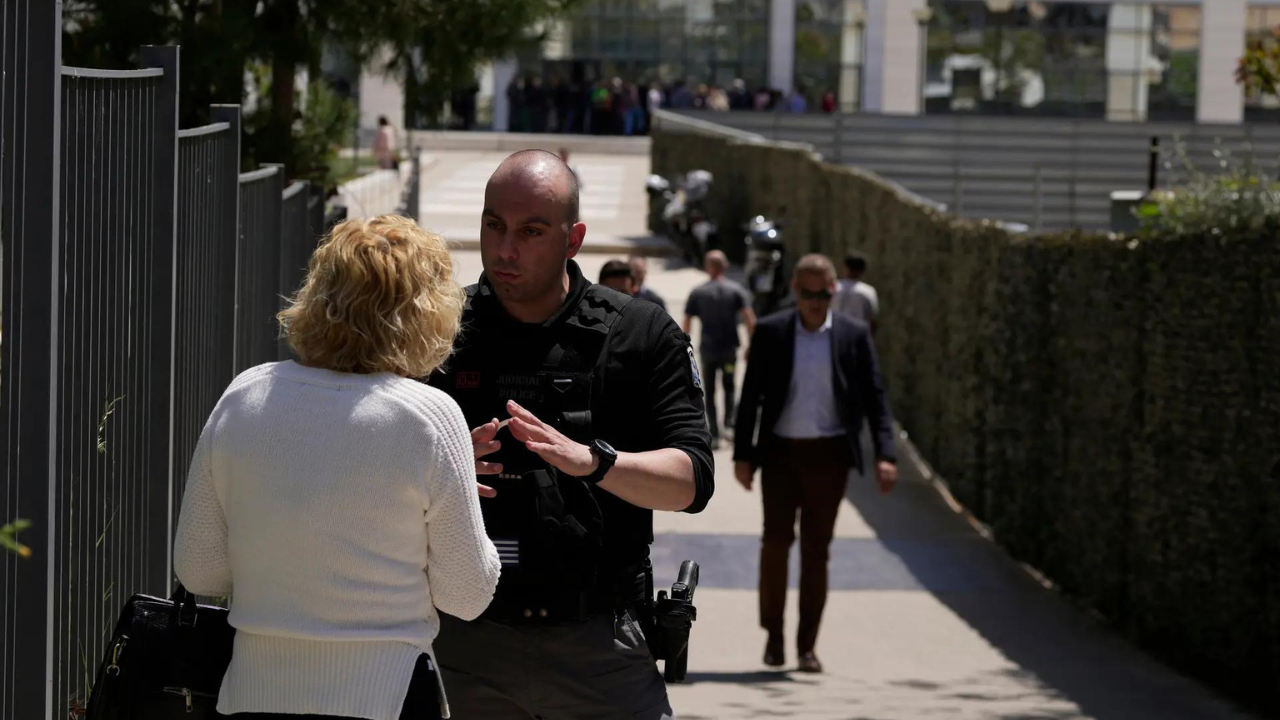
The failure of physical security at two high-value administrative hubs in Athens—a social security office and a courthouse—exposes a critical misalignment between perceived threat profiles and the operational reality of "low-probability, high-impact" geriatric violence. On April 28, 2026, an 89-year-old male perpetrator exploited the structural gaps in public sector access control, resulting in four casualties across two distinct geographic points. This event provides a blueprint for understanding the erosion of the Greek state’s domestic security perimeter when confronted with non-traditional, non-systemic threats.
The Dual-Node Breach Framework
To understand the systemic failure, we must categorize the event not as a random act of violence, but as a sequential penetration of two distinct institutional nodes. Each node possesses a unique defensive architecture, yet both failed to mitigate the risk posed by a single, high-mobility elderly assailant.
Node 1: The Social Security Bureau (EFKA)
Administrative offices like the EFKA function on a high-throughput/low-friction model. Their primary objective is the processing of citizen claims, which necessitates open access points. The perpetrator utilized the "Social Friction Factor"—the inherent tension in bureaucratic settings—to mask his intent until the moment of discharge.
The failure here is categorized as a Detection Lag. In environments where verbal aggression is a daily baseline, the transition to kinetic violence is often missed by security personnel trained to de-escalate words rather than intercept weapons.
Node 2: The Athens Courthouse
The subsequent shooting at a judicial facility represents a more severe breakdown: a Perimeter Integrity Breach. Unlike the social security office, a courthouse is legally and operationally defined by controlled entry. The presence of a firearm within these walls indicates one of three failure points:
- Equipment Obsolescence: Metal detection systems calibrated for high-density metallic objects failing to flag smaller or legacy-style firearms.
- Procedural Complacency: A "profile-based" screening bias where an 89-year-old male is categorized as low-risk, leading to a cursory search or an outright bypass of standard operating procedures.
- Internal Logistical Gaps: Unauthorized entry via secondary service doors or staff entrances that lack the rigorous screening of the primary public gate.
The Geriatric Violence Variable: A Statistical Outlier
Security models are built on historical data that prioritizes the "Prime Offender Demographic" (males aged 18–35). When an 89-year-old enters the decision matrix, the system experiences a logic error. This "Outlier Effect" creates a tactical advantage for the perpetrator through three mechanisms:
- The Invisibility of Intent: Social conditioning leads security personnel to associate advanced age with physical frailty rather than lethal capability.
- Reduced Reactionary Speed: Responding officers often hesitate during the "OODA Loop" (Observe, Orient, Decide, Act) because the visual stimuli—an elderly man—contradicts the internal threat model of an active shooter.
- The Zero-Sum Incentive: For an actor in their ninth decade, traditional deterrents such as life imprisonment or social ostracization carry diminished weight. The "Horizon Problem" in behavioral economics suggests that as the remaining life-years decrease, the cost of extreme actions approaches zero.
The Mechanics of Public Sector Risk Contagion
The Athens shootings illustrate how a single incident can trigger a Risk Contagion across an entire urban administrative network. When Node A is hit, Node B remains vulnerable if the communication latency between agencies is higher than the perpetrator's transit time.
The perpetrator moved from the social security office to the courthouse with enough speed to stay ahead of the city-wide lockdown. This indicates a failure in Real-Time Inter-Agency Interoperability. In a functional security grid, the first shot fired at a government building should trigger an automated "Hard Lockdown" of all tier-one administrative sites within a 5-kilometer radius.
Athens operates on a fragmented security model where individual buildings manage their own gates, creating a "Siloed Defense." This lack of a centralized, responsive command structure allows a mobile threat to exploit the gap between the incident report and the execution of a regional perimeter.
Quantifying the Cost of Institutional Inertia
The economic and social costs of these breaches extend beyond the immediate medical needs of the four injured parties. We can define the Institutional Recovery Cost (IRC) using the following variables:
- Immediate Operational Loss: The cessation of judicial and social security functions during the investigation.
- Security Retrofitting: The inevitable, often reactive, capital expenditure on scanners and personnel that follows a high-profile breach.
- The Legitimacy Deficit: The erosion of public trust in the state's ability to protect its citizens within its own "safe" zones.
The Greek state currently faces a "Scarcity Trap." Post-crisis austerity measures have historically thinned the density of armed security in non-military government buildings. While the numbers of police may seem adequate on paper, the Effective Security Density (the ratio of trained, alert responders to the total floor area of public buildings) has reached a critical low.
The Tactical Misalignment of the Greek Police (ELAS)
The response by the Hellenic Police (ELAS) reveals a reliance on post-factum containment rather than proactive interruption. While the perpetrator was eventually neutralized or detained, the duration of his "Active Window"—the time between the first shot and the apprehension—suggests a lack of rapid-response units stationed in the city’s administrative core.
This is a Deployment Topology error. Most police resources are diverted to riot control or high-crime residential districts, leaving the "White Collar" administrative zones as soft targets for motivated individuals.
Structural Recommendations for Administrative Hardening
The Greek Ministry of Citizen Protection must move away from "Security Theater" and toward a Data-Driven Defense Model. This requires a shift in three specific areas:
1. Mandatory Biometric and AI-Augmented Screening
Relying on human judgment to "profile" threats is a proven failure. Modernizing the courthouse perimeter must include AI-integrated video analytics that detect the specific "Gait and Weight" signatures of concealed weapons, regardless of the age of the carrier.
2. The Unified Command Trigger
Establish a "Red-Line Protocol" where an active shooter event at any government facility automatically triggers a Level 1 lockdown for all public buildings in the prefecture. This removes human hesitation from the loop and closes the window for a multi-node attack.
3. Behavioral Risk Profiling in Social Services
The EFKA and similar bureaus require a specialized tier of security trained in Behavioral Detection and De-escalation (BDD). These agents focus on identifying the psychological precursors to violence—escalating vocal patterns, physical tics, and signs of extreme distress—common in citizens dealing with high-stakes bureaucratic outcomes.
The events in Athens are a symptom of a broader European trend: the collision of an aging, sometimes desperate population with a strained and technologically lagging state infrastructure. The assumption that elderly citizens are non-combatants is a systemic vulnerability. The Greek government must now decide if it will treat this as an isolated anomaly or as the catalyst for a radical overhaul of its domestic security architecture.
The immediate strategic priority is the implementation of a "Zero-Bias Screening" policy at all judicial facilities. If an 89-year-old can penetrate a courthouse with a firearm, the perimeter does not exist; it is merely a suggestion. The state must re-establish its monopoly on force within its own walls through a hard-reset of entry protocols, removing age-based exemptions and prioritizing mechanical detection over human intuition.