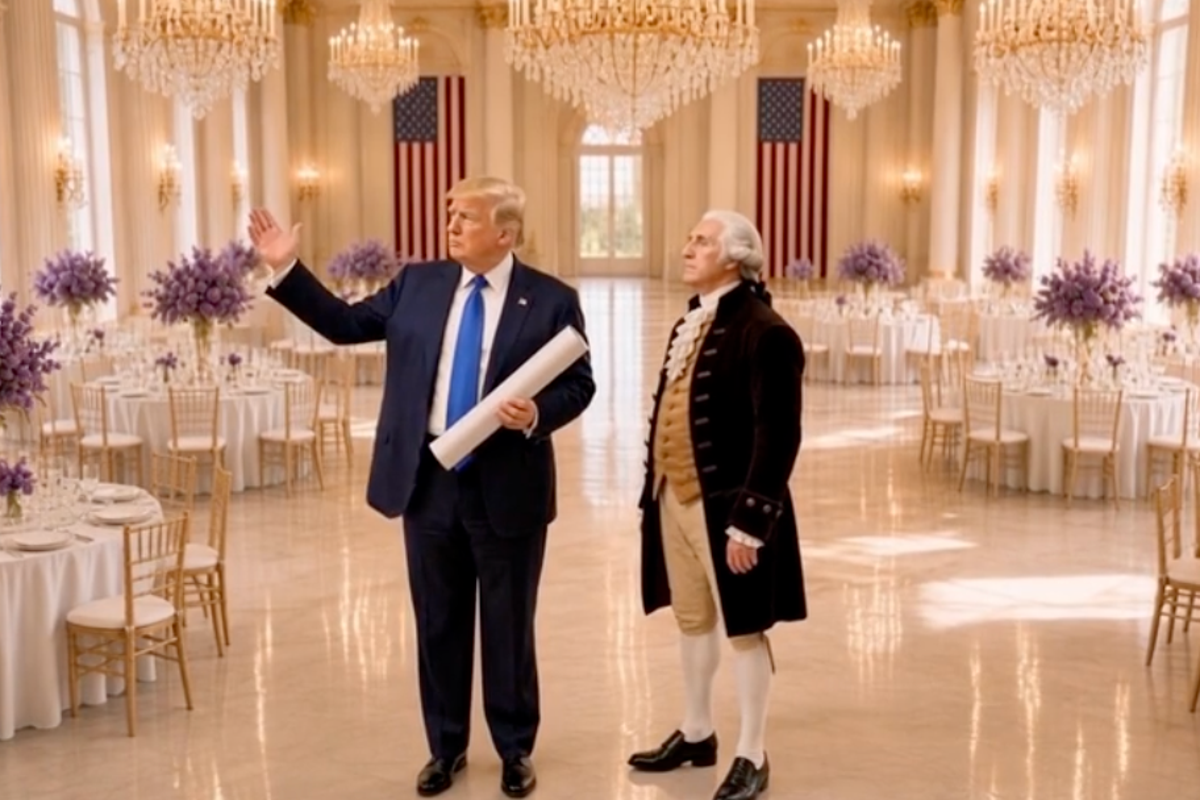
President Donald Trump is fighting a high-stakes legal war over a four-hundred-million-dollar White House ballroom project, choosing to wage a parallel campaign in the digital ether by sharing artificial intelligence-generated media that features George Washington acting as an architectural consultant.
The intersection of generative media, presidential legacy building, and constitutional power struggles has rarely looked quite like this. As the administration petitions the Supreme Court to override a federal appeals court halt on aboveground construction, the public discourse is simultaneously saturated with synthetic clips of America's first and forty-seventh presidents strolling through unbuilt banquet halls, writing with quill pens, and riding horses across the lawn. Beneath the surreal surface of these digital artifacts lies a very real, hardball dispute over executive authority, separation of powers, and the physical architecture of executive power.
The Legal Precipice of a Presidential Vanity Project
The immediate crisis facing the White House project is structural and jurisdictional, not digital. A ruling from the United States Court of Appeals for the District of Columbia Circuit determined that aboveground construction on the massive ballroom cannot proceed without explicit congressional authorization. Lawmakers are currently on summer recess, and Capitol Hill leadership has shown zero appetite for rubber-stamping the luxury expansion before midterms.
Cornered by the judicial branch, the administration executed an emergency maneuver by appealing directly to the Supreme Court. The core legal defense relies on an aggressive interpretation of national security architecture. Government lawyers argue that the ballroom project cannot be cleanly severed from the underground military command and security infrastructure situated directly beneath it.
Every concrete pour and steel beam, according to the legal filing, functions as an integrated shield for critical underground installations. The appeals court granted clearance for the subterranean security work to continue, but drew a hard line at the opulent superstructure planned for the grounds. This leaves the administration scrambling to protect a legacy project that has become a flashpoint for congressional oversight.
Rewriting History Through the Lens of Generative Media
While solicitors general and appellate judges argue over statutory authority, the president's online footprint tells a different kind of story. Synthetic media has transformed from a campaign novelty into a primary vehicle for political myth-making.
The digital sequence posted to Truth Social features a ten-second video clip of Trump and George Washington walking through the proposed ballroom layout. "Thank you, George, for some of your brilliant ideas on this great Military Complex/Ballroom!" the caption read. Additional images depict the pair sharing quills and consulting on parchment.
Historians immediately pointed out the glaring chronological irony. George Washington selected the site for the executive mansion and oversaw its initial planning, but he left office in seventeen-ninety-seven and died two years later, never spending a single night inside the building. John Adams inherited the damp, unfinished structure as its first resident.
More than mere historical inaccuracy, the invocation of Washington highlights an ideological contradiction. Washington defined his legacy by voluntarily relinquishing military command to civilian oversight and stepping down after two terms to prevent the consolidation of monarchical power. Trump, by contrast, has tested the absolute limits of executive tenure, recently sharing digital artwork hinting at third-term aspirations despite constitutional prohibitions.
The Weaponization of Synthetic Spectacle
The deployment of synthetic imagery is not random window dressing. It serves a calculated political function. By blending hyper-heroic fantasy with mundane policy fights, political figures can bypass traditional media gatekeepers and speak directly to a base that thrives on anti-establishment symbolism.
When mainstream outlets focus on procedural injunctions and appellate court deadlines, synthetic renderings reframe the narrative entirely. The debate shifts from building permits and architectural integrity to an epic clash between modern ambition and founding-era mythology. The architecture becomes secondary to the aura.
Critics warn that normalizing ultra-realistic synthetic media in political communication erodes shared consensus reality. Supporters counter that digital creations function simply as modern political cartoons—exaggerated, satirical, and transparently fictional. Yet the sheer volume of high-end fantasy imagery shared by political accounts blurs those traditional boundaries, conditioning audiences to evaluate leadership through aesthetic impact rather than factual provenance.
The Physical and Financial Stakes
Stripped of the digital filters and constitutional theory, the physical reality on Pennsylvania Avenue remains messy. The multi-hundred-million-dollar price tag for a space designed to host large-scale state dinners and military functions has alienated fiscal conservatives and energized congressional Democrats.
The administration insists that the existing State Dining Room is woefully inadequate for modern geopolitical entertaining, forcing large delegations into temporary tents on the South Lawn. The proposed ballroom aims to permanently resolve that logistical bottleneck. However, opponents view the project as an unmitigated exercise in executive overreach, tearing into the historic fabric of the executive campus for a vanity structure.
As the Supreme Court weighs whether to lift the injunction, the clock ticks toward an August deadline set by the lower court to freeze aboveground work completely. Whether the highest court in the land will intervene on behalf of an executive branch eager to break ground remains to be seen.
The scaffolding stays up for now. The digital renderings continue to circulate. George Washington remains dead, buried, and drafted into service as an imaginary architectural partner for a president determined to reshape the Washington landscape by any means available.
This video provides additional context regarding the controversy surrounding Donald Trump's use of artificial intelligence-generated media and political imagery.
http://googleusercontent.com/youtube_content/1