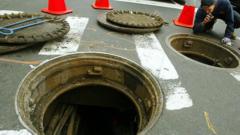
A series of viral videos showing disciplined teams of men pulling open heavy manhole covers and vanishing into the New York City sewer system has triggered an intense, late-night game of cat-and-mouse between law enforcement and a highly organized network of underground scavengers.
The New York Police Department and the Department of Environmental Protection are scrambling to identify dozens of individuals captured on security cameras in Brooklyn and Queens. Operating under the cover of darkness, these crews spend hours deep inside the subterranean infrastructure before emerging with industrial tools, changing out of specialized gear, and escaping in waiting vehicles. While initial public fears leaned toward infrastructure sabotage, senior law enforcement officials have confirmed that investigators are tracking a much more pragmatic motive. A lucrative, highly dangerous underground economy centered on urban treasure hunting is expanding beneath the feet of New Yorkers.
Security footage from the Gravesend neighborhood of Brooklyn captured eight men lifting a maintenance cover near McDonald Avenue around 11:00 p.m. They remained underground for three hours. When they emerged, they systematically stripped off heavy hip waders, packed away flashlights, changed into clean street clothes, and drove away in parked cars. Just hours later, a nearly identical scene played out in Williamsburg near Bedford Avenue, where another crew vanished into the labyrinth for two and a half hours. A third recorded incident in Astoria, Queens, featured men equipped with specialized suits and industrial tools descending into the dark.
The NYPD Emergency Service Unit conducted sweeping sweeps of the subterranean locations, checking for structural damage or hazardous materials. They found none. The city infrastructure remains intact, which shifted the focus of the investigation away from terrorism and toward targeted, illicit economic activity.
Beneath the asphalt lies a vast, multi-tiered network of century-old brick tunnels, modern storm drains, and active sewage lines. For decades, the conventional wisdom was that anything dropped down a New York catch basin was lost forever to the Atlantic Ocean or the treatment plants. That calculation has changed.
The combination of high-definition waterproof cameras, compact gas detectors, and skyrocketing precious metal prices has turned the city drainage network into an active frontier for specialized scavengers. The primary target is not loose change or discarded trinkets. It is industrial scrap, precious metals from aging infrastructure, and heavy jewelry lost through the city’s millions of sidewalk grates.
Every heavy rainstorm washes tons of debris from the streets into the catch basins. Heavy objects settle into specific choke points, bend radiuses, and subterranean junction boxes before reaching the main interceptors. Experienced urban scavengers use public city utility maps, easily accessible online, to chart the flow of storm runoff. They target historical neighborhoods where decades of accumulated sediment can yield vintage jewelry, lost coins, and luxury watches that slipped through street grates during summer downpours.
There is also a market for historical artifacts. Nineteenth-century bottles, antique hardware, and relics from New York's early expansion command premium prices among niche collectors. To the untrained eye, the sludge of a Brooklyn sewer line is toxic waste. To an equipped crew, it is a dense placer deposit waiting to be sieved.
Stepping inside the municipal sewer system is a Class A misdemeanor, potentially rising to burglary or criminal mischief charges if tools are used to breach secure areas. The legal risks, however, pale in comparison to the immediate physical dangers.
The Department of Environmental Protection constantly warns that the underground network is an unforgiving environment. The most immediate threat is invisible. Pockets of methane, hydrogen sulfide, and carbon monoxide can accumulate in unventilated dead ends. A single breath of highly concentrated hydrogen sulfide can paralyze the respiratory system, causing immediate unconsciousness and death. The teams captured on camera appear well aware of this, utilizing specific breathing apparatus and multi-gas meters to test the air quality before descending.
Then there is the hydraulic reality of New York. The city relies heavily on a combined sewer system, meaning storm water and sanitary sewage flow through the same pipes. A sudden, unpredicted cloudburst miles away can cause water levels inside a storm main to rise from inches to a roaring, insurmountable torrent in a matter of minutes. Getting swept away means drowning in absolute darkness, miles from the nearest exit.
The level of organization displayed in the Brooklyn and Queens videos suggests these are not casual thrill-seekers or disorganized vagrants. The operations are run like military maneuvers.
A standard crew utilizes scout vehicles to monitor police frequencies and spot civilian witnesses. They use heavy-duty magnet fishing rigs, industrial-grade metal detectors calibrated for wet, mineralized environments, and specialized sluice boxes designed to separate heavy metals from dense sludge. The fact that the men in Williamsburg closed the heavy cast-iron manhole cover perfectly behind them demonstrates a desire to avoid detection and keep their entry points viable for future operations.
City officials face a difficult enforcement dilemma. There are hundreds of thousands of manholes across the five boroughs. Locking every cover is logistically impossible, as utility workers require immediate, unhindered access during electrical fires, gas leaks, and water main breaks.
The NYPD is currently reviewing license plates from the getaway vehicles and tracking online forums where urban explorers and scrap markets intersect. For now, the city’s underworld remains highly profitable for those willing to risk their lives in the toxic dark, turning the forgotten refuse of the metropolis into a high-stakes, subterranean gold rush.