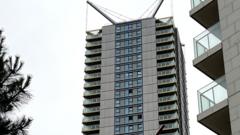
The tragic deaths of a family falling from a high-rise flat block are not isolated anomalies. They are the predictable consequences of a systemic failure in urban housing security and oversight. While local news outlets routinely rush to name the victims, publish grieving family photos, and wait for a brief police statement, they consistently skip the uncomfortable questions. Why do these falls keep happening? What specific architectural and regulatory flaws permitted it? The reality is that modern high-rise living carries hidden, structural risks that municipal authorities and corporate landlords actively ignore to avoid costly retrofitting liabilities.
To understand how a family can fall from a high-rise building, one must look beyond the immediate police tape. Investigation into urban planning records and structural engineering reports reveals a stark divide between aesthetic modern architectural trends and basic human safety.
The Illusion of Safety in Vertical Architecture
Modern high-rise residential buildings are heavily marketed as secure, self-contained sanctuaries. Developers boast of smart access keys, CCTV coverage, and concierge desks. Yet, the physical barriers separating residents from a fatal drop are frequently compromised by cost-cutting measures, outdated building codes, and poor maintenance.
Window restrictors are a prime example. These small metal mechanisms are designed to limit how far a high-rise window can open, theoretically preventing an adult or child from falling through. In theory, they require specialized tools or significant force to disengage. In practice, budget-conscious housing associations and private landlords frequently install cheap, plastic-bodied restrictors that degrade rapidly under UV exposure and wind pressure.
Furthermore, building regulations in many jurisdictions only mandate these safety devices for properties housing children under five. This policy ignores a fundamental reality of housing. People move. Families grow. Guests visit. A flat deemed safe for a single tenant today becomes a death trap for a visiting family tomorrow.
The Regulatory Blind Spots
Municipal safety inspections are broken. In the wake of high-profile tower disasters, public attention usually fixes on fire safety and cladding. While fire risks are undeniably critical, this hyper-focus has created a dangerous blind spot regarding structural fall hazards.
An independent analysis of housing enforcement notices reveals that window and balcony integrity checks rank near the bottom of priority lists for municipal inspectors. Landlords are often permitted to self-certified window safety during routine tenancies. This means the person with the greatest financial incentive to overlook a defect is the one responsible for checking it.
Consider the mechanics of a standard window failure. Over time, building settlement shifts window frames out of alignment. This warping puts immense pressure on the hinges and restrictors. When a resident attempts to force a jammed window open on a hot day, the weakened safety catch can snap entirely. It happens in an instant. A sudden loss of balance, a faulty frame, and no secondary barrier to catch the fall.
Balcony Failures and the Push for Modern Aesthetics
Balconies have become a standard selling point for urban apartments, offering a premium slice of outdoor space. However, the engineering behind these structures is increasingly compromised by the desire for unobstructed views.
The traditional, heavy steel or concrete balustrade has been largely replaced by frameless glass balustrades. These glass panels are held in place by base shoes or structural pins. While aesthetically pleasing, glass balustrades introduce significant points of failure:
- Thermal Shock: Rapid temperature swings can cause micro-fractures in tempered glass, leading to sudden shattering without warning.
- Improper Installation: If the chemical anchors securing the base shoe into the concrete slab are mixed incorrectly or exposed to moisture during construction, they degrade silently over time.
- Lack of Redundancy: Traditional railings offer physical vertical bars that can be grabbed in an emergency. Smooth glass provides zero handhold if a person slips or trips.
When a failure occurs, the legal defense from property management companies is almost entirely uniform. They blame tenant behavior. They point to over-crowded balconies, furniture placed too close to the edge, or unauthorized modifications. By shifting the blame to the victims, corporate landlords protect their insurance premiums and avoid broader scrutiny of their maintenance logs.
The True Cost of Local Authority Negligence
The financial burden of upgrading high-rise safety is immense, which explains the persistent institutional inertia. Retrofitting a single 20-story tower block with heavy-duty, tamper-proof window restrictors and reinforced balustrades can cost hundreds of thousands of pounds. Multiply that across a city's entire social and private housing stock, and the figure becomes astronomical.
Local authorities face a brutal calculus. They are chronically underfunded, balancing social care budgets against infrastructure maintenance. Deciding to replace windows across an entire estate means cutting services elsewhere. Consequently, they opt for reactive maintenance. They fix a window only after a tenant files multiple complaints, or worse, after an accident occurs.
This reactive model relies entirely on the tenant's ability to recognize a hazard and navigate a complex bureaucratic reporting system. For vulnerable families, non-native English speakers, or those struggling with precarious tenancies, pushing a landlord for structural repairs is incredibly daunting. They stay quiet, live with the broken latch, and hope for the best.
Redefining High Rise Safety Mandates
The current framework of voluntary compliance and self-certification is completely inadequate to protect lives. Preventing further high-rise fatalities requires a fundamental overhaul of how vertical residential spaces are regulated and managed.
First, window safety restrictors must be treated with the same legal gravity as fire doors or gas certificates. They should require annual, independent engineering certification, with severe criminal penalties for landlords who fail to comply. These devices must be hard-engineered into the window frame itself during manufacturing, rendering them impossible to remove or bypass without heavy industrial tools.
Second, building codes must outlaw frameless glass balustrades on residential buildings above three stories. Aesthetics cannot take precedence over human life. Balconies must feature mandatory structural redundancy, including vertical steel balustrades and a minimum height requirement that accounts for modern human height averages, which have outgrown century-old building standards.
Finally, there must be a transparent, centralized database tracking all fall incidents and near-misses in high-rise buildings. Currently, these events are scattered across local police logs, hospital admission data, and private insurance files. Aggregating this data would expose the true scale of the crisis, forcing lawmakers to acknowledge that these deaths are not freak accidents, but a public safety emergency that demands immediate, structural intervention.