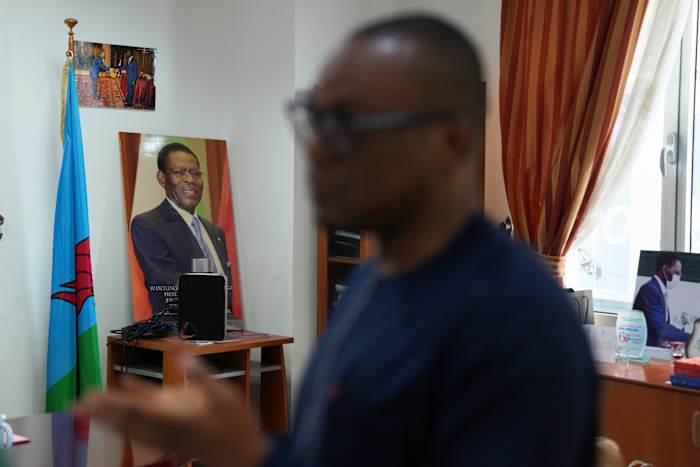
An international coalition of human rights lawyers filed a sweeping lawsuit against Equatorial Guinea at the African Commission on Human and Peoples’ Rights on June 5, 2026. The legal challenge targets a highly secretive, multi-million-dollar immigration deal between Washington and the central African petrostate. Under this agreement, the United States deports African asylum seekers to Malabo, which then quickly expels them to their home countries where they face documented threats of torture, political imprisonment, and death. This process, known as chain refoulement, represents a structural circumvention of international human rights law designed to erase the legal protections granted by American judges.
The filing seeks an immediate emergency order to halt all further onward expulsions, guarantee immediate access to legal counsel, and expose the transactional mechanisms of a migration strategy that operates largely in the shadows.
The Shell Game of Human Lives
For decades, international law has relied on the absolute principle of non-refoulement, which dictates that no sovereign nation may return an individual to a territory where their life or freedom is fundamentally threatened. When a migrant secures "withholding of removal" or protection under the UN Convention Against Torture in an American immigration court, the U.S. government is legally barred from returning that individual to their home country.
Washington has discovered an operational loophole. Instead of direct repatriation, the Department of Homeland Security boards these protected individuals onto unmarked flights. They are told they are moving to another domestic detention center. They land instead in Malabo, the isolated capital of Equatorial Guinea, a country ruled by Africa’s longest-serving dictator, Teodoro Obiang Nguema Mbasogo.
http://googleusercontent.com/image_content/232
The administrative handoff is clean, swift, and brutal. Since November 2025, at least 32 third-country nationals, including citizens of Mauritania, Angola, Eritrea, Ethiopia, and Ghana, have been funneled through this pipeline. Once on the ground, Equatorial Guinean authorities hold them without formal charges inside a heavily guarded tropical hotel. They are denied legal representation, isolated from international oversight, and presented with documents written in Spanish demanding they sign away their claims. Within weeks, the local regime arranges onward flights to their countries of origin.
Laundering Accountability for Seven Million Dollars
This is not an administrative mistake. It is a deliberate, cash-for-custody transaction. A Senate Foreign Relations Committee investigation revealed that the U.S. State Department quietly routed $7.5 million in taxpayer funds to Equatorial Guinea. Officially, the money was earmarked for "humanitarian assistance for refugees."
The ground reality exposes that explanation as entirely hollow. Equatorial Guinea does not maintain a functional asylum infrastructure, nor does it intend to build one. Local immigration officials have explicitly informed the detainees that domestic asylum options do not exist. Instead, the money effectively purchases a processing waystation where American legal liabilities are washed away.
The cash transfer allows Washington to maintain a posture of technical compliance while achieving the exact outcome prohibited by its own courts. Because the U.S. does not technically execute the final deportation flight to the dangerous homeland, the administration claims its hands are clean.
The consequences for the deportees are devastating. Among those already returned is Diadie Camara, an anti-slavery advocate who originally fled hereditary servitude in Mauritania. After being processed through Malabo, he was flown back to Mauritania via Morocco and has since gone into deep hiding. Another case involves a gay Ghanaian man who was originally granted protection by a U.S. judge due to severe anti-LGBTQ+ violence in his homeland. After landing in Malabo, he was promptly forced onto a flight back to Ghana, where he now faces immediate communal and state persecution.
A Broken Blueprint Across the Continent
The legal architecture under scrutiny in Malabo is part of a broader, systemic trend toward the externalization of border enforcement. Western democracies are increasingly treating developing nations as outsourced holding cells for unwanted populations.
The strategy relies on a calculated bet that regional human rights bodies lack the enforcement teeth to intervene effectively. While the African Commission can issue urgent protection orders and refer cases to the African Court on Human and Peoples’ Rights, its rulings are frequently ignored by authoritarian regimes.
There are, however, early signs of institutional friction. The litigation against Equatorial Guinea follows a parallel case brought against the kingdom of Eswatini, where the U.S. government established an identical third-country deportation pipeline. In that instance, detainees were held in a maximum-security prison for nine months without access to legal counsel before Eswatini’s Supreme Court intervened to grant them lawyer access.
The current litigation faces even steeper hurdles. Equatorial Guinea remains a tightly closed society where domestic dissent is systematically crushed and corruption is woven into the fabric of the state monopolies. The $7.5 million payout represents a significant financial incentive for a regime accustomed to converting state resources into private wealth.
The Bureaucratic Cycle of Hell
The mechanics of this pipeline create a bizarre, circular legal limbo for those who manage to survive the initial expulsion. In late May, Equatorial Guinean authorities attempted to forcibly deport an East African political dissident back to his home country, where he had previously been tortured by military forces. When the aircraft landed, border officials in his home country refused to admit him because he lacked valid travel documents and Malabo had failed to provide advance diplomatic notification.
The deportee was placed back on the plane and flown back to Equatorial Guinea. He remains locked in the Malabo hotel facility, technically unreturnable, legally unprotected, and functionally stateless. Human rights litigators describe the pattern as an inescapable cycle of bureaucratic torment.
The U.S. federal courts have attempted to curb the practice, but the legal battle remains gridlocked. In February 2026, a U.S. District Court declared the third-country removal policy unlawful, ruling that the Department of Homeland Security cannot deport individuals to unlisted third nations without providing meaningful notice and a formal venue to raise fear claims specific to that destination. However, that ruling remains stayed pending a lengthy appeals process, allowing the deportation flights to continue climbing into the sky from American runways.
National security and border security cannot be achieved by dismantling the foundational treaties that emerged from the wreckage of the twentieth century. When the world's wealthiest superpower pays an authoritarian petrostate to systematically strip away the legal protections of vulnerable people, it does not solve an immigration crisis. It merely institutionalizes a global black market for human rights avoidance.