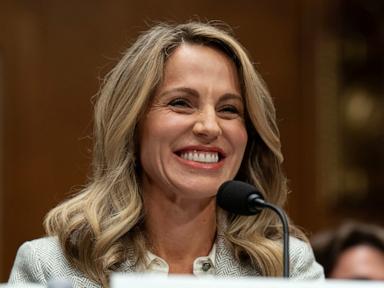
The recent advancement of Dr. Nicole Saphier’s nomination for United States Surgeon General by the Senate Health, Education, Labor and Pensions Committee is far more than a routine administrative tick on Capitol Hill. It represents a calculated pivot in federal health leadership after months of friction between the White House, congressional Republicans, and the Department of Health and Human Services. When a presidential administration advances a media-visible physician to the nation's highest public health post, the underlying mechanics reveal how modern political survival dictates public health strategy.
To understand why this nomination cleared the committee by a party-line vote, one must examine the wreckage of what came before it. President Trump’s initial choice for the post had stalled indefinitely amid intense legislative scrutiny and open infighting among key GOP senators and HHS leadership. The legislative branch made it clear that traditional public health orthodoxy—specifically regarding vaccine safety and established empirical science—would be a major battleground. Saphier, a practicing radiologist, director of breast imaging, and former television medical commentator, entered the confirmation arena with a built-in national profile, yet faced immediate skepticism from both sides of the aisle regarding how she would navigate an increasingly polarized health bureaucracy.
During her confirmation hearings, the questioning rapidly zeroed in on core ideological fault lines. Senators pressed her on historical immunizations, childhood developmental disorders, and the integrity of federal agencies. Saphier explicitly rejected the notion that routine childhood immunizations correlate with autism, pointing directly to the measles, mumps, and rubella shot as an essential cornerstone of preventative medicine. For committee members anxious about ideological purity tests overriding empirical data, these statements served as a necessary reassurance.
Yet, securing a committee vote is merely the opening act. The broader reality of the Surgeon General's office is that the position carries immense symbolic weight paired with remarkably limited statutory power. The occupant is dubbed the nation's doctor, expected to rally public sentiment around health crises ranging from chronic disease to mental health burnout. However, without direct command over regulatory enforcement or massive budgetary allocation, the effectiveness of any surgeon general relies entirely on their credibility with both the scientific community and the political executive branch appointing them.
When an administration staffed with disruptive health reformers intersects with a traditional medical establishment, the surgeon general becomes a tightrope walker. Saphier’s background bridges these worlds. She possesses mainstream clinical credibility paired with a fluency in modern media communication. This combination explains why the administration shifted toward her candidacy after earlier nominations floundered. Lawmakers who previously dug in their heels against unconventional nominees found themselves staring at a candidate whose public record was thoroughly documented across years of television appearances and written commentary.
The ideological fractures visible during the committee markup underscore a deeper institutional weariness. Public health agencies have spent years absorbing unprecedented levels of public distrust. Every nomination hearing now functions as a proxy war over institutional authority, public messaging, and scientific governance. Senators on the committee did not just vet an individual physician; they interrogated the future trajectory of federal health advisories.
As this nomination moves toward the full chamber, the outcome is effectively sealed by party lines, but the constraints facing the incoming surgeon general are only beginning to crystallize. Navigational hazards await any official attempting to deliver standard clinical guidance while operating under an administration committed to structural disruption of federal health agencies. The underlying tension between political loyalty and empirical science remains entirely unresolved, waiting on the desk of whoever ultimately takes the oath.
The Senate Committee Advances Dr. Nicole Saphier's Nomination for Surgeon General
This video provides coverage of the Senate committee advancing Dr. Nicole Saphier's nomination for surgeon general and details the legislative debate surrounding her confirmation.